
Edmond’s Community Agency Review Commission recommends $1 million for nonprofits; food and mental‑health groups prioritized
Get AI-powered insights, summaries, and transcripts
Subscribe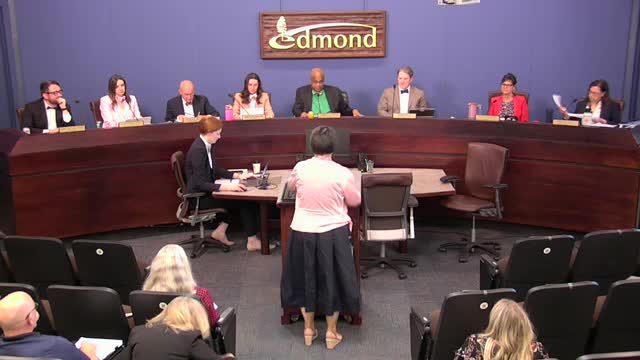
Summary
Christy Batterson presented CARC’s recommendations to allocate a flat $1,000,000 in city funding among local nonprofits; 23 organizations applied for $1.6 million and allocations prioritized food assistance and counseling services.
Christy Batterson, director of Housing and Community Resources, presented the Community Agency Review Commission’s (CARC) recommendation that Edmond allocate a flat $1,000,000 to local nonprofit programs in fiscal year 2025–26.
Batterson said the CARC met twice to hear applications and deliberated for about four hours. The commission received 23 applications requesting roughly $1.6 million; CARC members used a new scoring rubric and recommended awards that prioritized food assistance and mental‑health counseling. "31% of the funding went to agencies providing counseling and mental health services," Batterson said, listing Edmond Family Counseling, Peaceful Family Solutions, Lilyfield and Oasis Clubhouse among the recipients. She said 25% of funds were recommended for agencies that feed Edmond residents, including Edmond Mobile Meals, Project 66 Food Pantry and the Hope Center.
Batterson said CARC’s revised process sets a scoring threshold: applicants with an average score of 70 or above were eligible for full funding, and CARC adjusted some awards upward from undersubscriptions so additional money could go to food and mental-health providers facing growing demand. She said six voting members participated in the cycle — a seventh member had been appointed but was not yet participating — and that one new applicant, Be Different, was disqualified for missing supporting documentation and therefore received no award.
Batterson described oversight requirements for funded organizations: monthly, quarterly and annual reporting on who was served and how city funds were spent, with audits or single-audit documentation required as part of monitoring. “There is oversight in everything that they do,” she said, and staff will return in the fall with a report covering the first full year of the revised CARC reporting.
Council members praised the volunteer commission for developing the rubric and noted the growing demand for food assistance and senior support. Batterson and council members also said the city will continue to leverage other local funds to support utility assistance programs that partner with nonprofits. No formal council action on the allocation was recorded during the workshop; the CARC recommendations are scheduled to be reflected in the formal budget process at the May hearing and adoption timeline.