Get Full Government Meeting Transcripts, Videos, & Alerts Forever!
Get email alerts on the Subdivision Mystic Estates topic
No spam. Unsubscribe anytime.
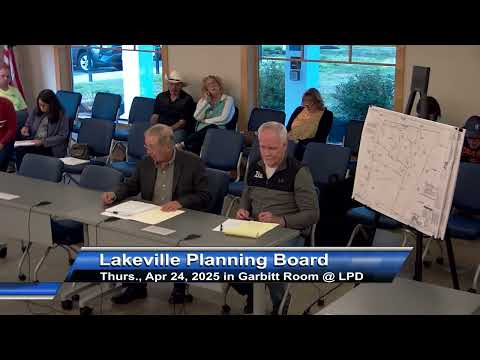
Planning board hears objections, approves waivers request for Mystic Estates subdivision; peer review ordered
Summary
The Lakeville Planning Board on Thursday heard a detailed presentation and public comments on Mystic Estates, a proposed two‑lot subdivision at 92 Howland Road, and agreed to send the project to peer review before taking final action.
The Lakeville Planning Board on Thursday heard a detailed presentation and public comments on Mystic Estates, a proposed two‑lot subdivision at 92 Howland Road, and agreed to send the project to peer review before taking final action.
Robert Mather, attorney for the applicant William Logan (trustee of L and B Realty Trust), told the board the 6.43‑acre parcel would be split into two lots and that the developer will withdraw one waiver request and accept conditions to keep the new roadway private in perpetuity. “The homeowners association will provide that the roadway has to remain private in perpetuity,” Mather said.
The proposal calls for Lot 1 to contain about 4.035 acres with 175 feet of frontage and Lot 2 to contain about 1.607 acres with 282.56 feet of frontage. The project would build a private roadway roughly 590 feet long with a 20‑foot paved width and a T‑style turnaround to meet fire‑access requirements, according to Bob Forbes, project engineer at Zenith Consulting Engineers. “The roadway is about 590 feet long, and we provide a 20‑foot paved width of road,” Forbes said; he also described a drainage plan that uses one constructed infiltration basin and one existing deep depression as a low‑impact development (LID) measure.
Forbes told the board the existing depression is roughly 20–21 feet deep and would hold about 3 feet in a 100‑year storm, leaving roughly 17 feet of freeboard compared with the town’s 1‑foot standard. Utilities shown in the presentation include private wells and on‑site septic systems; the applicant withdrew a request to allow overhead electric after noting the developer typically installs underground utilities and the board’s usual position.
The applicant also asked for multiple waivers from the town subdivision regulations commonly granted for two‑lot private subdivisions, including reduced centerline and intersection radii, a 40‑foot right‑of‑way instead of 50 feet, a 20‑foot paved width (the board’s standard for minor private roads in similar past approvals), no sidewalks or street lights, and use of HDPE drainage pipe rather than reinforced concrete pipe. Forbes said HDPE has adequate structural properties and advantages in installation.
Neighbors at the meeting raised concerns about wetlands, tree clearing and wildlife. “I’ve got obviously got concerns, my own wetlands and such,” said Kimberly Carr, who identified herself as the homeowner at 84 Holland Road and said earlier clearing near the front of the larger parcel had removed many trees. Carr said her property contains two ponds and culverts and that she has observed turtles in the area. “We have turtles in our property. We have 2 ponds, and so they come right to our grass, and they lay the eggs there,” she said.
Board members and applicants acknowledged multiple next steps. The board will require a peer review of the stormwater design (to be paid by the applicant), coordinate with the fire chief to confirm turning radii and emergency access, and require a homeowners association and deed language making the roadway private and placing lien authority for unpaid assessments. Mather described additional deed language and HOA covenants the developer will record to reduce the risk that future owners later ask the town to assume the private road.
Conservation concerns were also raised: a planning‑department staff member noted the conservation commission had flagged potential “natural heritage / endangered species jurisdiction,” and staff said the typical trigger for certain conservation reviews is the filing of a Notice of Intent. The applicant said there are no wetlands within 100 feet of the proposed construction and that the project team will work with conservation staff and peer reviewers.
The board did not close the public hearing. After discussion, the Planning Board voted to continue the public hearing to May 22 for peer‑review results and any revised plans.
The continuation gives the board time for an external stormwater peer review, additional information about wildlife/heritage jurisdiction if required, and final utility/turning‑radius coordination with the Fire Department.