Get Full Government Meeting Transcripts, Videos, & Alerts Forever!
Get email alerts on the Human Rights Labor Trafficking topic
No spam. Unsubscribe anytime.
Office of Human Rights reports FY26 budget drop; discusses labor trafficking work and investigatory limits
Summary
The Office of Human Rights presented a reduced FY26 proposal and discussed prior funding for anti‑trafficking outreach, its investigative scope for labor trafficking and new authority to review county contractors.
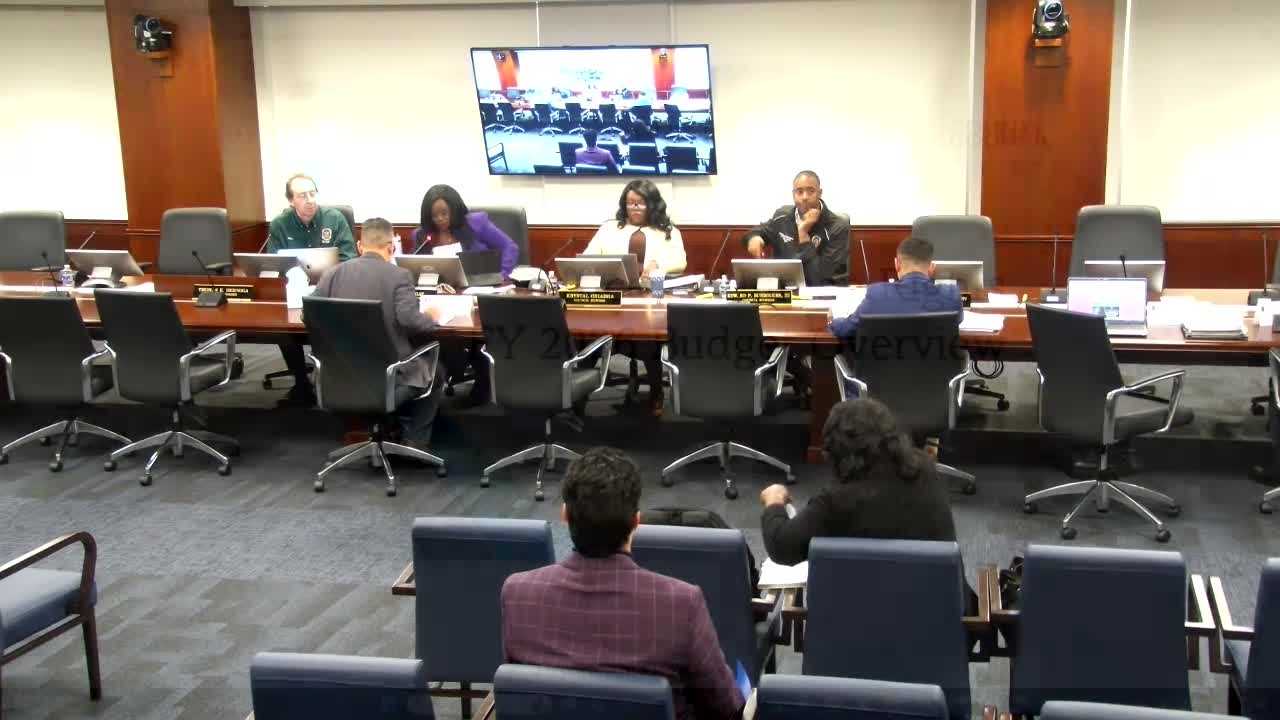
The Office of Human Rights presented its FY26 proposed budget to the Government Operations and Fiscal Policy Committee and discussed its human‑trafficking initiatives, prior outreach spending and the limits of its investigatory authority for criminal labor trafficking.
Budget analyst Roger Benagas said the Office of Human Rights' FY26 proposed budget is approximately $2,774,600, a 9.1% decrease from FY25. The general fund portion is about $2,717,600; the office is authorized for 14 general‑fund positions and was funding 13 of 14 in the compensation budget. Benagas said the office reported two vacant general‑fund positions as of March 2025, including the executive director slot (an acting director was in place).
Council members pressed the office on a prior line item added to the budget to address labor trafficking and asked how those funds were spent. Acting OHR leadership said funds previously were used for a public awareness campaign (bus‑shelter and billboard advertising) and for a data analyst role to build a data collection program; those funds have been reduced in the FY26 proposal. The committee asked whether the office had authority to investigate labor trafficking involving private employers. OHR staff said the office's civil investigatory authority covers discrimination complaints (employment, housing, public accommodations) and that criminal labor trafficking investigations are led by the police department. OHR said it will coordinate with police on cases that appear to involve criminal trafficking and that, under recently enacted county procurement rules, OHR now has authority to investigate labor complaints against county contractors.
Felipe Urquia, the human‑trafficking division manager, told the committee OHR conducts training for law enforcement and maintains partnership arrangements—including a contract with the University of Maryland Safe Center—and has coordinated multi‑jurisdictional task force efforts. Urquia said police staffing reductions had reduced specialized detectives on trafficking to four from a higher prior count, complicating case work and cross‑jurisdictional investigations. He and other staff described efforts to pilot targeted training and to work with partners such as Truckers Against Trafficking and the regional Family Justice Center to improve identification of labor trafficking.
Council members requested clearer accounting of the prior anti‑trafficking funds and urged stronger collaboration with police and unions to identify and investigate workplace exploitation. OHR agreed to provide follow‑up detail on how earlier funds were allocated and to coordinate with the police department and the council on next steps.