Get Full Government Meeting Transcripts, Videos, & Alerts Forever!
Get email alerts on the Higher Education Budget topic
No spam. Unsubscribe anytime.
House panel places omnibus higher education budget bill on general register after bipartisan compromise to shore up state grant program
Summary
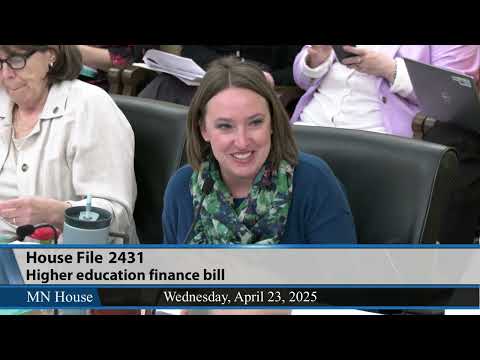
The Minnesota House Ways and Means Committee on April 23 voted to place House File 2,431, the omnibus higher education budget bill, on the general register after adopting amendments that the chairs described as a bipartisan compromise to address a $239 million shortfall in the state grant program.
The Minnesota House Ways and Means Committee on April 23 voted to place House File 2,431, the omnibus higher education budget bill, on the general register after adopting a DE4 amendment and a technical A2 amendment.
The amendment package reflects a bipartisan compromise from the House Higher Education Finance and Policy Committee and aims to close a roughly $239 million shortfall in the state grant program by changing eligibility and funding levers, co-chairs said.
Key provisions in the DE4 as amended include a cap that limits state grant coverage to match tuition increases at Minnesota State and the University of Minnesota to 1 percent; treating the negative Student Aid Index (resulting from recent FAFSA changes) as zero for assigned family responsibility calculations; reducing the credit limit for state grant coverage from 180 credits to 120 credits; eliminating four Office of Higher Education programs while continuing funding for 38 others; cuts to parts of the University of Minnesota–Mayo Clinic partnerships (including Mayo Medical School and Mayo family medicine residency funding); and redirecting ALS research grant funds previously routed to the University of Minnesota back to the Office of Higher Education.
“By bringing this number to 0, we are then cutting off that fraud,” Representative Barrack said, describing why the committee treated negative Student Aid Index values as zero. The co-chairs said the change also preserves the core state grant program for students who most need it.
Co-chair Wolgamott described the DE4 as a negotiated compromise. “This bill reflects the success of that accomplishment,” he said, noting he preferred other approaches but supported the package as a bipartisan result. Co-chair Rehrig said the committee had conducted deep dives into residency and nonprofit budgets and that some appropriations were cut after reviewing audits and salaries.
Fiscal staff told the committee the higher education committees received a target of no change from the February forecast for both the 2026–27 biennium and the 2028–29 tails. The chairs said they reallocated approximately $33 million to $35 million back into the state grant program but that a remaining gap of roughly $62 million would have to be addressed in negotiations with the Senate.
Members raised program-specific concerns during member discussion. Representative Gomez urged preservation of the student parent support initiative, noting the program’s role in preventing downstream costs to other public systems; she noted the bill cuts that program to a lower base and sets it to zero in fiscal 2028. Other members praised preservation of fostering independence grants and urged continued support for family medicine residency programs to maintain physician training capacity in rural areas.
The committee adopted the A2 amendment to the DE4 as technical fixes, then adopted the DE4 as amended by voice votes. The chair then moved that House File 2,431 as amended be placed on the general register; members responded by voice vote and the motion prevailed. Nonpartisan staff were authorized to make necessary technical corrections to reflect the committee’s actions.
Discussion: the bill will now proceed to floor action and to conference as negotiations continue with the Senate to close the remaining gap.
Ending: Chairs said they expect further work in conference committee and thanked committee staff for review of audits and program budgets.