Get Full Government Meeting Transcripts, Videos, & Alerts Forever!
Get email alerts on the Wildlife Management topic
No spam. Unsubscribe anytime.
Senate bill would pilot ‘tree-and-free’ hazing program in El Dorado County after fatal mountain lion attack
Summary
Senate Bill 818, by Sen. Susan Alvarado Gill, would create a pilot “tree‑and‑free” hazing program in El Dorado County authorizing permitted, trained houndsmen to proactively haze problem mountain lions and collect data on whether that reduces livestock losses and public‑safety risk.
Senate Bill 818, by Sen. Susan Alvarado Gill, would create a pilot “tree-and-free” program in El Dorado County that authorizes the Department of Fish and Wildlife to register and permit trained, authorized houndsmen to haze mountain lions deemed a threat to livestock, domestic animals or public safety and to collect data on that program’s effectiveness.
The bill’s author said the measure responds to a March 2024 attack in which two brothers were contacted by a mountain lion; one brother was killed and the other seriously injured. “This is not about hunting lions; this is about finding a middle ground of coexistence with wildlife and with human life,” Senator Alvarado Gill told the committee. She said the bill is limited to El Dorado County and would require the department to develop registration criteria and oversight with local partners including the sheriff and the county agricultural commissioner.
Supporters — including El Dorado County officials and multiple residents who testified — described repeated daytime sightings, a sharp rise in livestock depredations in recent years, and local wildfire-scarring that they say has driven mountain lions into populated areas. Leanne Mila, El Dorado County agricultural commissioner, told the committee the county has the most depredation permits in the state on a per‑capita basis in recent years and described large male lions entering neighborhoods and attacking pets and livestock during daylight hours. “This would allow us to have a very limited number of dogs that are specifically trained just to haze mountain lions,” Mila said, adding the dogs are used to tree lions for nonlethal removal and that the program would be coordinated with Fish and Wildlife and law enforcement.
Family members of Talon and Wyatt Brooks also testified in support. Malcolm Brooks, an uncle who testified briefly, and Wyatt Brooks, the surviving brother, appeared at the hearing and described the family’s loss.
Opponents included conservation, wildlife-research and animal-welfare organizations. They argued the bill likely violates Proposition 117 (1990), which broadly forbids the “take” of mountain lions and restricts hunting and pursuit methods; legal analyses provided to the committee by several groups said the proposed permitted pursuit and use of hounds could constitute an illegal take. The Mount Lion Foundation and the Center for Biological Diversity urged the committee to let ongoing studies and existing Department of Fish and Wildlife processes continue rather than authorize new permitted hounding.
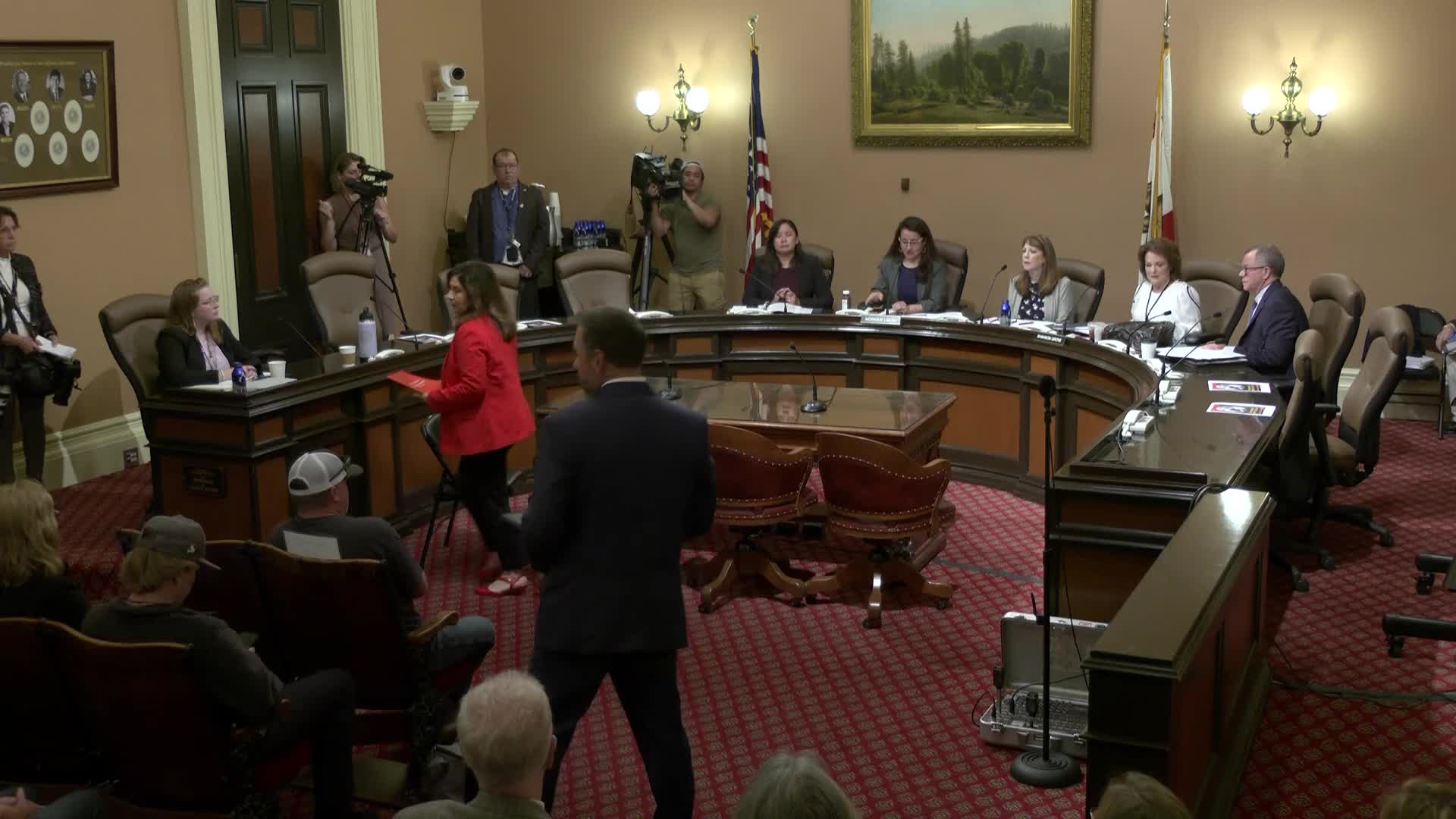
Committee discussion focused on whether the measure should be a narrowly tailored district pilot (the author’s position) or amended to insert additional statewide safeguards and reporting requirements (the chair’s preferred approach). Senator Alvarado Gill said she could not accept the committee amendments offered at the hearing and emphasized the bill is a district bill responding to a community tragedy. The committee chair said staff and members sought to craft amendments that would broaden consensus and make sure the program could meet the legal tests of Proposition 117.
The committee record shows the bill was recommended “do pass as amended to Appropriations” at the committee disposition stage (committee recommendation recorded in the hearing record). The committee debate and letters on the measure show strong local support from El Dorado County residents and officials and organized opposition from statewide conservation and wildlife groups.
What’s next: SB 818 was advanced by the committee for further consideration. If it continues to move, the Department of Fish and Wildlife would be responsible for implementing the pilot program and for developing permit criteria, subject to the bill’s language and any implementing regulations.