Get Full Government Meeting Transcripts, Videos, & Alerts Forever!
Get email alerts on the Healthcare topic
No spam. Unsubscribe anytime.
Council approves Texas Health ambulatory facility and special use permit for helipad with signage variances
Summary
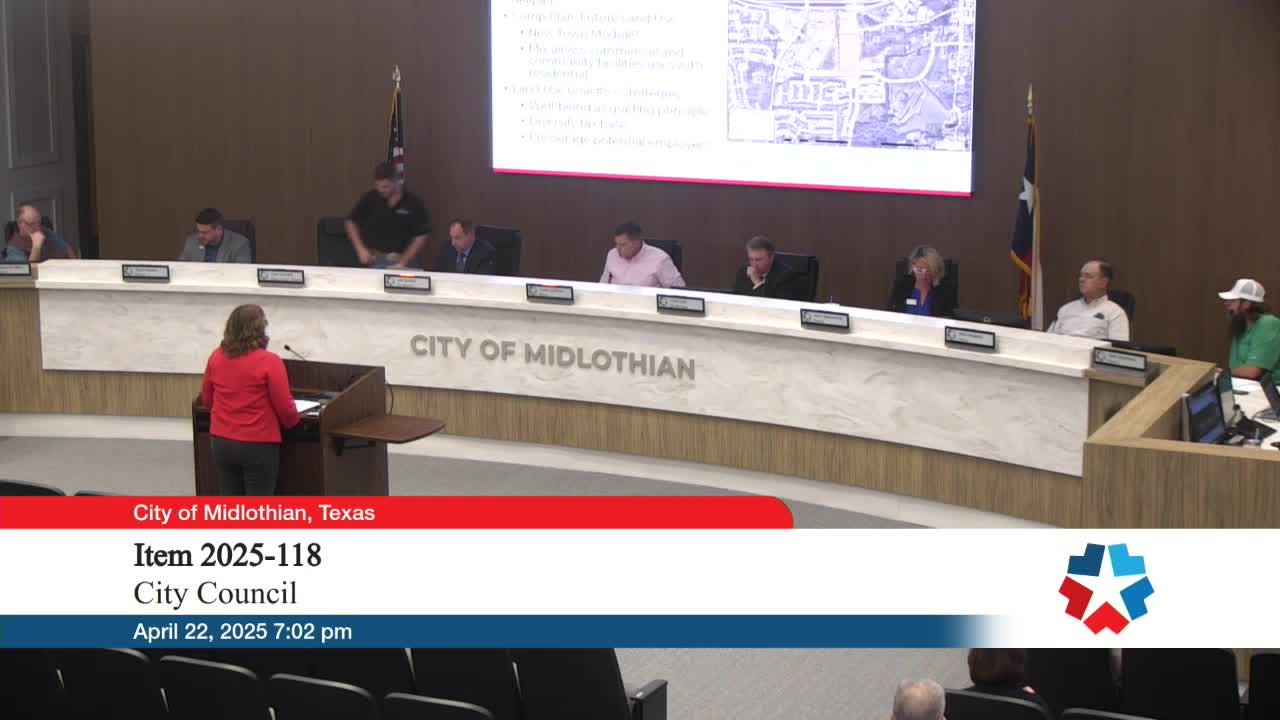
After a public hearing and extended questioning from council and public safety officials, the council approved a site plan amendment and a special‑use permit to allow a helipad at a proposed Texas Health ambulatory emergency facility; council also granted sign and parking variances requested in the plan development district.
Midlothian — The Midlothian City Council on Tuesday approved a plan‑development amendment and a special‑use permit to allow a helipad for a proposed Texas Health ambulatory emergency facility on a 12.689‑acre tract at South 14th Street and Hawkins Run Road.
Mary (city planning staff) told council the base zoning (community retail) allowed a medical clinic by right and that the site's future‑land‑use designation supported mixed commercial and community facility uses. Staff and the Planning & Zoning Commission recommended approval with variances for signage, parking calculation, and some facade articulation standards.
John Sullivan, representing Texas Health Resources, described the proposal as a two‑phase development. Phase one includes a two‑story clinical building with an approximately 11,000‑square‑foot emergency department; later phases include medical office and an ambulatory surgery center. "We have an emergency department there. It's an 11,000 square foot emergency department," Sullivan said.
Council members and public safety leaders asked how often ambulance and helicopter transfers occur and whether the helipad was necessary. Sean Lemon, on the applicant team, described an example in which a patient stabilized at a small ED was flown to a larger facility for an eight‑hour operation. The applicant said comparable Texas Health ambulatory emergency facilities in other cities receive a low number of helicopter trips (example cited: combined facilities in two cities produced about one helicopter trip per month).
Midlothian Fire Department leadership said the department generally transports patients to facilities with inpatient capability and that, without a helipad, some transfers would fall to local ground EMS. "If you don't put a helipad there ... the most likely scenario ... somebody walks into their emergency room with a STEMI and they need to go get a cath done emergently, they're calling the Midlothian Fire Department to transfer that patient," the fire chief said. The chief said the city occasionally conducts interfacility transfers when helicopters cannot fly due to weather.
Applicant representatives said the helipad would be sited near the north‑west corner of the building next to a detention pond and that they met early with an FAA representative, who reviewed the proposed location and commented it met general guidelines for approach and setback. Staff said the ordinance includes conditions that the helipad must be on the same lot as the primary use.
Signage: The applicant requested monument sign design allowances (not framed entirely in masonry) and a larger maximum allowable building sign area (900 vs. city standard 600). Staff said Texas Health uses standardized signage and noted the applicant was willing to add a masonry frame if the council preferred; council did not require the masonry frame as a condition.
Motion and vote: Councilman Ross Weaver moved approval of the PD amendment and the SUP for the helipad, including the variances described in the staff report; Mayor Pro Tem Whitcliffe seconded. The council vote was 6–1 in favor.
Why it matters: The decision permits a freestanding emergency department and related ambulatory services to operate with a helipad on the property. City officials and the fire chief said the helipad would reduce pressure on local ground EMS for rare high‑acuity transfers but acknowledged actual helicopter use at similar facilities is uncommon. The approval included sign and parking variances that the applicant said are standard for its facilities.