Get Full Government Meeting Transcripts, Videos, & Alerts Forever!
Get email alerts on the Stormwater topic
No spam. Unsubscribe anytime.
Midlothian council hears overview of updated stormwater management program
Summary
Consultants outlined a new five-year stormwater management program required by the Texas Commission on Environmental Quality, emphasizing public outreach, illicit discharge response, construction controls, pond maintenance and city facility housekeeping.
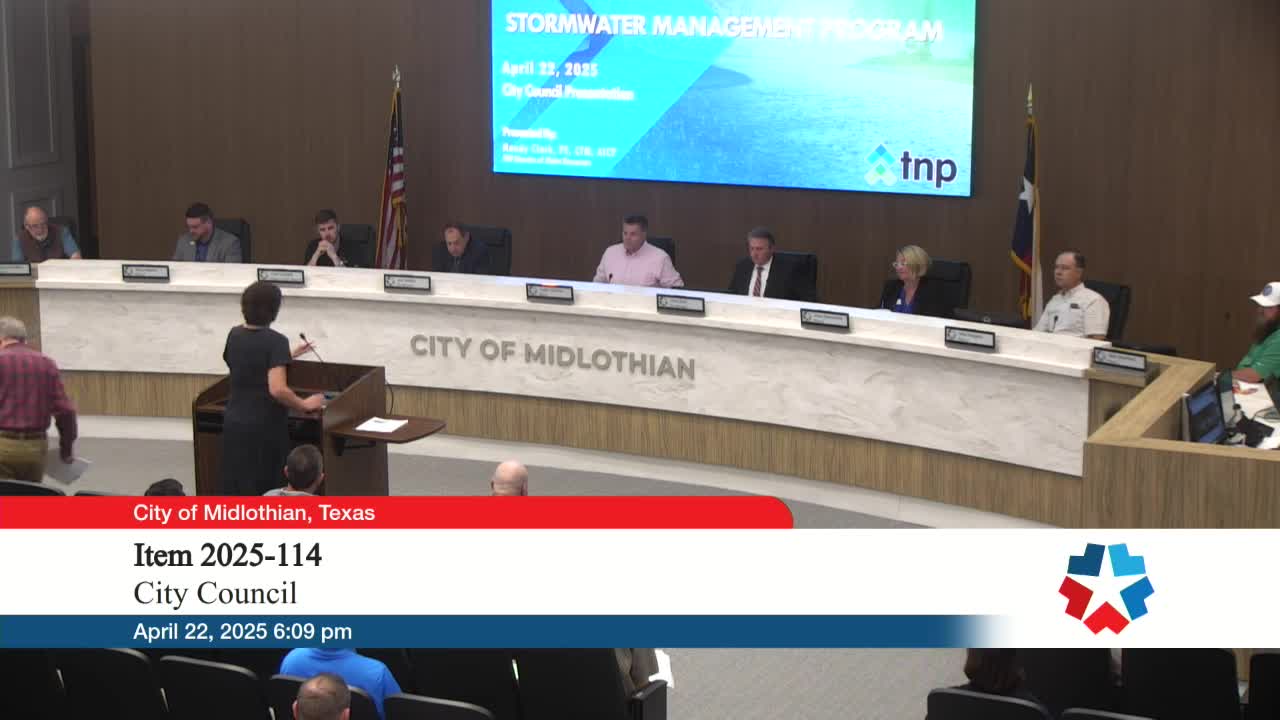
Midlothian — Consultants for the city on Tuesday presented an updated stormwater management program the city will implement in 2025 and report on in March 2026.
The presentation by Mandy Clark of Teague, Nall & Perkins summarized a municipal separate storm sewer system (MS4) program required under the federal Clean Water Act and administered in Texas through the Texas Pollutant Discharge Elimination System (TPDES) by the Texas Commission on Environmental Quality (TCEQ). "It is basically a water pollution prevention program," Clark said.
The presentation explained the program is on a roughly five‑year cycle, that Midlothian participates because it sits inside the Dallas–Fort Worth urban area designation, and that the city submitted a Notice of Intent and a new program in February 2025 and is awaiting formal approval. Clark said the program groups activities into six minimum control measures and related best management practices, including public education and outreach, public involvement, illicit discharge detection and response, construction site controls, post‑construction controls for stormwater quality (such as detention ponds), and pollution prevention and good housekeeping for city facilities.
Clark said outreach materials — social posts and fact sheets about not dumping into storm drains and marking inlets — are planned, and staff will continue existing quarterly social posts. She described illicit discharges as anything that should not reach creeks, citing examples such as sewer cross‑connections, commercial wash water, and recreational vehicle discharges. "If you see a camper draining right into a storm drain, just call somebody about that," Clark said.
On construction controls, Clark said the program emphasizes ordinance language, plan review, and construction inspections to prevent silt and erosion from reaching streets and creeks. For post‑construction, she said most stormwater detention facilities in subdivisions are privately maintained and that the program calls for ordinances and agreements to ensure maintenance and enforcement records are available to the city.
Clark also called the city's Public Works service center a high‑priority facility for inspections because of outdoor storage and materials that could reach the storm system if not managed. She said the city identified 32 facilities in total and will set inspection frequencies, checklists and maintenance tasks for them.
City staff confirmed implementation of the identified practices in 2025 and return reporting in spring 2026. No formal action or vote was required at the meeting; Council received the presentation and asked no follow‑up questions at the meeting.
Why it matters: The MS4 program is the local implementation of federal and state clean water rules and dictates how the city monitors and prevents pollutants entering local creeks and streams. Meeting the program's documentation and inspection requirements can affect enforcement risk and permit compliance.