Get Full Government Meeting Transcripts, Videos, & Alerts Forever!
Get email alerts on the Rail Safety topic
No spam. Unsubscribe anytime.
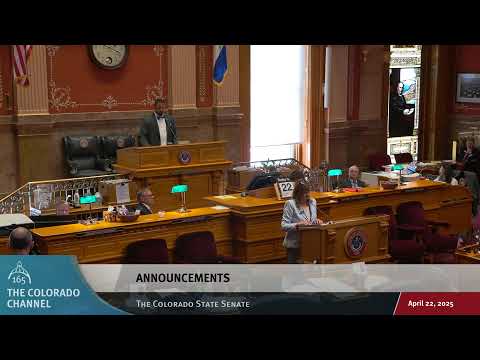
Senate passes rail-safety bill creating Office of Rail Safety and new fee structure after extensive floor debate
Summary
Senators approved Senate Bill 162 to fund and expand Colorado’s Office of Rail Safety and to create a rail-safety fee paid by railroads. Sponsors said the fee will support inspectors and emergency response; opponents warned about federal preemption, added costs, and rural impacts.
The Colorado Senate on April 22 adopted Senate Bill 162, establishing funding and expanded authorities for the Office of Rail Safety and directing the Public Utilities Commission to set a fee on railroads based on metrics such as train miles, gross ton miles and public crossings.
Senator Cutter, one of the bill’s sponsors, said the measure follows work by advisory committees created after last year’s creation of the Office of Rail Safety. "The work of the advisory committees and their recommendations is what you see in the bill that we're presenting today," Cutter said on the floor, describing the bill’s data‑collection, notification and inspection elements.
Sponsor Senator Snyder said the fee is modeled on what more than 30 other states use. Snyder told colleagues the fee will be used to hire inspectors, emergency response teams and pay for equipment and communications, and that without the fee Colorado would remain underfunded on rail safety work.
Amendments and negotiations were a major part of the session. The bill’s sponsors and committee reports added multiple technical fixes, clarified that short-line railroads (class 2 and 3) are treated differently in some circumstances, and included a provision allowing the Office of Rail Safety to decide whether certain data are infeasible to collect. The Appropriations Committee report clarified that the legislation aims to avoid a general-fund impact in the initial fiscal year and relies on a fee schedule and transitional funding already appropriated in prior legislation (House Bill 24 10 30) for startup costs.
Floor debate ran long and included repeated objections from senators representing rural districts and other critics. Concerns included:
- Federal preemption: opponents pointed to the Federal Railroad Safety Act and the role of the Federal Railroad Administration (FRA) and the Surface Transportation Board in regulating railroad safety, arguing some reporting and regulation could be preempted by federal law.
- Financial impacts: critics warned the fee burden would be passed to consumers and could harm local economies. A senator cited an estimate in the fiscal note showing an initial estimated assessed amount (for three railroads) totaling about $434,482 (transcript reference), and senators noted a $400,000 per-year startup appropriation already in HB 24 10 30.
- Rural and operational capacity: several senators said the bill could increase regulatory costs for short-line operators and for small, local communities. Calls were made to preserve DOT/Department of Public Safety roles and to avoid duplicative oversight.
Sponsors and supporters countered that Colorado lacked sufficient in‑state federal inspectors and that a funded state office is needed to address gap areas such as wayside detector reporting, blocked crossings and hazardous-material preparedness. They argued the fee is proportionate to industry size and intended to be implemented through rulemaking at the PUC with safeguards including caps and a phased collection timeline.
The Senate adopted multiple committee and floor amendments before passing SB162. The final third‑reading adoption was recorded on the floor; the transcript does not include a detailed roll-call tally for the final third‑reading vote.
Why it matters: The bill creates a new revenue stream and an institutional framework for state-level rail safety work, expanding Colorado’s capacity for inspections, data analysis and emergency coordination. Opponents said it risks duplicating federal oversight and imposing new costs on rail operations that could be passed on to customers.
Votes at a glance: Senate Bill 162 — outcome: adopted (final tally not specified in the floor transcript). Several floor amendments were adopted and debated during the session.
What’s next: The bill will require PUC rulemaking to set the fee methodology and timelines; sponsors said consultation and data-sharing agreements with federal partners and railroads will be part of implementation.