Get Full Government Meeting Transcripts, Videos, & Alerts Forever!
Get email alerts on the Civic Governance topic
No spam. Unsubscribe anytime.
Board directs staff to finish advisory‑committee policy rewrite; sets parameters on committee size and appointment process
Summary
County staff asked the Board for policy direction on a comprehensive rewrite of advisory‑committee rules; commissioners gave preliminary guidance on committee sizes (odd numbers, min 5, max 11), appointment method (individual commissioner recommendation plus full‑board approval) and residency flexibility.
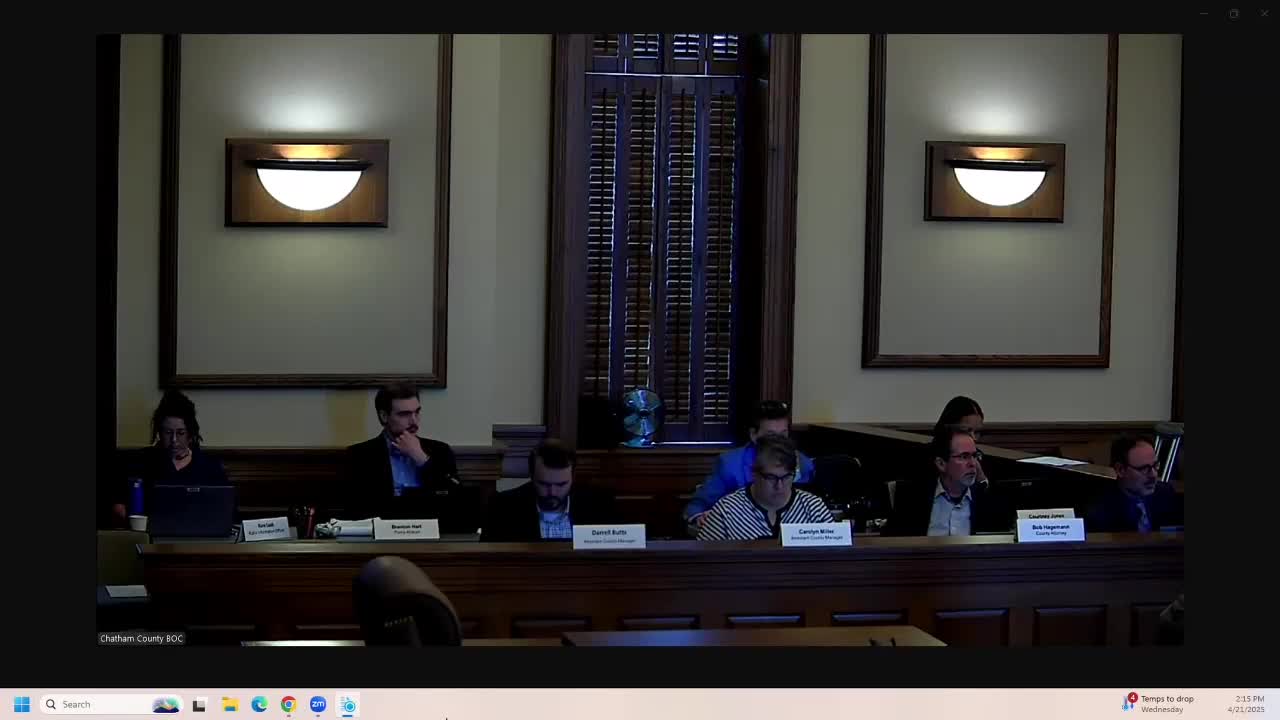
At its April 21 meeting Chatham County staff presented a draft rewrite of the county’s advisory‑committee policy and asked commissioners for guidance on key questions: committee size and composition, how appointments are made, residency requirements, term limits, and other procedural items.
Staff said inconsistencies between written policy and practice prompted a comprehensive rewrite and presented a short list of options for the Board to consider. After discussion, commissioners provided preliminary direction on several items:
- Committee size: commissioners favored odd numbers to avoid tie votes, with a minimum of five members and a maximum of 11; staff will align individual committee sizes with current practice and program needs. - Appointment method: the Board signaled support for keeping the current practice—individual commissioners recommend appointees and the full Board approves them—rather than moving to central appointment by the chair or full‑Board selection for every seat. - Residency/eligibility: commissioners agreed to retain the current flexibility that allows business owners and landowners who do not live in Chatham County to be appointed, while noting conflict‑of‑interest safeguards must be clear and enforced. - Multiple service: the Board indicated members may serve on multiple advisory committees when appropriate.
Staff said they will use the board’s guidance to complete the draft policy, discuss details with committee staff leads, add clarifying language about recusal and conflicts of interest, and return a full draft for board consideration in May. The Board also requested that staff provide a short survey or checklist in advance for commissioners to register any additional preferences, and that the final policy remain administrable by staff.
No formal vote was taken; the Board asked staff to incorporate these directions and to return with a near‑final policy in May for adoption.
(Staff will coordinate with county attorney’s office on open‑meeting requirements and conflict‑of‑interest language as part of the final draft.)