Get Full Government Meeting Transcripts, Videos, & Alerts Forever!
Get email alerts on the Land Use topic
No spam. Unsubscribe anytime.
Planning commission recommends limited retail cannabis zones; council debates buffers and timing
Summary
The Lynnwood Planning Commission recommended allowing retail recreational cannabis in three commercial zones with specified buffers and a re‑evaluation of City Center after the planned Town Square Park. Council members raised concerns about buffer distances, the process timeline and a looming 60‑day notice to the state.
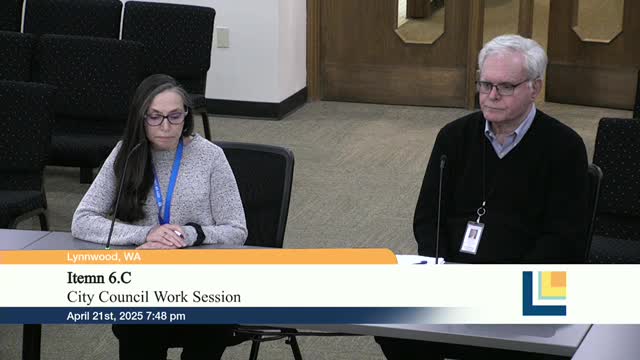
The Lynnwood Planning Commission recommended the City Council permit retail cannabis sales in three commercial zones — Highway 99 Mixed Use, General Commercial and the Alderwood zone — subject to buffers and standards, during a work session on April 21. The commission proposed a 1,000‑foot minimum buffer for Highway 99 Mixed Use and General Commercial (subject to the state’s list of restricted entities), a 300‑foot buffer in the Alderwood zone and a requirement that retail cannabis meet the usual landscaping, parking and security standards for the underlying zone. The commission also recommended the council reevaluate the City Center zone after Town Square Park is constructed.
Rebecca Sammie, the principal planner joining remotely, framed the recommendation in state law: “Chapter 69.5 of the RCW provides the statutes for recreational cannabis,” she told the council, and state rules allow local governments to reduce a 1,000‑foot buffer to as little as 100 feet for certain uses — though the statutes exclude reductions for elementary and secondary schools and public playgrounds.
Why it matters: Lynnwood currently has an allocation of four retail licenses from the state. Planning staff said the Washington State Liquor and Cannabis Board (LCB) presented revenue examples for neighboring jurisdictions, noting cumulative sales‑tax receipts in the approximate range of $100,000 for cities with four retail licenses. Council members focused on two main concerns: (1) whether permitting in City Center should be postponed until Town Square Park is built, because a park could later create buffer conflicts that would grandfather in existing businesses; and (2) whether the city should take more time to set precise buffer rules so retail shops do not cluster near one another.
Council debate and timing: Several council members urged more study and public input before finalizing rules. Council member Decker said he remains opposed to allowing retail cannabis in Lynnwood and cited public‑health concerns. Other members — including Council President Coelho and Council member Parcel — urged caution about adopting permanent limits driven by a park that will not be complete for years.
Staff also warned of a procedural deadline: to have an ordinance considered concurrently with the city’s Unified Development Code work, staff said they must submit a 60‑day notice to the Department of Commerce by April 23. Planning Manager Carl Almgren told councilors a draft ordinance would be needed quickly to meet that timing; councilors argued they want broader public input and additional council discussion before directing staff to draft final code language.
The commission’s recommendation did not set a numerical cap on total licenses beyond the state allocation; staff noted the state’s social‑equity program could increase local allocations in the future. Commissioners also discussed advertisement rules, security measures such as bollards and site design considerations for retail cannabis.
Next steps: Council members asked staff to return with more detailed options on buffer distances, the practical effect of grandfathering if the park is built later, and a clearer revenue and enforcement analysis. Several councilors said they prefer that a draft ordinance be developed but not rushed: the item can move forward on a future council agenda after additional work sessions and public hearings.