Get Full Government Meeting Transcripts, Videos, & Alerts Forever!
Get email alerts on the Zoning Form Based Code topic
No spam. Unsubscribe anytime.
Argyle amends form-based code to allow small restaurants and fitness studios in commercial village transition areas; residential parcels excluded
Summary
Council amended the Town Development Standards to permit limited food-service and fitness uses in Village Center Transition areas of Waterbrook and similar form-based developments, adding a size-based guardrail and excluding existing residential lots from the change.
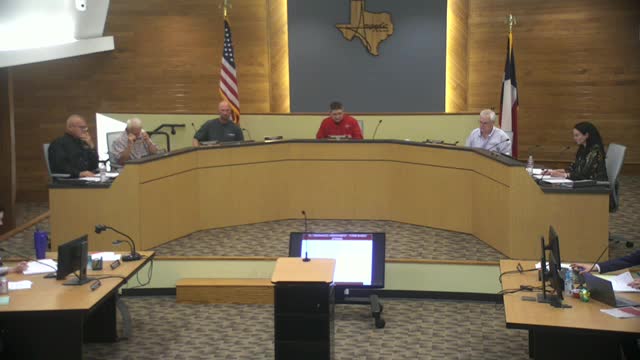
The Argyle Town Council on April 21 approved an amendment to the town’s form-based code (Town Development Standards TDS‑25‑2) to permit limited food-service and fitness uses in Village Center Transition (VCT) districts — but the council excluded existing single-family residential lots from the change and accepted Planning & Zoning edits to the use definitions.
Why it matters: the change opens commercially zoned parcels within the Waterbrook/Heritage developments to smaller restaurants and boutique fitness studios. Councilmembers said they supported the amendment to encourage a more pedestrian-oriented, mixed-use corridor on FM 407 while avoiding larger or 24-hour operations that would conflict with neighborhood character.
What the amendment does: Harrison (staff member) explained the form-based sections designate three character zones — Village Center Mixed Use, Village Center Transition and Village Center Neighborhood — and the VCT band had not previously allowed food service or fitness uses. Planning & Zoning recommended adding food service and fitness to the VCT schedule of uses but asked staff to replace the terms “cafeteria” and “snack bar” with “limited service” and “counter service” to better match the intended scale and operations. Council approved the P&Z recommended language.
Developer concept and design guardrails: developer and local resident Ryan Kage (presenter) described a plan under consideration for a commercial parcel in Waterbrook that would be built in two phases as two separate roughly 10,000-square-foot buildings (each building occupying about a 5,000-square-foot footprint): the concept would place a Gracie Brazilian Jiu-Jitsu academy on an upper floor and limited counter-service retail (juice/acai/yogurt) or small local restaurants on ground floors. Kage asked the council to permit the uses as-of-right for the undeveloped commercial parcels rather than require a special-use permit for franchise or fitness uses. Councilmembers said they preferred a guardrail focused on building size and no drive-through facilities and asked staff to exclude existing single-family residential parcels from the new permitted uses.
Council concerns and resolution: council members raised two recurring concerns: (1) preventing larger corporate 24-hour fitness centers or drive-through restaurants from establishing in the small-scale Village Center setting; and (2) avoiding unintended conversions of existing homes in VCT-zoned areas into commercial uses. The council and staff agreed on two limiting measures: (a) allow the new food service and fitness uses in VCT only in buildings at or below a defined square-foot threshold (staff and P&Z suggested the existing pattern of “10,000 sq ft or less” used elsewhere in the code as an initial guardrail), and (b) exclude currently developed residential parcels from the change so the amendment applies only to undeveloped commercial tracts in the VCT band.
Outcome: the measure passed unanimously after an amendment to include Planning & Zoning’s recommended wording for food-service definitions and the exclusion of existing residential areas. Staff will return revised ordinance language for publication and codification reflecting the size limitation and the exclusion language.
Ending note: proponents said the change aims to diversify uses in the Waterbrook commercial areas, enable small, walkable retail and fitness options near neighborhoods, and avoid large, nonpedestrian uses; opponents on P&Z had earlier expressed concerns about certain use terms (cafeteria/snack bar) that the council addressed by changing the definitions.