Get Full Government Meeting Transcripts, Videos, & Alerts Forever!
Get email alerts on the Agriculture Budget topic
No spam. Unsubscribe anytime.
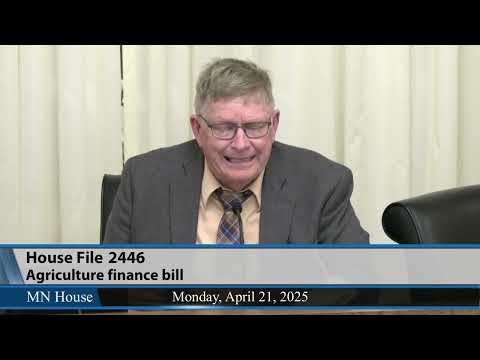
House panel advances $17 million agriculture omnibus bill, adopts three technical amendments
Summary
The Minnesota House Ways and Means Committee placed House File 2446, the agriculture omnibus budget, on the general register after adopting three amendments and a series of funding and transfer instructions totaling roughly $17 million in general fund impact.
House File 2446, the omnibus agriculture and broadband budget bill, was advanced to the general register Wednesday after the Ways and Means Committee adopted three amendments and approved the bill as amended.
The bill, described by committee chairs as a bipartisan package, directs about $17 million in new general fund spending across fiscal 2026-27 and the tails and includes targeted funding for the Board of Animal Health, meat inspection, farm-to-school programs, and a one-time $3.1 million appropriation to the First District Association for dairy-processing wastewater assistance in Litchfield. Committee members also adopted three amendments described by sponsors as technical or clarifying changes.
Committee chair statements framed the measure as bipartisan and focused on emergency preparedness for avian influenza, local meat inspection capacity, food procurement, and new grant programs. Chair Anderson said the bill “fully fund[s] the board of animal health” to respond to H5N1 concerns and that the package includes $3,000,000 to help the First District milk processing creamery in Litchfield meet MPCA wastewater requirements. Chair Hansen said the authors split a $17 million target among priorities and backed competitive grant approaches for certain earlier direct appropriations.
Nonpartisan staff walked members through the bill spreadsheet. Ken Savory of House Fiscal summarized appropriations and transfers, noting a $1.3 million operating adjustment for the Department of Agriculture in FY 26-27, an increase to the farm-to-school program, a new biofertilizer payment program, and a one-time $4,000,000 transfer to the agricultural emergency account from the general fund in the first year. House Research staff Megan Mollenbach reviewed policy language, including a new definition for pesticide “handler,” changes that would require the Minnesota Department of Agriculture to revise its certification plan to the EPA, and creation of the Biofertilizer Innovation and Efficiency Program with per-acre payments to reduce commercial nitrogen fertilizer use.
During member discussion, Representative Gomez pressed the chairs on a $3.1 million direct appropriation to the First District Association rather than routing the funds through a competitive grant process. Chair Anderson and Chair Hansen said the Litchfield wastewater problem has been on legislative and agency radars for years and that the funding was negotiated as part of the bipartisan package. Representative Pinto and others asked whether legislatively named awards receive the same pre-award financial risk assessment as nonprofit appropriations; Mr. Sullivan (agency/legal staff) replied that grants are subject to the grants-management requirements in chapter 16B and Department of Administration policy and that agencies retain authority to scrutinize or refuse to award funds when required by those processes.
The committee adopted three amendments described in the hearing as noncontroversial: the A4 amendment (which directs MMB to set aside funds for a transfer covering specified years and clarifies treatment of transfers vs. appropriations), the A6 amendment (which clarifies that the transfer is from the general fund), and the A5 amendment (a GOP-sponsored change clarifying that a broadband-study grant uses a competitive request-for-proposals process). Each amendment was adopted by voice vote with no recorded roll-call tallies in the transcript.
After closing remarks, the committee voted to place House File 2446, as amended, on the general register. The committee’s action was recorded as a voice vote and the bill was ordered to the general register.
Votes at a glance: The transcript records adoption of three amendments (A4, A6, A5) and a committee motion to place House File 2446 on the general register. All actions were adopted by voice vote with “aye” recorded and no roll-call tallies listed in the transcript.
The bill now moves to the next stage of the House process, where additional amendments or a floor vote are possible.