Get Full Government Meeting Transcripts, Videos, & Alerts Forever!
Get email alerts on the Capital Construction Bond Bill topic
No spam. Unsubscribe anytime.
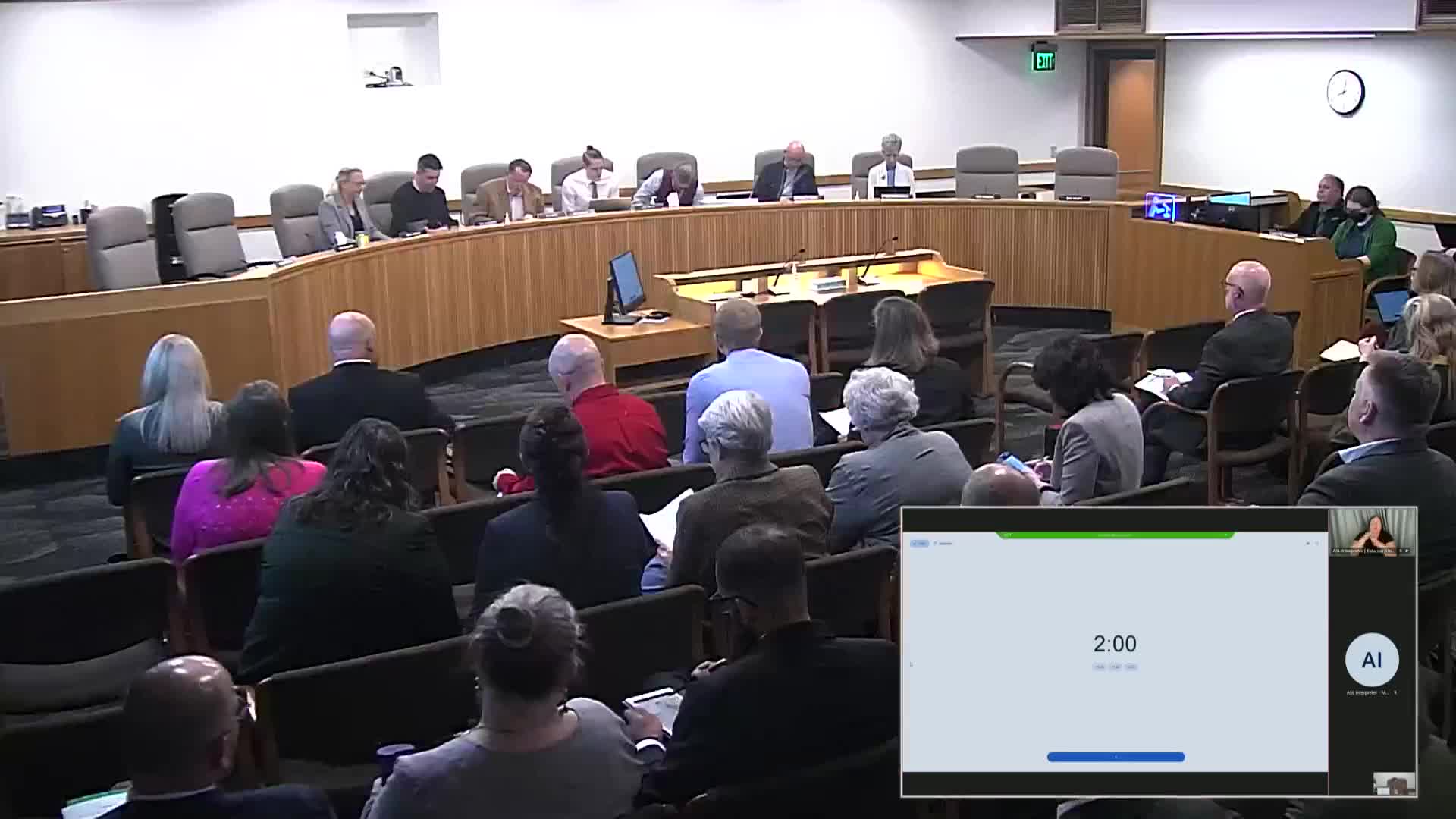
Public hearing on Senate Bill 5505 draws wide requests for bond funding across housing, courts, public safety and IT
Summary
The Joint Committee on Ways and Means Subcommittee on Capital Construction heard more than three hours of testimony on Senate Bill 5505, the governor's general obligation bond authorization bill, as state agencies, local governments and housing advocates sought funding for schools, housing, courts, public safety facilities and multiple IT upgrades.
The Joint Committee on Ways and Means Subcommittee on Capital Construction opened a public hearing on Senate Bill 5505 — the governor's general obligation bond authorization bill — and heard more than three hours of testimony from state agencies, local governments and housing advocates seeking funding for projects across Oregon.
Committee Co-Chair Gerrod and committee members heard requests that together span school capital matching grants, housing programs, courthouse replacements, public safety facilities and multiple agency IT modernizations. Witnesses sought both new bond authority and reauthorizations of previously authorized bonds.
Sean McCormick, chief of state affairs for the Oregon Military Department, told the committee the department "is requesting just over $33,000,000 in GO bonds for three armory service life extension projects," as well as funds for a new readiness center in Klamath Falls and other property purchases and upgrades. Tom Martin, assistant director for administrative services at the Oregon Department of Corrections, said DOC is seeking $85,700,000 to address high‑priority capital renewal needs, wireless communications upgrades and replacements for a 20‑year‑old maintenance management system.
Housing was a dominant theme. Andrea Bell, executive director of Oregon Housing and Community Services, said the governor's budget would increase Article XI‑Q bond capacity by $880,000,000 to support Lyft rental, Lyft homeownership and permanent supportive housing. Multiple housing developers and nonprofit advocates — including Tracy Manning of Housing Development Center, Margaret Salazar of REACH Community Development and Maria Elena Guerra of Farmworker Housing Development Corporation — urged the committee to set aside additional general obligation bonds for preservation of existing affordable housing, with repeated requests for roughly $100,000,000 dedicated to preservation in addition to the governor's proposals.
Education and school facilities funding also drew testimony. Michael Elliott and Melissa Garner of the Department of Education described a request for $108,900,000 for the Oregon School Capital Improvement Matching Program and a $92,600,000 bond request to begin renovation of the Oregon School for the Deaf campus in Salem.
Courthouse replacement requests were detailed by the Oregon Judicial Department. David Moon, director of business and fiscal services for OJD, requested $175,300,000 for replacement projects in Hood River, Morrow and Umatilla counties. County officials and the Association of Oregon Counties described local shares and specific needs, including an $85,800,000 request for Hood River County.
Several agencies sought technology upgrades. Lisa Uddland, deputy attorney general, asked the committee to reauthorize and increase bond authority for the Department of Justice's legal tools program to replace legacy case, time and billing systems. The Oregon Public Defense Commission requested $13,900,000 in bonding authority for a financial and case management system (FCMS). Other IT requests came from the Oregon Liquor and Cannabis Commission, the Department of Public Safety Standards and Training, the Department of Agriculture (Project 1), and others. Representative Rick Mason (co‑chair of the Joint Committee on Information Management and Technology) later told the committee he counted at least nine major IT projects in the bill, worth about $62,000,000, and urged a more systematic, statewide approach to prioritizing such work.
Environmental and infrastructure items included a $20,000,000 issuance of dedicated‑fund obligation bonds proposed by the Department of Environmental Quality to meet federal match requirements for the Clean Water State Revolving Fund and a $1,300,000 request for DEQ laboratory instrumentation upgrades. The Oregon Department of Forestry requested deferred maintenance and facility replacements for field offices, and the Department of Fish and Wildlife asked for $25,500,000 for hatchery infrastructure and office replacements.
Public safety, training and veterans' facilities were also prominent. The Department of State Police described plans to purchase sites to replace leased command centers in Coos Bay and Ontario. The Oregon Department of Veterans Affairs described requests for HVAC, roof and other repairs at existing veterans homes and state matching funds for a new Roseburg veterans home. DPSST requested funding for a learning management system to expand training access across the state.
Several speakers emphasized urgency or risk if funds are not approved. Tracy Manning of Housing Development Center said preservation funding is needed now to avoid losing existing affordable units. Phil Castle, director of DPSST, described training and distance‑learning gaps that the requested learning management system would address. Many presenters described projects as addressing safety, deferred maintenance or federally matchable projects and asked the legislature to consider federal match availability when authorizing bonds.
No committee votes were taken during the hearing. Committee staff noted the lottery bond allocation and separate hearings for the lottery bond bill and for capital construction (Senate Bill 5506) will occur in future meetings. Co‑chairs closed the public hearing with scheduling notes: the subcommittee will not meet the following Friday and will reconvene on May 2 with an informational meeting from public universities and community colleges and a public hearing on SB 5506.
The hearing produced a broad list of requested authorizations and reauthorizations that the legislature will weigh over the coming weeks as it drafts the capital construction budget. Requests and figures reported to the committee are summarized in testimony submitted for the record and in the written materials agencies provided to committee staff.