Get Full Government Meeting Transcripts, Videos, & Alerts Forever!
Get email alerts on the Speed Limits Fines Points topic
No spam. Unsubscribe anytime.
Senate passes package raising some speed limits, changing fines and points, and authorizing variable speed zones
Summary
The Senate approved House Bill 12-98 with amendments that increase interstate speed limits in parts of the bill, simplify speeding fees to $5 per mile over the limit, assign points to priority violations, and authorize variable speed-limit adjustment zones; the measure passed after division votes and floor debate.
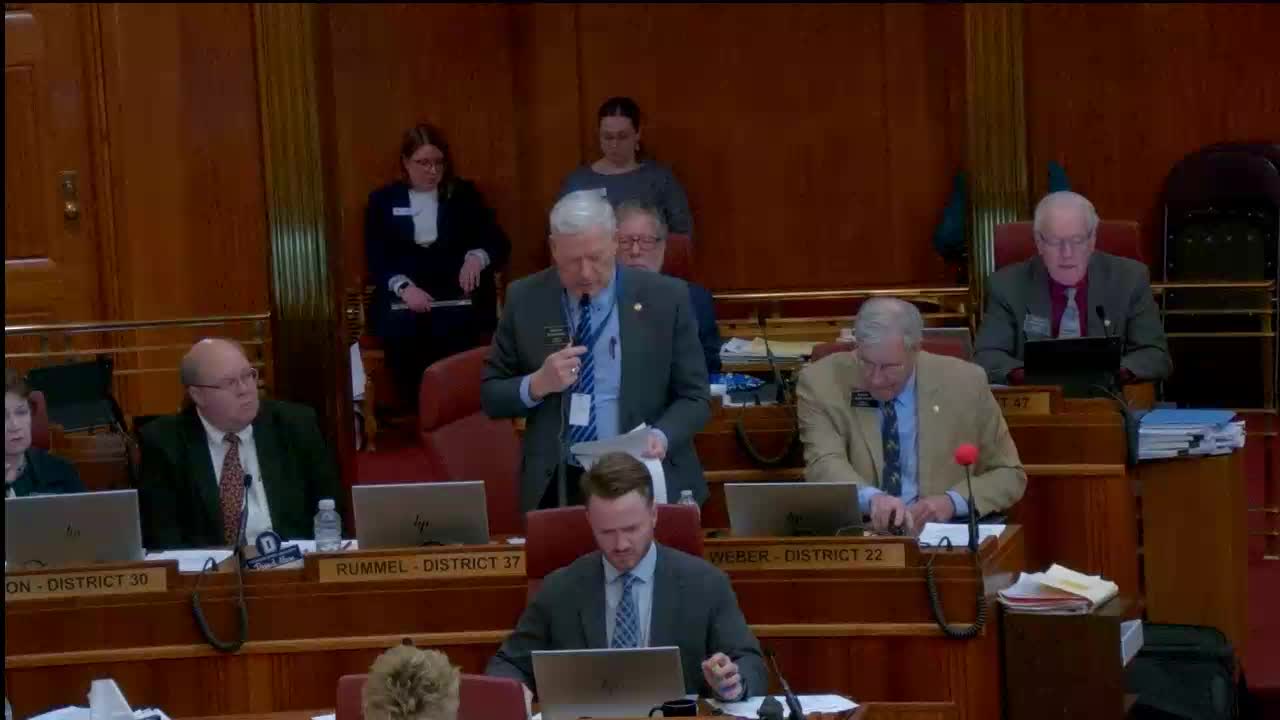
The North Dakota Senate on Friday passed House Bill 12-98 with amendments that include a package of changes to speed limits, statutory fine schedules, the driver-point system and a new mechanism for variable speed-limit adjustment zones on state highways.
The bill’s sponsor, Senator Rummel, said the package pairs an increase in interstate speed limits with safety measures: simplified fees, a revised point system for high-priority violations and authorization for the Department of Transportation and the Highway Patrol to temporarily lower posted speeds in identified problem locations. “People most likely drive the speed that they feel safe and comfortable at,” Rummel said in floor remarks explaining the package.
Key elements adopted by the Senate: - A simplification of speeding fees to $5 for each mile per hour over the limit across zones; the measure removes a complex multi-tier fee schedule. - Assignment of three points to each of 29 high-priority violations the committee identified, and an adjusted points schedule tied to license suspension rules. - Authorization for the Department of Transportation to install variable speed-limit signs; the DOT director and the superintendent of the Highway Patrol may adjust posted speeds temporarily due to unsafe conditions at identified pilot sites. - An upward adjustment in some interstate speed limits (the sponsor noted prior bills and gubernatorial vetoes on similar speed-limit increases).
The measure was debated at length. Opponents argued the increase in permitted speeds could cost lives and raised concerns about workforce impacts when employees lose driving privileges because of points. Senator Dwyer said the faster speeds “will cost some lives” and urged keeping the limit at 75 mph. Senator Grama warned that increased points could affect employees’ ability to drive company vehicles and raise insurance costs.
Supporters including Senator Paulson and others stressed the variable-speed signs as a safety tool and said fines and points were long overdue adjustments. Several senators cited a video provided to members showing interstate pileups in hazardous conditions; sponsors said those incidents motivated variable-speed pilots. Senator Rummel and other proponents noted that neighboring states allow interstate speeds up to 80 mph and that North Dakota’s observed average interstate speed was in the low 80s.
The Senate first voted on a floor division of the bill. Division A (sections 3–5, covering speed-limit changes) passed 28 yeas to 18 nays. Division B (the remainder, including fines and points) passed 30 yeas to 16 nays. On final passage the secretary recorded a tally of 25 yeas, 20 nays and 1 absent; the presiding officer announced the bill had passed.
Senator Meyer and others urged focusing the bill on the interstate speed limit element; opponents said separating the package could have unintended consequences for municipal fine-doubling provisions tied to municipal court revenue. The carrier said the package was intended to be considered together and said a conference committee would follow if needed.
The enacted language covers statutory fee schedules, changes to driver-record point assignments, variable speed zones, and related penalties. The bill’s fiscal note was described in committee discussion as minimal for sign replacement because DOT replaces signs regularly; sponsors said most costs were implementation timing rather than new ongoing expenditures.
The Senate approved the bill after the division votes and final roll call; the measure will proceed as part of the legislative process and may be subject to a conference committee.