Get Full Government Meeting Transcripts, Videos, & Alerts Forever!
Get email alerts on the Zoning And Land Use topic
No spam. Unsubscribe anytime.
Planning commission denies 7-Eleven request to allow alcohol sales as accessory use in LLC zone, 4-0
Summary
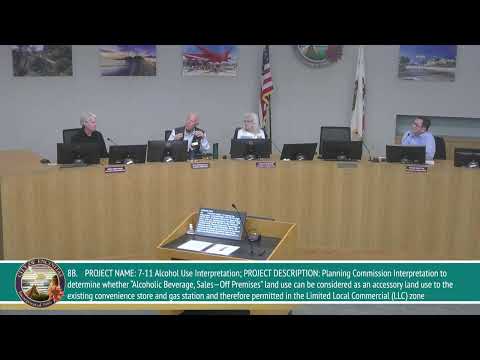
The Encinitas Planning Commission voted 4-0 (Commissioner Ryan absent) to adopt staff’s recommendation that alcohol beverage sales off-premise cannot be considered an accessory use in the Limited Local Commercial (LLC) zoning district at 1988 Village Parkway. The applicant sought an interpretation to allow limited alcohol sales (proposed 4% sales
The Encinitas Planning Commission voted 4-0, with Commissioner Ryan absent, to adopt a resolution finding that alcohol beverage sales off premise cannot be considered an accessory use to an existing retail convenience store in the city’s Limited Local Commercial (LLC) zoning district at 1988 Village Parkway in the Village Park planned development.
Fran Carr, associate planner, presented staff’s analysis. Carr said the site is on the corner of Mountain Vista Drive and Village Parkway and is surrounded on three sides by residential uses. Carr summarized city zoning rules and said alcohol beverage sales off premise are “explicitly prohibited in the LLC zone.” She told the commission the applicant requested an interpretation to allow alcohol sales as an accessory use not to exceed 4 percent of sales area and 7 percent of gross sales, and that the applicant also sought the ability to pursue a conditional use permit with conditions to regulate the use. Staff’s position was that the municipal code provides no mechanism to issue a conditional use permit or to allow alcohol as an accessory use within the LLC zoning district; staff recommended adoption of a draft resolution denying the requested interpretation.
The applicant’s attorney, Bruce Evans, argued the commission has discretion to treat alcohol sales as an accessory use in the LLC zone and pointed to a 2006 decision allowing limited alcohol sales as an accessory use in the LC zone for a Rite Aid at 4455 Manchester Avenue. Evans said that prior planning commission decision established limits (a 4 percent floor-space limit and a gross-sales cap) that could be applied consistently in this case. Evans told commissioners the applicant would accept reasonable restrictions, including hours, coolers and percentage limits, and that the franchisees operate the store and want to improve neighborhood conditions.
Franchisee Raja Saini (Raja Saini) spoke about the franchisees’ recent takeover of the store and told commissioners they had rehabilitated the store’s appearance and were invested in running a neighborhood-oriented operation. He said allowing alcohol sales at the convenience store would reduce vehicle trips to more distant stores.
Commissioners and staff discussed precedent, differences between the LC and LLC zoning districts, the conditional-use process, and available alternatives. Staff noted the Rite Aid example involved a different zoning designation (LC), and that the municipal code treats LC and LLC as distinct districts with different allowable uses and expectations about commercial intensity. Commissioners asked about concentration of alcohol retailers and whether the site was in an area of undue concentration; staff said that would require further analysis and the applicant might need to pursue additional findings if the commission allowed the use.
After deliberation, Commissioner Susan moved to adopt the staff resolution and deny the interpretation; a second was made and the motion passed 4-0 with Commissioner Ryan absent. The resolution directs that alcohol beverage sales off premise cannot be considered an accessory use to the primary retail use in the LLC zoning district for the property at 1988 Village Parkway. The applicant may seek other options such as a rezone or pursue appeals to the City Council.