
Draft BSRB survey: Kansas behavior-analyst licensees back multistate compact and a board seat; response rate 14%
Get AI-powered insights, summaries, and transcripts
Sign Up Free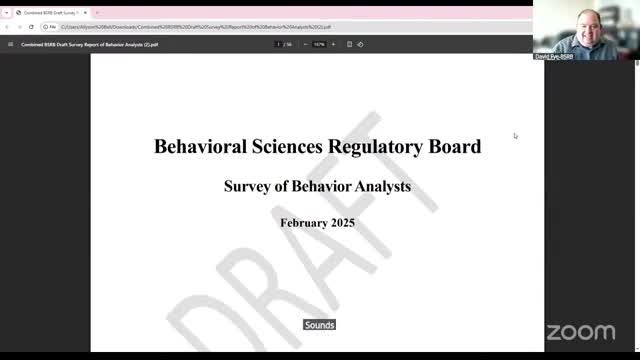
Summary
The board's draft survey of behavior-analyst licensees recorded 71 responses (14%), strong support for a multistate compact and broad support for adding a behavior-analyst to the BSRB; respondents identified supervision, telehealth guidance and insurance/billing as recurring concerns.
The Behavioral Sciences Regulatory Board shared a draft survey of Kansas behavior-analyst licensees at the advisory committee meeting March 12, showing early findings on where licensees work, how many hours they provide services and priorities for the BSRB's regulatory work.
BSRB staff reported that, as of January 2025, Kansas had 506 behavior-analyst licensees (18 LABAs, 488 LBAs). The draft survey was open Jan. 24–Feb. 23 and received 71 completed responses, a roughly 14 percent response rate, the board reported.
Survey highlights presented by staff included: - Practice location: Johnson County and Sedgwick County were the most frequently named single counties where licensees provide services. - Practice setting: Private practice was the most common setting (41 percent); education and public practice were also sizable shares. - Experience: About half of respondents reported more than 10 years in practice; the remainder were spread across mid- and early-career ranges. - Supervision and workforce: Respondents raised supervision gaps, inadequate supervisor training, and concerns about RBT training and oversight. - Telehealth: Most respondents reported fewer than five telehealth hours per week; insurance barriers and confidentiality/HIPAA questions were cited as issues where more guidance is needed. - Artificial intelligence: Most respondents said they did not use AI in practice, although some use tools for scheduling, brainstorming and documentation and some respondents expressed privacy or guidance concerns. - Multistate compact: A large majority expressed interest in a multistate compact modeled on the social-work compact; respondents cited cross-border practice, teletherapy and lower costs compared with obtaining multiple state licenses. - Board seat: Most respondents said they support adding a behavior-analyst board member to the BSRB, saying it would bring profession-specific knowledge and improve disciplinary processes and visibility.
Staff warned the draft report is not final, and appendices contain full open-field responses that the committee was asked to review. Fewer than half of respondents suggested no additional recommendations; common suggestions included clearer complaint filing instructions, tighter enforcement against billing fraud, aligning BSRB and BACB renewal cycles, and offering continuing education on risk assessment and supervision.
Why it matters: The findings will inform the advisory committee's recommendations to the BSRB, particularly on priorities such as supervision standards, telehealth guidance and legislative outreach to secure a behavior-analyst board seat.
Committee members were asked to read the appendices before the next meeting so those open-field responses can shape the committee's work plan and continuing-education offerings.
Ending: Staff will finalize the survey report after committee review and bring the final draft to a future meeting for formal discussion and potential recommendations to the board.