Get Full Government Meeting Transcripts, Videos, & Alerts Forever!
Get email alerts on the Development Services Budget topic
No spam. Unsubscribe anytime.
Hartford development services presents flat budget, touts faster permitting and progress on rental licensing and blight remediation
Summary
Hartford’s Department of Development Services told a city budget committee Thursday that its recommended budget is largely personnel-focused and roughly flat to last year, while directors reported faster permitting, early success with the rental licensing program and ongoing remediation of vacant properties.
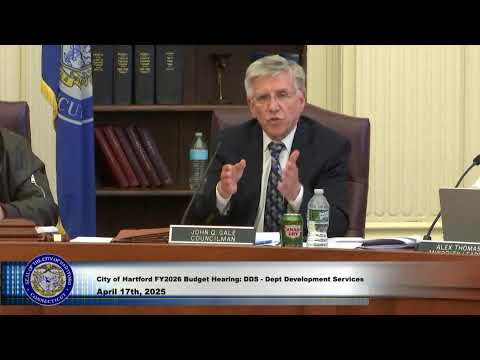
Hartford — The Department of Development Services told the city’s Operations Management, Budget & Government Accountability Committee on Thursday that its recommended fiscal-year budget is largely personnel-focused and about flat to last year, while directors described measurable gains in permitting speed, steps to expand home- and rental-housing units, and ongoing work to reduce vacancy and blight.
Director of Development Services Jeff Aaker told committee members the department’s total headcount remains steady at 88 positions and the recommended budget is down about 2.1% from last year largely for accounting reallocations. “The budget that you’re gonna see here is for the people, almost entirely,” Aaker said, adding discretionary spending and some special funds were accounted for elsewhere.
The department highlighted three operational achievements the committee said it is tracking closely: a large reduction in permit processing time, progress on the newly implemented rental licensing program, and targeted remediation of vacant and blighted properties.
A 57% reduction in average time from application to permit issuance was reported by Judith Rothschild, director of Licensing and Inspections, comparing permit performance in 2024 to 2023. “We have really increased the speed of getting your permits through the city of Hartford,” Rothschild said, citing staff training and fixes to the online permitting system.
On rental licensing, Rothschild reported 582 building applications filed through December 2024 and said that as of the day before the hearing 617 buildings had applied; 47 rental licenses had been issued. She reminded members that the program first covers buildings with 10 or more residential units and that an expanded cohort of 4–9 unit buildings must file applications by Oct. 31, a step she said will add more than 1,000 buildings to the program next year. Rothschild credited the licensing work with a 36% drop in housing-related complaints year-to-date, from 2,604 to 1,628.
Acting Director of Housing Selena Kai told the committee the department used federal, state and local funds to improve 43 housing units this fiscal year, including seven new rental units and four new homeowners who received homebuying assistance. The council recently increased the city employee homebuyer assistance benefit to $40,000, Kai said, with the goal of helping at least 10 city employees buy homes in Hartford.
Mike Perez, who leads the city’s blight remediation effort, said staff completed a citywide survey that identified roughly 560 parcels with vacant structures and that 31 of those properties were restored to constructive use so far this fiscal year. Perez described the city’s use of priority liens and a relatively fast foreclosure process on certain blighted properties as tools to return buildings to productive use, and said the city has successfully defended that approach against legal challenges.
Economic development and small-business directors described active programs and one-time grant initiatives: Paige Birche, director of Small Business Initiatives, reviewed a $2 million facade-improvement program and a $5 million neighborhood investment fund, and Pat Antelow, Director of Economic Development, cited recent disposals and predevelopment projects including a student-housing project at 64 Pratt that he said is drawing additional private interest.
Committee members questioned staff about the end of ARPA-funded programming, a reported HUD shortfall in Section 8 funding, and public-safety issues tied to emergency hotel placements for displaced residents. On ARPA, directors said most ARPA dollars in their portfolio are program-specific and are not intended to be ongoing operating funds; two positions funded by ARPA were rolled into the general fund earlier in a planned transition. On Section 8, staff described a HUD funding shortfall that reduces expected spending from about $66 million this year to an estimated $46 million next year; housing staff said vouchers have not been lost but turnover vouchers are being held while HUD decisions are clarified.
Council members also pressed staff on enforcement capacity and technology. Planning and Zoning acting director Owen Deutsch listed nearly 1,000 land-use applications handled this fiscal year and said several neighborhood plans and transportation projects are moving toward construction. Licensing staff reported fee collections over $5,000,000 through December 2024 and emphasized cross-department coordination to keep permitting moving.
Several operational items were confirmed during the hearing: the tenant-liaison position has been posted; offers were sent to fill three housing-code inspector vacancies; the rental-license rollout continues with prioritization of larger buildings; and a pilot for automated traffic enforcement is being developed with Hartford Police Department.
Council members urged faster progress on remediating small, privately owned contaminated sites and discussed ways to bundle smaller properties for remediation funding. City staff said they routinely pursue state brownfield grants and recently secured a grant of about $9.4 million for demolition and remediation tied to a data center parcel.
The department closed the presentation with a promotion announcement for William Diaz to assistant director of economic development and returned to the committee for follow-up questions.
What’s next: Directors said departmental staffing and system improvements aim to sustain permit speed gains and to process the larger wave of rental-license applications next fall. Several council members requested follow-up details on the special-revenue reassignments for development projects and a breakdown of the city’s remaining ARPA-funded positions before the final budget vote.