Get Full Government Meeting Transcripts, Videos, & Alerts Forever!
Get email alerts on the Administrative Citations topic
No spam. Unsubscribe anytime.
Oak Grove council adopts administrative-citation ordinance after extended debate
Summary
The Oak Grove City Council on April 28 adopted an ordinance creating a civil administrative-citation process for code violations, emphasizing complaint-driven enforcement, council oversight for designees and a focus on compliance rather than revenue.
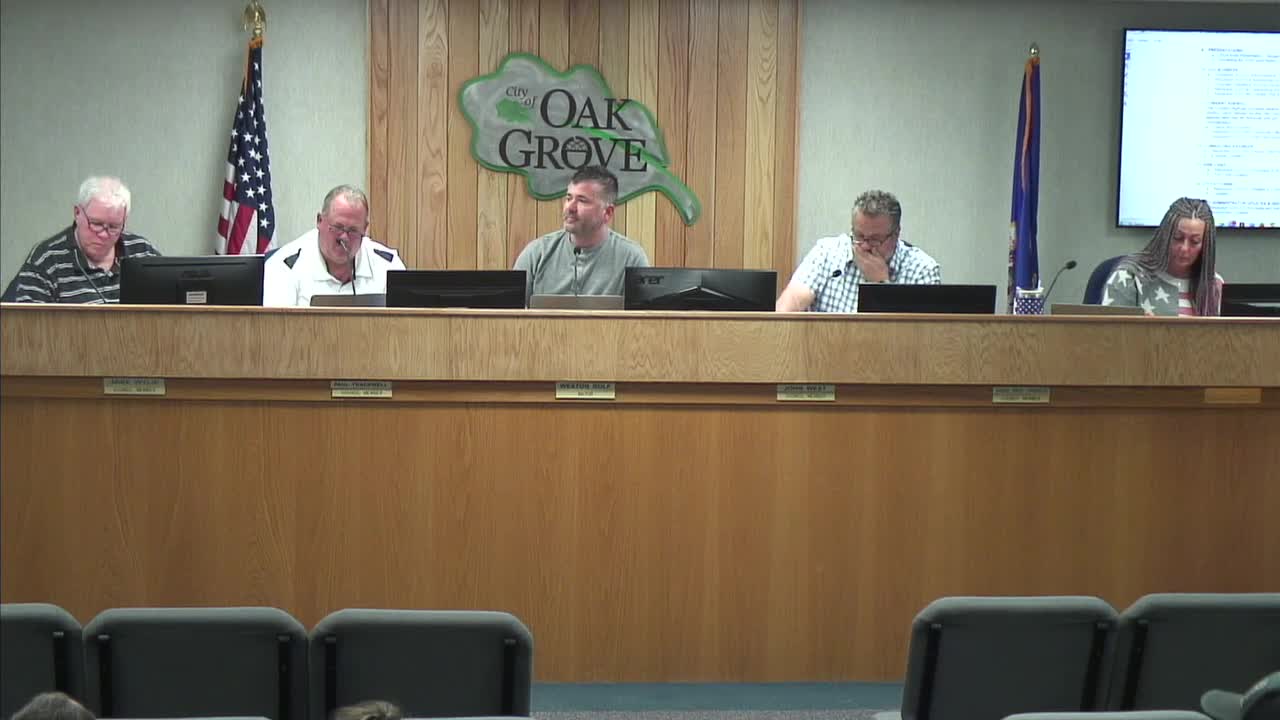
Oak Grove — The Oak Grove City Council voted 5-0 on April 28 to adopt an administrative-citation ordinance to change how the city enforces many local code violations, following more than an hour of briefing, council questions and public comment.
Council members and staff said the ordinance creates a complaint-driven, graduated enforcement process intended to obtain compliance more quickly than the existing criminal-prosecution path and to reduce legal costs. The measure passed with a motion by Council Member West and a second by Council Member Wylie; the council also approved the ordinancepublication and related fee language in separate votes.
City Administrator Lauren explained the proposal as a tool that would mirror the city's current complaint-driven code enforcement while adding a civil citation option implemented largely through the city's contractor, Rum River Consultants. Lauren and Carrie of Rum River described the practical steps: a verified complaint triggers an inspection, staff- or consultant-generated notice and a compliance period (typically 30 days), then a shorter follow-up period (commonly 10————30 days) before citations are imposed if the property owner does not respond. Council members and staff said that most property owners who work with staff avoid fines and that the goal is compliance, not revenue.
The ordinance specifies who may issue citations: the city administrator, the building official, a licensed peace officer, the fire chief and others designated by the city administrator only after council approval. Attorney review added language requiring council consent before any additional individual is designated. Council members repeatedly stated they expect Lauren and staff to report back monthly so the council can monitor use and outcomes.
Public commenters were split. Several residents and property-owners urged the council to approve the ordinance as a practical way to stop long-running nuisance properties that neighbors say have harmed property values, created health hazards and incurred significant legal costs for the city. Other residents asked for tighter legal guardrails: a defined list of offenses that may be handled administratively, a neutral hearing officer for appeals, a sunset clause for the new authority and clear exclusions for traffic enforcement. John Anderson and Kevin Shepherd, among others, urged precise language to limit potential misuse. Council members noted that the city's administrative-citation statute is distinct from state-authorized traffic administrative citations and said they do not intend to use the new process for routine traffic enforcement.
The ordinance sets a default civil penalty of $100 per day for continuing violations, though council members and staff said the city retains discretion to waive fees if property owners ultimately come into compliance. Staff estimated that, in typical cases, citations would not begin until roughly 45————60 days after the first notice because of the initial 30-day notice and a shorter follow-up notice period.
Council members emphasized several procedural safeguards added during drafting: (1) designation of additional enforcement officers requires council consent; (2) complainant information will be verified and treated as confidential; (3) the city will continue to prioritize voluntary compliance and will still use the prosecuting attorney for cases that do not resolve; and (4) the council will receive regular reports on complaints, compliance and citation activity. Staff and the consultant also said administrative hearings are rare in jurisdictions they serve.
Councilors approved an accompanying motion to add a standing agenda item on the first meeting of each month to review code-enforcement activity. The council also unanimously approved a related update to the city's published code-enforcement procedure to state explicitly that enforcement is complaint driven.
The council noted one recent criminal case that underscored the intent behind the change: a long-running nuisance at 22730 Cedar Drive progressed through criminal channels and ended with a judicial order giving the property owner until October to achieve compliance; city staff said the criminal route had proved slow and costly. Council members said the civil citation option aims to produce faster compliance while preserving due process and the option for criminal prosecution when appropriate.
Council members, staff and the consultant said the city's contract with Rum River Consultants obligates the consultant to follow city direction and that the consultant will perform site inspections under staff supervision. The ordinance text and council statements make clear that the instrument is intended as an additional enforcement tool, not a substitute for notice or for the city's existing complaint-resolution steps.
Council members also agreed to monitor the program closely and to revisit the ordinance if the monthly reports indicate misuse or unintended consequences.
The ordinance is recorded in council actions as ordinance 2025-02 (Administrative Citations); the council also approved publication and the related fee schedule amendments in separate votes that same evening.
The council will begin monthly reviews of code-enforcement results on the first meeting of each month, per an amendment added to the motion.
The measure drew frequent public comment and several requests that the city add explicit statutory guardrailsincluding a limited list of covered offenses, a specified neutral hearing officer and a sunset clausewhich the council said could be considered in future amendments but were not in the ordinance the council approved.
Ending: The council voted to adopt the ordinance and to publish it; separate votes approved fee-schedule language needed to implement the administrative fines. Council members said they expect the program to reduce the city's criminal-case legal costs and to speed compliance for persistent nuisance properties, but they also asked staff to return to the council if monitoring shows the tool is being misapplied.