Get Full Government Meeting Transcripts, Videos, & Alerts Forever!
Get email alerts on the Parks And Recreation topic
No spam. Unsubscribe anytime.
Parks and Recreation details 2018 bond spend-down, land-acquisition strategy and new equity-led criteria
Summary
Parks and Recreation briefed the task force on spend-down from the 2018 bond, land-acquisition results and a new set of prioritization criteria that place social equity first, followed by reinvestment, resilience, leveraging and strategic alignment.
Parks and Recreation Department staff told the Bond Election Advisory Task Force on April 28 that the department has spent and committed the majority of 2018 bond resources and outlined how future prioritization for the 2026 bond will be scored.
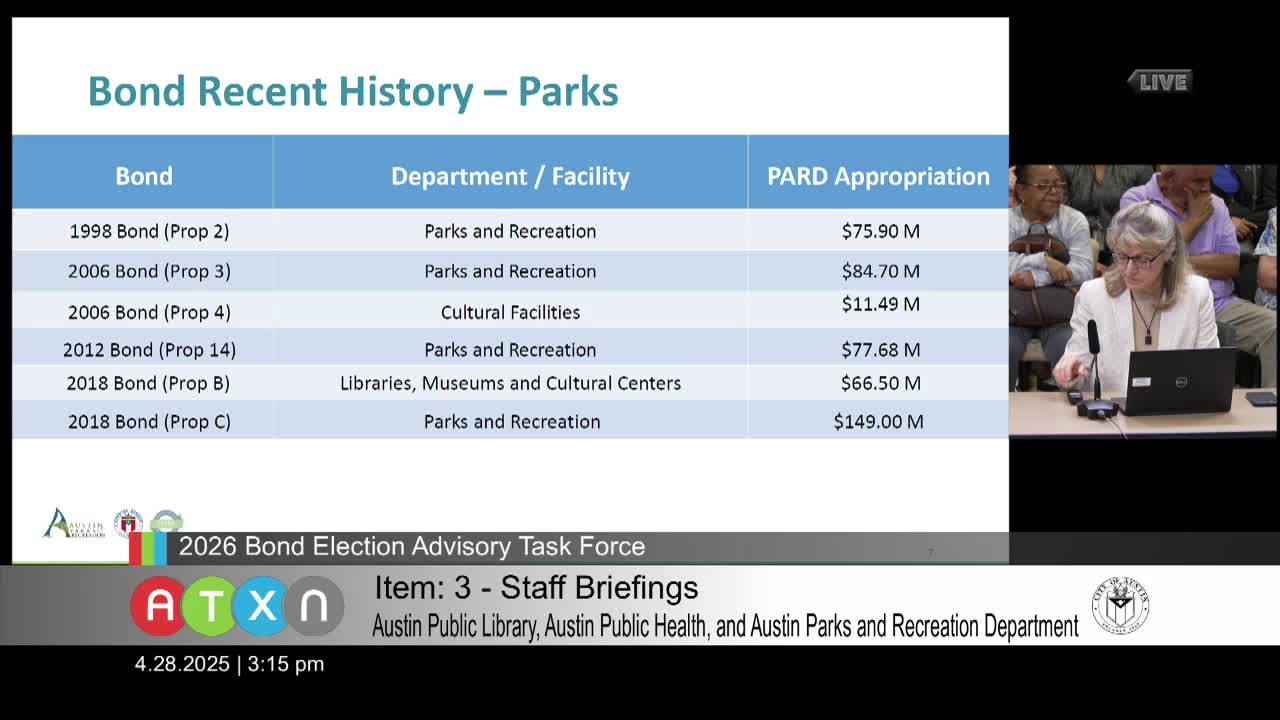
Assistant Director Lianna Kaluboka and division managers reviewed the 2018 bond results and recent grants that extended project scope. PARD said the 2018 Prop C (parks) allocation totaled $149 million; of that, department staff reported approximately 68% spent and 13% encumbered (about 81% committed). PARD said Proposition B funds (assigned to cultural facilities and split across departments) totaled $66.5 million; the department reported approximately 39% spent and 18% encumbered (57% committed), noting that named-project approaches limited flexibility and slowed spend-down for some facilities.
On land acquisition, PARD said it received $45 million in 2018 for purchases; staff said roughly $39 million of that has been spent and that the department leverages parkland-dedication fees such that each bond dollar for acquisition is matched by roughly $0.70 in dedication funding.
For the 2026 process, PARD described new technical criteria that lead with social equity and evaluate proactive reinvestment, sustainability and resilience, leveraging of funds and partnership opportunities, and strategic direction. The department has produced gap analyses for recreation and senior centers and a heat map of parkland deficiency; staff said the gap analysis prioritizes areas with limited access, population vulnerability and forecasted growth.
PARD also highlighted recent competitive grant awards that increased project scopes, including approximately $3 million for Montopolis Pool replacement, $4 million for John Trevino Jr. Metropark and $1.5 million for Walter E. Long Metropark.
Why it matters: PARD's prioritization, land-acquisition strategy and ability to pair bond dollars with other funds will shape what park projects are recommended to voters in 2026. Staff said land acquisition and targeted reinvestment are necessary to meet city goals for equitable access to parkland.
What happens next: PARD staff will supply scored project lists and additional data to task force members and to working groups. Members asked for clarification of maps, definitions of deficiency colors and whether carbon-sequestration potential could be integrated in future criteria.