Get Full Government Meeting Transcripts, Videos, & Alerts Forever!
Get email alerts on the Public Health topic
No spam. Unsubscribe anytime.
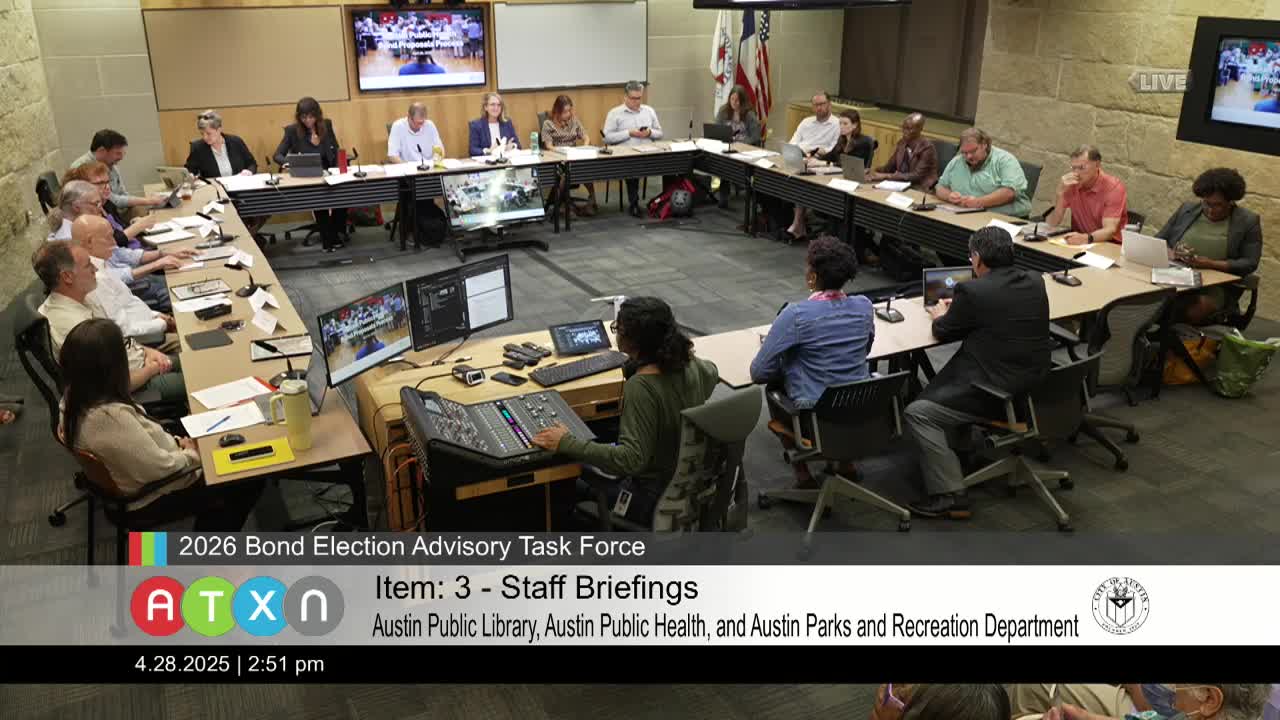
Austin Public Health outlines facility needs, recent bond-funded projects and scoring approach
Summary
Austin Public Health briefed the task force on past bond-funded facilities, current service sites, technical scoring criteria and a draft scoring matrix they will use to prioritize projects for the 2026 bond.
Austin Public Health (APH) presented a high-level overview of its capital projects, past bond-funded work and a scoring framework for 2026 on April 28.
Director Adrienne Sturrup and Health and Safety Manager Alberto Ortiz reviewed APH's core services and recent capital investments supported in part by bond appropriations. The department said it operates 14 WIC clinics, six neighborhood centers and a mobile clinic program and provides immunizations, inspections, refugee services and other public-health services.
APH highlighted recent bond-funded facilities including the Dove Springs Health Center, completed in 2024 with an approximate $20 million budget, and the Montopolis Recreation and Public Health Center completed in 2020 at about $15.5 million. APH said it has used bond funds and other local sources to renovate the Women and Children's Center (about $6.7 million total; $3.8 million from the bond and about $2.9 million from council funds) and to expand parking and kennels for animal-related services.
The department summarized its guiding principles, which mirror the citywide bond development principles (advancing equity, promoting affordability, sustainability and resilience, prevention and community trust), and described technical criteria linked to those principles. APH said it translates criteria into a 100-point scoring matrix to rank capital needs.
During questions, members asked about federal funding cuts and operational impacts. APH said there was no immediate capital impact from recent federal funding changes, but that some programs (for example an STI clinic expansion) would be structured so general-fund support could continue service if federal funds change.
Why it matters: APH provides essential neighborhood health services; capital decisions affect clinic capacity, immunization access and services for vulnerable populations.
What happens next: APH said it will continue to provide scored project information to the task force. Task force members requested more detail about sustainability assumptions, indoor-air-quality approaches and operational-budget impacts for proposed facilities.