Get Full Government Meeting Transcripts, Videos, & Alerts Forever!
Get email alerts on the Parks And Open Space topic
No spam. Unsubscribe anytime.
Speakers urge larger parks allocation, push for Lower Colorado River Trail in 2026 bond
Summary
Public commenters, trail advocates and the Austin Parks Foundation urged the Bond Election Advisory Task Force to prioritize parks funding in the 2026 bond and highlighted the Lower Colorado River Trail as a major, region-spanning project to include in the package.
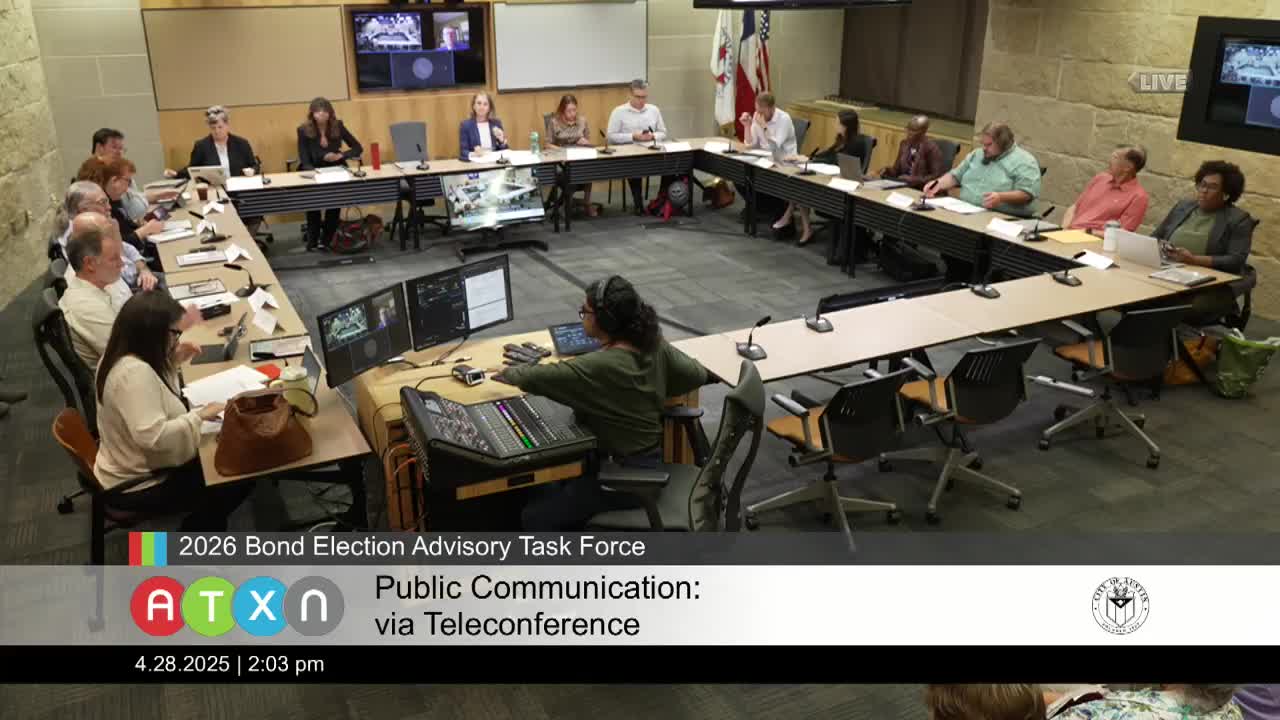
Several residents, nonprofit leaders and trail advocates urged the Bond Election Advisory Task Force on April 28 to prioritize parks, open space and trail investments in the city's 2026 bond package.
The most detailed presentation came from a coalition formed by the Trail Conservancy, the Travis County Parks Foundation and Great Springs Project, which promoted a vision for a Lower Colorado River Trail extending from the Longhorn Dam to the Bastrop County line. "This concept of a trail along the Colorado River is also in direct alignment to a number of other plans we have related to climate resiliency, economic development," said Joanna Woliver, executive director of the Travis County Parks Foundation.
Julie Fisher, chief executive officer of the Trail Conservancy, said the partnership seeks to expand a connected 10-mile hike-and-bike experience and link it with the city's urban trails vision. Mikey Guralnick, a planner with Great Springs Project, said the project's scale ' roughly 20 river miles across multiple jurisdictions ' can deliver public-health, climate adaptation and connectivity benefits that match the bond program's guiding principles.
Separately, public commenters urged a substantially larger parks allocation than has been discussed publicly. "Parks investments are overdue," said Mike Kanati, a remote speaker, who said the last parks bond was adopted in 2018 and that most of those funds are now spent or encumbered. He argued a parks ask far larger than the $100 million range would be required to meet capital needs. Kanati recommended beginning the discussion well above six figures for the parks category; an upper amount he voiced in his remarks contained an apparent transcription error, making the exact upper bound unclear.
Kayla Reese, advocacy manager at Austin Parks Foundation, said the department's needs total about $1.5 billion and that a parks ask under $300 million would be insufficient. "A bond package less than $300,000,000 won't go very far to the needs of our city," she said.
Multiple residents from northeast Austin asked the task force to recommend funding for a senior activity center in that part of the city. Naomi Delgado said the area north of U.S. 183 is underserved and that the Gus Garcia Recreation Center is the only nearby facility; she and other speakers asked the task force to recommend a dedicated senior facility rather than shared space that would be difficult for elders with mobility limitations to navigate.
Sheridan Lorenz and other commenters urged connections between affordable-housing projects and open-space features, voicing a preference for green space to be integrated with housing rather than located far away as mitigation.
Parks and Recreation staff highlighted the department's 2018 bond spending and its current prioritization framework during a follow-up presentation to the task force. Assistant Director Lianna Kaluboka summarized that Prop C (parks) had 68% spent and 13% encumbered, leaving about 81% of funds committed with limited remaining contingency, and that land-acquisition funds have been paired with parkland-dedication fees to extend purchasing power. The department's new prioritization criteria lead with social equity and include proactive reinvestment, sustainability and resilience, leveraging of funds and strategic alignment.
Why it matters: Parks, land acquisition and regional trails affect access to recreation, climate resilience and neighborhood equity. Task force recommendations will help shape what voters see on the 2026 bond proposition, and speakers argued that current needs substantially exceed small- or single-project asks.
What happens next: PARD staff and the trail partnership said they will continue providing technical details to the task force and working groups as projects are refined for inclusion in the bond program.