Get Full Government Meeting Transcripts, Videos, & Alerts Forever!
Get email alerts on the State Bonding Requests topic
No spam. Unsubscribe anytime.
Capital Investment Committee hears local bonding requests for schools, water, public safety and recreation
Summary
The Minnesota House Capital Investment Committee heard a string of bonding requests from school cooperatives, cities, tribes and nonprofits seeking funds for special-education facilities, water and sewer upgrades, a regional fire facility, veterans' services, flood mitigation and recreation projects. No votes were taken at the hearing.
The Minnesota House Capital Investment Committee held a hearing on May 20, 2025, taking testimony from local officials, tribal leaders and nonprofit representatives on a series of capital requests for infrastructure, public-safety and human-services projects. Committee members heard pleas for state partnership on projects ranging from a specialized school facility and regional fire station to wastewater lagoons, municipal water systems and park improvements. No formal votes were recorded at the hearing.
Why it matters: The committee reviews bonding requests that, if approved by the Legislature, would send state dollars to local projects. Witnesses emphasized that local tax bases and small populations limit communities' ability to fund large infrastructure projects on their own, and that some projects are prerequisites for housing, public health and regional economic growth.
Education and special education facilities Northern Lights Special Education Cooperative and Area Special Education Cooperative requested state bonding support through House File 568 to build specialized learning centers for students with intensive behavioral, developmental and medical needs. Barb Mackey, assistant special education director for Northern Lights, said their current campus is “outdated, overcapacity, and not designed as a specialized school,” and asked for $6.5 million to construct a facility “built specifically for the students with our significant needs.” Tanya Severson, assistant director for the Area Special Education Cooperative, told the committee that “families in our region are facing impossible choices” because the nearest level-4 facility is more than 100 miles away.
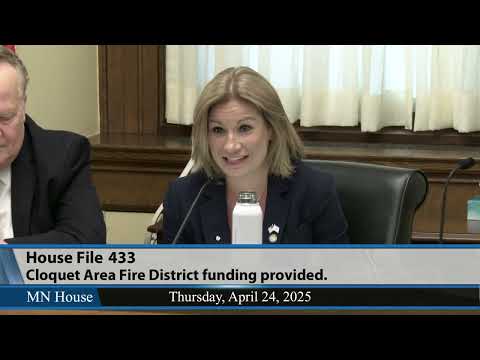
Public safety and regional consolidation Cloquet Area Fire District asked for $10.5 million under House File 433 to build a new regional fire and ambulance facility. Fire Chief Jesse Buse told the committee the district, formed from four former departments, is a “model for what regionalization can look like” and routinely provides mutual aid 20 to 30 miles beyond its base. Buse said local revenue is constrained by large amounts of non-taxable land in the district and that most construction funding would come from a local levy if state partnership is not available.
Veterans health services The Magnus Veterans Foundation of Dayton requested $900,000 to expand facilities and space for clinical services. Founder Lt. Col. (Ret.) Sean Alderman described a multidisciplinary, “whole person” model of care and said Magnus currently serves more than 1,000 patients statewide. Veteran Chris Lamott told the committee, “Magnus literally saved my life,” describing treatment for trauma and recovery supports the program provides at no charge to patients.
Municipal water and wastewater projects A large number of small cities presented needs for drinking water, treatment and sewer systems: - Fulda asked for $17 million toward a $49.5 million multi-phased rebuild of water and wastewater systems (House File 1237). Deputy Clerk Jessica Mitchell said the project is needed to stop inflow and infiltration losses and to prevent utility rate increases that could approach $100 per month per household without state assistance. - Edgerton (House File 3137) and Palisade (House File 3049) described aging cast-iron and fiberglass infrastructure and multiple Department of Health deficiencies; Palisade said its median age is 61 and its population under 200 and asked for funding to address water quality and failing sewer lift stations. - Kandiyohi (House File 2887) described an estimated $7 million second-phase water infrastructure request to replace wells and upgrade treatment for iron, manganese and hardness compliance. - Tonka Bay (House File 2802) asked for $5.7 million to continue a multiyear program after experiencing repeated water-main breaks; Mayor Adam Jennings said each break cost about $15,000 and imposed significant burden on a small operating budget. - Palisade, Kandiyohi, Barnesville and Hendrum each testified about the need for state partnership to complete upgrades that local tax bases say they cannot shoulder alone.
Tribal wastewater and housing Red Lake Nation officials testified in support of House File 2819 to build a wastewater lagoon and associated water and sewer lines for the Little Rock District on the Red Lake Reservation. Secretary Sam Strong said three overloaded lagoons and aging systems from the 1960s and 1970s block housing and business development. Little Rock District Representative Thomas Barrett said the project is “a critical first step” to unlocking housing and economic development and that the proposal is shovel-ready with environmental clearances in place.
Flood mitigation and natural resources The Boyd and Sioux watershed representatives updated the committee on a large Red River Valley impoundment project seeking $13.7 million (House File 2664). Jamie Beyer, watershed district administrator, said the project is roughly 60% complete and designed for multiuse benefits—flood hazard mitigation, water-quality improvements and 260 acres of public recreation.
Transportation and economic development Douglas County and Alexandria officials asked for $1.5 million for design and preliminary engineering for a new interchange on Interstate 94 (House File 3135). County engineer Tim Erickson said the interchange would initially serve lakes-area tourism and growth east of Alexandria; construction cost is estimated at $5 million and would be funded by local option sales tax when built.
Smaller community street projects Several small towns asked for road funding: Hendrum requested $2 million for street improvements (House File 3145); Holly requested state help for a commercial corridor and residential streets (House File 2267); Barnesville presented two requests for Thirteenth Street reconstruction and northwest-area infrastructure (House Files 799 and 800). Mayors stressed that improved roads are tied to housing, economic development and safety.
What the committee heard about timing and local capacity Witnesses repeatedly said projects are shovel-ready or in late planning, but many emphasized constrained local tax bases and the need for state partnership to avoid severe tax or rate increases. Several presenters noted prior local investments and leveraged federal or legacy funds; for some projects, local matches were already committed.
No action taken Committee members did not take votes at the hearing. The committee adjourned with plans to meet again next Tuesday; Co-chair Lee will preside at the next meeting.
Ending note: committee staff will compile requests and bill language for future committee consideration; no formal recommendations or appropriations were made at this hearing.