Get Full Government Meeting Transcripts, Videos, & Alerts Forever!
Get email alerts on the Mental Health Response topic
No spam. Unsubscribe anytime.
Cedar Hill Police to internalize CARES follow‑up work; victim services coordinator to lead outreach
Summary
With Dallas County grant funding ended, Cedar Hill will move mental‑health follow‑up from the regional CARES team into city staff. Officer Rollins will return to patrol while training PACT officers; Jessica Caldeel will handle follow‑up calls beginning in May.
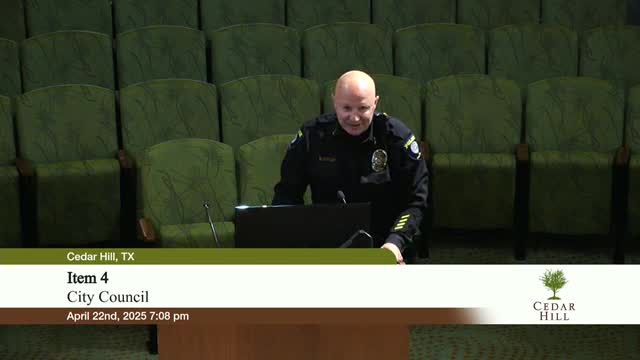
Chief Eli Riaz briefed the City Council on April 22 about planned changes to Cedar Hill’s mental‑health response after a regional grant supporting the CARES team expired.
The shift does not end the city’s follow‑up work for people taken into protective custody after mental‑health crises, Riaz said. “We’ll continue immediate follow‑up,” he said, but the work will be done by Cedar Hill staff rather than by the regional CARES program that had been funded by Dallas County.
Why it matters: Dallas County’s grant that helped fund the regional CARES team ran out last year, and other partner cities reduced or ended participation. The council heard that continuing as a regional participant would have been “cost prohibitive,” so the police department developed a local workflow to preserve follow‑up services.
How the new approach will work: Officer Rollins will return to Cedar Hill patrol in the first week of May and will train PACT officers to conduct in‑person follow‑ups when needed. Jessica Caldeel, the city’s victim services coordinator, will take lead responsibility for follow‑up calls and coordination of care for people the department classifies as APOW (a peace officer commitment without a warrant). Chief Riaz said Caldeel has credentials similar to the social workers used by the regional team and will do phone outreach, appointment coordination and referrals.
Training and timeline: Riaz said the PACT officers will complete a 40‑hour mental‑health peace‑officer certification and additional modules—including ICAT (integrated communications and tactics), active‑bystander training and motivational interviewing—starting in May. Rollins will split time between patrol and training duties while building the local follow‑up program.
Scale and scope: The council was told Cedar Hill averages about 10 APOWs a month, with roughly 63 “contacts” logged in a recent quarter (multiple contacts can belong to a single case). Riaz described contacts as phone calls, emails or in‑person follow‑ups; one case might generate several contacts.
Limits and safeguards: Riaz told the council that follow‑up with minors requires parental permission: “You have to have the parents’ permission … we wouldn’t be able to just interact with the minor without a parent or adult being present.”
Council response and next steps: Council members asked that staff report back periodically; Riaz agreed to provide updates a few times a year as the transition progresses. The city manager said the program kickoff will be in the first week of May and that the department will share website resource links for mental‑health services soon.
No formal council action was required or taken on the CARES changes at the April 22 meeting.