Get Full Government Meeting Transcripts, Videos, & Alerts Forever!
Get email alerts on the Land Use And Infrastructure topic
No spam. Unsubscribe anytime.
Commissioners defer adoption of formal policy on opposing MUDs, ask staff to add road‑maintenance language
Summary
Court members discussed a proposed policy formalizing Collin County’s historical practice on opposing municipal utility districts (MUDs) and municipal management districts (MMDs), focusing on requirements for service contracts and whether districts should retain roads. The court directed staff to return with revised language.
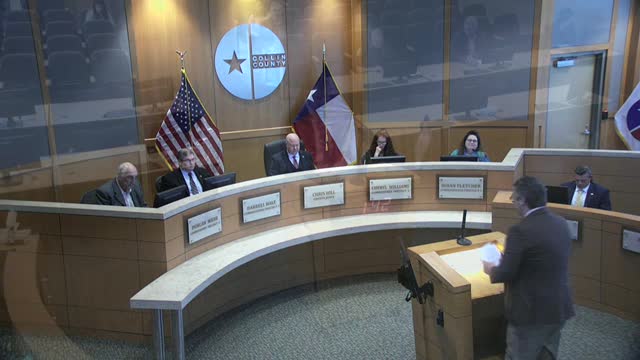
Collin County Commissioners Court on Thursday discussed and temporarily pulled a proposed resolution that would formalize the court’s historical practice on whether to oppose or not oppose municipal utility districts (MUDs) and municipal management districts (MMDs).
Deputy County Administrator Russell Schauffner presented the draft policy, which would require supplemental contracts for police, fire, emergency services and animal control for any district the court chooses to classify as non‑opposition, and would continue the court’s historical practice of preparing a resolution when districts meet the county’s listed requirements. Schauffner said the draft also adds administrative monitoring of districts created through the Texas Commission on Environmental Quality (TCEQ) so the court can consider non‑opposition or opposition when MUDs are created administratively rather than by legislation.
Why it matters: Commissioners flagged that many MUDs now seek “road powers,” meaning they build and seek to retain roads rather than dedicate them to county maintenance. One commissioner urged the court to add streets/roads to the list of services MUDs should be expected to retain. “So, essentially, just let them know we’re not going to accept their roads for county road maintenance. They’re gonna keep their roads,” a commissioner said during the discussion.
Court action: Rather than vote on the draft policy, commissioners agreed to pull the item for one week and asked staff to return with revised language that clarifies the court’s stance on road powers and other service responsibilities. No final resolution or opposition was adopted at the meeting.
Substantive points and concerns: Commissioners discussed whether including streets in the policy could block legislative approval for some districts, and whether courts could require districts to voluntarily retain roads through agreements. Schauffner noted that many districts have shifted to formation through TCEQ because that path can grant road powers without legislative action. Commissioners asked about performance bonds for roads; staff said typical performance bonds require roads to stand up for two years.
Next steps: The court instructed staff to bring back the draft with clarified language addressing road powers and related concerns, and that item will return to a future court agenda for reconsideration.
Ending: The judge and commissioners agreed to delay final action to allow staff to incorporate requested edits and to give members time to review the revised text.