Get Full Government Meeting Transcripts, Videos, & Alerts Forever!
Get email alerts on the Comprehensive Permit topic
No spam. Unsubscribe anytime.
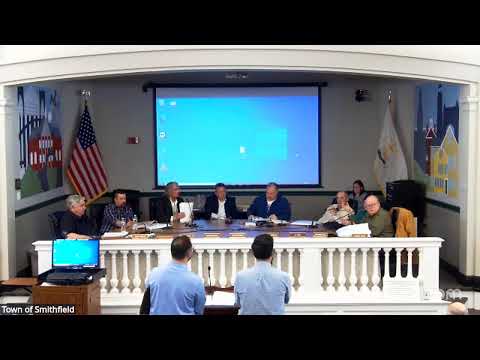
Smithfield planning board hears environmental, traffic and fiscal evidence on Greenville Farms comprehensive permit; decision continued to May 15
Summary
The Smithfield Planning Board heard expert testimony and public comment April 17 on a proposed comprehensive permit for 89 West Greenwich Road, focusing on environmental testing, traffic and fiscal impacts, then continued the hearing and extended the decision deadline to May 15 to allow members time to review late‑filed reports.
The Smithfield Planning Board heard three hours of expert testimony and public comment on April 17 over West Greenwich Road’s proposed comprehensive permit for a residential project at 89 West Greenwich Road, Assessor’s Plat 44 Lot 82. Attorney John Mancini, representing applicant West Greenwich Road LLC, asked the board to leave the public hearing open and continue the decision to the board’s May 15 meeting so members could review reports that arrived by email within 48 hours of the hearing.
The hearing focused on three technical areas: environmental testing and risk, traffic operations, and the project’s fiscal impact on town finances and schools. The board repeatedly cited incomplete hard-copy filing and asked the applicant to provide binders; several members said they had not had time to digest last-minute materials emailed to them.
Why it matters: The application is a comprehensive permit under Rhode Island General Laws §45-53-4 and would add multifamily housing to Smithfield if approved. Board members stressed they needed time to review peer reviews, supplemental reports and evidence on any environmental or school impacts before making the statutorily required findings.
Environmental testing and dust controls
Rick Mandel, senior principal with Sage Environmental, described a Phase I environmental site assessment and subsequent soil sampling at locations the report identified as former orchard areas. Mandel said Sage collected a dozen surface samples (0–12 inches) and “found analytical or laboratory evidence of pesticides” consistent with historic orchard use but that those detected compounds were “well below the applicable DEM standards for this type of a property.” He recommended targeted top‑two‑feet sampling where redevelopment would occur and recommended a soil/dust management plan during construction.
Multiple board members and residents pressed Mandel about a compound discussed in the report—identified during the hearing as dieldrin—and asked about the lack of a DEM or EPA numeric standard for that compound. Mandel said the detected compounds otherwise compared favorably to Rhode Island residential direct exposure criteria and offered to supply toxicological background on dieldrin. He agreed dust-control and a soil‑management plan would be appropriate best management practices during excavation and construction.
Traffic analysis: access, volumes and peer review
Paul Bannon, senior project director with Crosswind (Crossman) Engineering, summarized his traffic impact study. The parcel fronts on West Greenville/West Greenwich Road and Crosswind collected 24‑hour counts and peak‑period turning counts. Bannon said site driveway sight distances exceed AASHTO stopping‑sight requirements and that the state Department of Transportation had already issued a physical‑alteration approval for the proposed access. Based on trip generation estimates, he said the project would add roughly 36 morning peak‑hour trips (11 entering, 25 exiting) and 42 PM‑peak trips and that intersections in the study area would continue to operate at acceptable levels of service.
Bannon also testified that the town’s peer reviewer (Bridal Associates, named in the record) had agreed with the study’s findings, and he prepared a reply to the peer review. Board members asked for that reply and for the peer‑review appendices in hard copy; the applicant agreed to provide printed binders for the May meeting.
Fiscal-impact estimate and housing mix
Joseph (Joe) Lombardo of JDL Enterprises presented a fiscal‑impact estimate prepared as a checklist item for the master‑plan submission. Lombardo used multipliers based on unit type to estimate the project would bring approximately 174 new residents and about 26 school‑age children. Using town budget figures he calculated estimated added municipal and school costs of about $575,000 annually, and estimated property‑tax revenue of about $388,000—a net deficit of roughly $187,000 under his assumptions. Lombardo noted the development includes low‑ and moderate‑income (LMI) units that help the town toward its state affordable‑housing goal.
Planning consistency and affordable‑housing policy
Edward Pimentel, a municipal planner retained to evaluate comprehensive‑plan consistency, told the board he reviewed the town’s housing and land‑use elements and concluded the project was consistent with Smithfield’s comprehensive plan and identified growth areas. Pimentel emphasized state affordable‑housing law changes and said locating density in existing growth areas is a strategy to preserve rural character elsewhere. Several board members questioned whether the comprehensive plan and its capital‑improvements planning had specifically anticipated the infrastructure and school impacts of a permit of this scale; Pimentel said build‑out and capital planning should account for such growth and that his review found no inconsistency with the plan.
Public comment and outstanding materials
Members of the public raised questions about historic agricultural uses (including an assertion of recent hemp cultivation), soil disturbance and the potential for airborne dust during excavation. Residents also asked about pavement, flooding on nearby roadways, and utility impacts. The applicant and consultants agreed to provide hard copies of the traffic reply and Pimentel’s report and to return for the May 15 meeting for continued testimony if board members still had unresolved questions.
Board action and next steps
By voice vote the board agreed to continue the hearing and to continue the statutory decision clock by agreement of the parties to the board’s May 15 meeting so members could review the supplemental materials and peer reviews. No detailed roll‑call tally was recorded in the minutes; the vote was passed by voice. The board directed the applicant to provide printed binders of the emailed materials and to be prepared to return for follow‑up testimony.
The board also recorded that additional technical permits—freshwater‑wetlands review (DEM), soil‑erosion control, and sewer and water approvals—will be required as part of the project’s later permitting and that peer review of technical studies will continue to inform the board’s findings.
Ending: The debate over the Greenville Farms comprehensive permit will resume May 15 after board members receive hard copies of the applicant’s supplemental reports and peer‑review replies. Until then the public hearing remains open and the decision deadline is continued by agreement of the parties.