Get Full Government Meeting Transcripts, Videos, & Alerts Forever!
Get email alerts on the Utility Rates topic
No spam. Unsubscribe anytime.
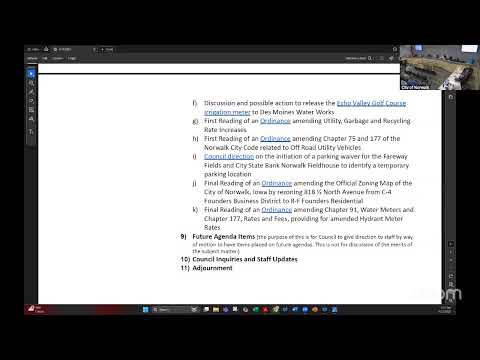
Council gives first reading to multiyear utility and garbage rate increases; water to rise up to 6% over four years
Summary
Council completed the first reading of an ordinance proposing multiyear increases for water, sewer and stormwater rates and a 2% garbage/recycling increase. The proposal includes a new per-meter availability fee and raises the large-user charge to 75% of retail.
The Norwalk City Council on April 17 completed the first reading of a package of utility and solid-waste rate changes staff said are necessary to cover rising costs including the city's planned water tower and Central Iowa Water Works buy-in.
Jean (finance director) said the city is proposing a four-year schedule for utility changes to meet Iowa Finance Authority loan requirements for planned borrowing. Key elements presented include a recommended 6% total water increase phased over four years, a per-meter availability fee (charging each meter a base availability fee rather than a single fee per property), and raising the large-user water rate from roughly 61% to 75% of the regular rate to better reflect peak-storage costs tied to the new water tower.
For sewer, staff proposed 3% over four years; water-reclamation costs (through the Water Reclamation Authority) currently account for about 57% of the sewer budget and are projected to rise. For stormwater the proposal is an increase of $0.50 per year for four years. Garbage and recycling would see a 2% increase for the coming year to reflect Metro Waste Authority cost changes.
Jean and staff said the multiyear approach gives the city flexibility to meet loan coverage and reserve requirements and to avoid abrupt spikes in rates. Staff said monitoring will continue; if irrigation behavior changes or other factors alter demand, council can revisit the schedule.
The ordinance cleared first reading on a motion by Council member Livingston, seconded by Council member Cool. Roll-call votes: Cool (yes), Livingston (yes), Meineke (yes), Baker (yes), Brown (yes). The motion carried.
Why it matters: The increases would appear in utility bills over the coming years and are linked to major capital projects and debt service. The proposed change to charge availability per meter will increase costs for properties with multiple meters, and the large-user rate change narrows the discount previously applied to sizable nonresidential usage.
Ending: The city will return the ordinance for subsequent readings and adoption; staff said they will track revenues monthly and recommend adjustments if actual usage patterns differ from projections.