Monroe County approves Tavernier development agreement for 86 workforce units and new grocery store with conditions
Loading...
Summary
Board approved a development agreement for two Tavernier parcels allowing an up-to-86 deed‑restricted workforce housing units, a roughly 49,340 sq ft supermarket and supporting commercial space; planning commission recommendations and public concerns on traffic, wetlands and open space will be addressed in later permits.
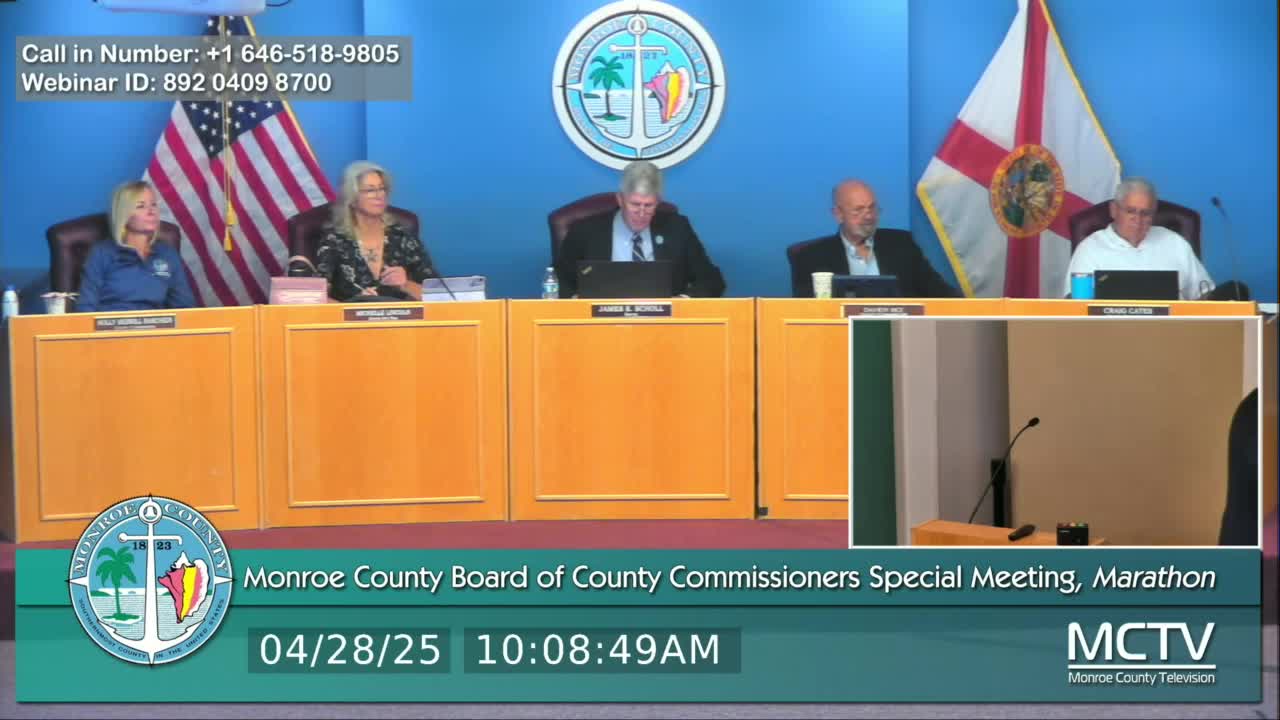
The Monroe County Board of County Commissioners on April 28 approved a development agreement for two parcels in Tavernier that will allow up to 86 deed-restricted workforce housing units and a 49,340-square-foot nonresidential commercial building, subject to subsequent site-plan approvals and conditions.
The agreement covers land at 92501 Overseas Highway (two parcels aggregated) and permits a mixed-use project with a supermarket, a 2,100-square-foot liquor component inside the nonresidential building, a 350-square-foot institutional office for a local nonprofit, and 86 attached affordable workforce dwellings. No structure in the agreement may exceed 38 feet in height.
Devon, planning staff, described the site and regulatory background: both parcels are in the Suburban Commercial zoning district and designated Mixed Use Commercial on the county future land-use map. The parcels lie within the Tavernier Corridor Overlay District and the Tavernier Commercial Overlay District, which limit nonresidential floor area to 49,900 square feet and the affordable dwelling count to 86 units under the adopted overlay. The project also lies in the Tavernier workforce subarea; code language adopted into the comprehensive plan allows use of up to 86 early evacuation workforce allocations without requiring a 1-for-1 exchange.
Wetland delineation on the site was discussed at length. Michael Roberts, county environmental staff, said wetlands were delineated according to Florida Administrative Code Chapter 62-340 and that both county staff and South Florida Water Management District (SFWMD) inspectors concurred with the delineation and the field-flagged stake locations. Staff said the applicant has applied for a restoration permit the county has reviewed and approved, and that SFWMD has a parallel consent order under review.
The conceptual site plan attached to the agreement shows the nonresidential building and 86 residential units, with parking proposed as 248 spaces for the nonresidential use and 189 spaces for the residential portion (one residential parking space designated for the institutional office use). Staff noted the conceptual plan is near the maximum allowed development intensity for the site and that the planning commission recommended the board request better architectural features for buildings A1 and A2, a buffer between Building E and the nonresidential store, improved ingress/egress, continuation of the bike path along U.S. 1, improved lighting, and more usable green space and pocket parks for residents.
Multiple members of the public spoke against the conceptual plan’s scale and certain design elements. Andrew Tobin, speaking for the Tavernier Community Association, said the site plan “does not do that” — meaning it does not provide livable, dignified housing for essential workers — and urged a smaller supermarket footprint so residential open space could be increased. Dottie Moses of the Island of Key Largo Federation of Homeowners Associations reiterated traffic-safety and environmental concerns, asked for clarity on whether the county or a village provides the existing ride-share mitigation service the agreement references, and urged contingency language if that service is discontinued. Helen Shinders, a Tavernier resident, said residents broadly oppose the project as presented and asked the board to consider reducing commercial scale.
Developer Bart Smith, appearing for Blackstone Group Tavernier 925 LLC and BC Tavernier LLC, said the applicants had made revisions in response to planning commission comments, including architectural changes to Building A1/A2, additional vegetative buffers (pigeon plum and buttonwood) between Building E and the commercial area, and approximately 3,000-square-foot pocket parks with recreational amenities for residents. Smith also said AH Monroe — a nonprofit that currently operates from space in a local church — is proposed to occupy the 350-square-foot institutional office on-site and that the applicant submitted an MOU showing that intent.
Staff and commissioners discussed traffic and access: a variance was approved by the planning commission to retain the driveway location at approximately 220 feet from a curb cut north of the property rather than the 400 feet required by code; staff said leaving the driveway in place avoids additional clearing of hammock habitat and meets variance criteria. The traffic study identified mitigation for 16 trips on a segment of U.S. 1 south of the site; the agreement ties a developer payment to Monroe County that staff said would be used for a ride-share service in Islamorada as mitigation, subject to further review and possible updates at building permit stage.
Commissioner Lincoln and other board members voiced support for using public‑private partnerships to deliver workforce housing and noted substantial downsizing and design revisions since the project’s earlier iterations. Commissioner Cates expressed continued concern about traffic but thanked staff and the developer for concessions.
On roll call the motion to approve the development agreement passed 4–1: Commissioner Kates voted no; Commissioner Lincoln, Commissioner Rashine, Commissioner Rice and Mayor Scholl voted yes. The board approved the conceptual development agreement and directed that the major conditional use permit and final site plan return to the planning commission for final site-plan approval and conditions to be enforced through subsequent permit reviews.