Get Full Government Meeting Transcripts, Videos, & Alerts Forever!
Get email alerts on the Public Safety topic
No spam. Unsubscribe anytime.
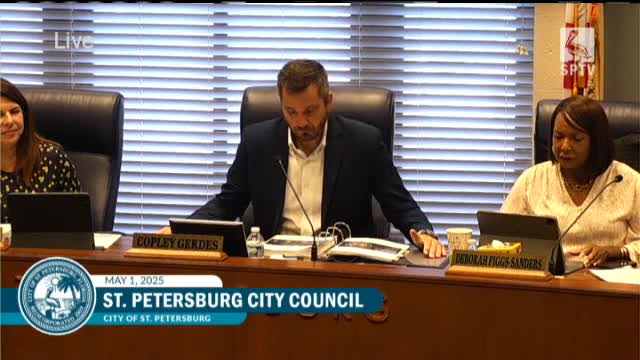
St. Petersburg police report falls in major crimes, outline youth and crisis-response programs
Summary
Chief Holloway told the City Council that major crime categories fell in the first quarter, and he described juvenile diversion, call-team and community programs backed by a $1 million city initiative to reduce reoffending and improve outreach.
Chief Holloway, chief of the St. Petersburg Police Department, told the City Council on the first-quarter report that auto thefts, burglaries, property crimes and violent crimes fell compared with the same quarter last year.
“Auto thefts are down by 19%. Burglaries are down by 17%. Property crimes are down by 17%. Violent crimes are down by 36%,” Chief Holloway said. He also reported five homicides in the quarter, the same number as the previous year, and gave a breakdown of the five cases: one by hand, one by handgun, two by knives and one by a vehicle.
The report framed declining major-crime totals alongside city programs aimed at prevention and crisis response. Chief Holloway described the city’s “call” program, a non‑police crisis-response approach that sends trained navigators and counselors to many calls that do not require armed officers. “97% of the call, the officers are not responding to,” Chief Holloway said, attributing part of the program’s success to navigators and partners who respond without law enforcement when appropriate.
Holloway and other presenters said the department’s youth-focused efforts are central to reducing juvenile offending. He described a second-chance program for low-level juvenile offenders that provides community service, education and coaching within about a week of an incident, rather than months in the court process. “That child will be enrolled into a program that Saturday,” Holloway said, adding that roughly “73 percent of these kids…have not reoffended” in a program tied to Gulf Coast partners, and that another program has a 68 percent non‑recidivism rate among participants.
The chief also gave quarterly figures for weapons removed from circulation, saying the department received 65 guns for safekeeping and recovered 24 firearms during the quarter “so that was 98 guns taken off the streets for this quarter.” He also reported that the department’s PATH team and related outreach had collectively logged hundreds of contacts and referrals to services.
Council members asked how the department will sustain outreach during the summer months, whether transportation barriers limit youth participation in programs, and how non‑emergency and “quality of life” calls are tracked. Council member Brandy Gabbard asked about bus access for youth; Chief Holloway said city staff are in conversation with Pinellas Suncoast Transit Authority (PSTA) and other partners to explore options.
Megan McGee, the city’s program lead for the call team, told council members the call team had experienced temporary staffing turnover but is “fully staffed” as of the meeting, and that a recent transition to Gulf Coast partners involved onboarding new personnel. Council members and the chief discussed marketing and outreach to increase participation in the Eagle Eye (camera‑registration) program; Holloway said the department aims to grow signups and encouraged neighborhood associations to assist.
Why it matters: City leaders framed the report as evidence that a mix of enforcement and community‑based prevention — including rapid second‑chance interventions, sports and scholarship programs, and non‑police crisis responses — is helping reduce major crimes while addressing juvenile and quality‑of‑life concerns.
The council recognized law enforcement appreciation month before the report and thanked officers and department staff for daily service. Several council members used their remarks to press for improved outreach, transportation access for youth programs, and stronger communication to ensure residents know available services and grants.
Speakers quoted in this article are identified from the meeting record. Chief Holloway provided the crime and program statistics; Megan McGee briefed the council on call-team staffing. Council members who spoke about program expansion and transportation include Brandy Gabbard, Gina Driscoll, Mike Harding, Deborah Fig Sanders and Corey Givens Jr.
The department and council members said follow-up work will address program marketing, possible transportation solutions with PSTA, and quarterly updates that incorporate quality‑of‑life and non‑emergency call metrics.