Get Full Government Meeting Transcripts, Videos, & Alerts Forever!
Get email alerts on the Committee Votes Roundup topic
No spam. Unsubscribe anytime.
Labor committee advances bills on pensions, public safety, ports, AI and apprenticeships
Summary
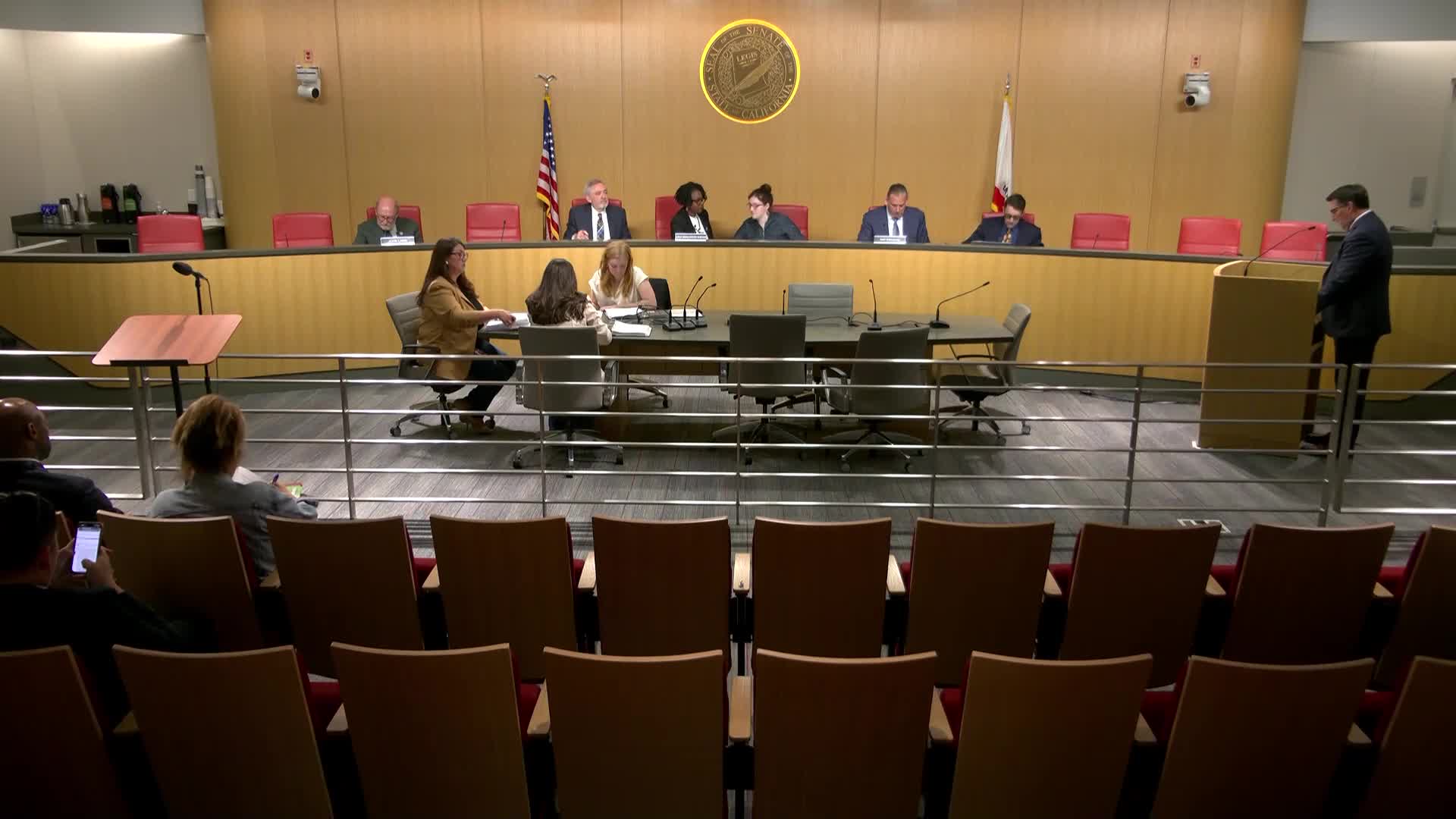
The California State Senate Labor, Public Employment and Retirement Committee met to hear multiple bills on pensions, public safety, workforce supports and infrastructure and moved most forward to the Senate Appropriations Committee or the Senate floor.
The California State Senate Labor, Public Employment and Retirement Committee met to hear multiple bills on pensions, public safety, workforce supports and infrastructure and moved most forward to the Senate Appropriations Committee or the Senate floor.
The committee advanced SB 301 on pension parity, SB 487 on injured public safety workers' civil recoveries, SB 617 on WARN Act layoff notices, SB 703 and SB 826 addressing port trucking transparency and port automation/cybersecurity, SB 366 commissioning a UCLA study of AI's economic and fiscal impacts, SB 469 establishing a Public Infrastructure Task Force, SB 845 expanding youth apprenticeships, and SB 850 addressing staff misconduct and pension forfeiture in women’s correctional facilities. One item, SB 801 (herder overtime and grazing for wildfire mitigation), was presented for testimony and was pulled by the author for further stakeholder work.
SB 301 (Grayson): The bill would bar selective exclusion of groups of employees from membership in retirement systems governed by the County Employees’ Retirement Law of 1937 (CERL), aligning those contracts with protections in the Public Employees’ Retirement Law (PERL). Sponsor testimony focused on a 2019 Placentia action that removed firefighters from pension coverage and on AB 2967 (2020) that closed a CalPERS loophole. Doug Subers of the California Professional Firefighters said, “We represent 35,000 professional firefighters and emergency medical services personnel statewide.” The committee recorded a vote of 4–0 and the item was placed on call for the Senate floor (motion: pass to Senate floor; outcome: on call).
SB 487 (Grayson): The bill would ensure that peace officers and firefighters injured in the line of duty receive a guaranteed share of third‑party civil recoveries when those recoveries are insufficient to fully cover both the employer’s reimbursement claim and the worker’s proven damages. Attorney Megan Bartlett described the practical harms that leave injured officers with little recovery beyond workers’ compensation and said the measure was modeled on existing reimbursement frameworks. Affected witnesses described lost overtime and promotion opportunities. The committee voted to pass SB 487 to the Appropriations Committee, 5–0 (motion: pass to Appropriations; outcome: passed to Appropriations).
SB 617 (Hernandez/Hargine presentation): The bill would amend California’s WARN obligations to require that layoff notices include information about dislocation services available through local workforce development boards and to notify those boards when employers plan a WARN notice. Testimony from Latoya Reid Adje and Javier Contreras of the Alameda County Workforce Development Board stressed rapid‑response, reemployment and retraining services. The motion passed to Appropriations, 5–0 (motion: pass to Appropriations; outcome: passed to Appropriations).
SB 703 (Richardson) and SB 826 (Richardson): SB 703 (Fair Trucking Accountability and Transparency Act) would require ports to collect and report data that helps identify misclassification of drivers as independent contractors; proponents said it would help enforcement and protect compliant employers. SB 826 would authorize a stakeholder process and a UCLA Labor Center contract to study cybersecurity, automation and workforce impacts at California seaports and require a report by 2027. Both bills drew supporters including the California Teamsters, the California Labor Federation and the International Longshore and Warehouse Union (ILWU); opponents included the California Trucking Association (SB 703) and some retail stakeholders. SB 703 passed as amended to Appropriations 4–1 (final recorded vote 4–1) and SB 826 passed to Appropriations 4–0 (motion: pass to Appropriations; outcomes: on call/ passed to Appropriations per roll call).
SB 366 (Smallwood Cuevas): The bill would direct the UCLA Labor Center to study how artificial intelligence may affect state and local revenues, employment and job quality and deliver findings by a statutory date. Brian Justy of the UCLA Labor Center testified for the proposal’s mixed‑methods, revenue‑focused approach. The committee voted to pass SB 366 to Appropriations, final vote 4–1 (motion: pass to Appropriations; outcome: on call).
SB 469 (Smallwood Cuevas): The bill would create a California Public Infrastructure Task Force to advise how federally funded infrastructure projects can expand equitable hiring and high‑road contracting. UCLA Labor Center and labor witnesses supported the task force as a means to increase enforcement capacity and contractor technical assistance. The motion passed as amended to Appropriations; recorded committee vote was 3–1 and later reported as on call (motion: pass to Appropriations; outcome: on call).
SB 845 (Perez): The bill implements components of the Career Education Master Plan and the California Youth Apprenticeship Committee’s recommendations to expand youth apprenticeships, allow high‑school credit for quality work‑based learning and reduce employer liability barriers. Sponsors included the California Workforce Association and CareerWise USA. The committee passed SB 845 to Appropriations, 5–0 (motion: pass to Appropriations; outcome: passed to Appropriations).
SB 801 (Hurtado) — targeted grazing and herder overtime: Senator Hurtado presented SB 801 for testimony; witnesses described wildfire mitigation value of targeted grazing and the effect of AB 1066 on overtime for herders. The author pulled the bill for further stakeholder work; no committee vote was taken. Supporters included sheep and goat producers and Kern County Fire Department; California Federation of Labor opposed statutory exemptions from overtime for farmworkers and urged continued protections (motion: none; outcome: pulled/held).
SB 850 (Ashby): The bill (as amended in committee) would (1) allow forfeiture of pension benefits for specified staff sexual abuse convictions or findings, (2) require staffing changes to avoid solo assignments in women’s institutions, (3) mandate completion of security camera installation in certain facilities by a statutory date, and (4) permit specified respite requests by incarcerated women to on‑duty supervisors. The sponsor, the California Correctional Peace Officers Association, said the measure holds staff accountable. Opponents, including the California Coalition for Women Prisoners and community advocates, urged stronger standards for evidence and expressed concerns about unintended operational impacts, transfers, and enforcement. The committee passed the amended bill as amended to Appropriations, recorded 4–0 (motion: pass as amended to Appropriations; outcome: on call).
Votes at a glance (committee actions): SB 301 — passed to Senate floor (on call) 4–0; SB 487 — passed to Appropriations 5–0; SB 617 — passed to Appropriations 5–0; SB 703 — passed as amended to Appropriations 4–1; SB 826 — passed to Appropriations 4–0; SB 366 — passed to Appropriations 4–1; SB 469 — passed to Appropriations (on call) 3–1; SB 845 — passed to Appropriations 5–0; SB 850 — passed as amended to Appropriations 4–0. SB 801 was pulled for further stakeholder work and received testimony only.
Why it matters: The committee moved a mix of narrow statutory fixes (pension parity, civil recovery allocation for injured public safety personnel) and broader studies and processes (AI fiscal impacts, port cybersecurity and automation, public infrastructure hiring), along with workforce continuity measures (WARN notice clarifications, youth apprenticeships). Several items now require Appropriations review before floor consideration; SB 801 and SB 850 remain the most operationally consequential and contested items and drew the strongest public testimony.
Next steps: Bills advanced to the Appropriations Committee may be held there for fiscal review, amendments or hearings. Several authors committed to ongoing stakeholder meetings where bills were pulled or where witnesses requested additional changes.