Get Full Government Meeting Transcripts, Videos, & Alerts Forever!
Get email alerts on the Housing Policy topic
No spam. Unsubscribe anytime.
Minnesota House passes housing omnibus (Senate File 2298) after debate and amendments, 106-25
Summary
The Minnesota House passed Senate File 2298, a housing omnibus bill that includes funding for prevention programs, infrastructure bonds and incentives for local pro-housing policies, following debate and adoption of several amendments. The final roll call was 106-25.
The Minnesota House passed Senate File 2298, the omnibus housing bill, as amended on a final roll call of 106 yeas and 25 nays, the clerk announced at the close of the floor session.
The bill, carried in the House by Representative Igo of Itasca and co-chaired in committee by Representative Jim Howard of Hennepin County, directs roughly three broad areas of action identified by the bill’s sponsors: affordability, housing diversity and housing stability. Sponsors described a package of investments and program changes that they said would expand production, preserve homes and prevent homelessness.
Republican Representative Igo, the bill’s author in the House, told members the measure "really focuses on the 3 major pillars that we talked a lot about housing, which is having affordability, diversity, and stability, for housing." Co‑chair Representative Howard, a DFL member, stressed bipartisan cooperation and highlighted specific programmatic investments, saying the bill "is a reflection of what Minnesotans are telling us."
The bill includes multiple funding and program provisions discussed on the floor. Members cited the following figures in debate (attributed to speakers as they stated them): a statewide housing shortage of 107,000 units; the average age of a first‑time homebuyer at 38; emergency rental assistance funding of $30,000,000 aimed at preventing homelessness for families; financing of $100,000,000 in housing infrastructure bonds; and an author estimate that the measure will support new rental and ownership housing across Greater Minnesota and the state. Representative Howard also said the bill will finance "11,029" new rental units in Greater Minnesota and enable the financing of more than "400 new affordable single family homes" through specific workforce and challenge programs included in the bill.
On amendments and provisions
On the floor the authors offered and secured several changes. Representative Howard moved an amendment (coded A6 on the desk) that creates a competitive scoring incentive for developments applying for Minnesota Housing Finance Agency funding when the development is in a city that adopts certain pro‑housing local policies. Howard described the approach as voluntary for cities and said the amendment caps the scoring incentive at "no more than 5% of total points in the scoring system," limits density thresholds for some menu items, adds new menu items such as the presence of an inclusionary zoning policy, and makes the change forward looking so it applies only to future competitive grants. The amendment was adopted on the floor.
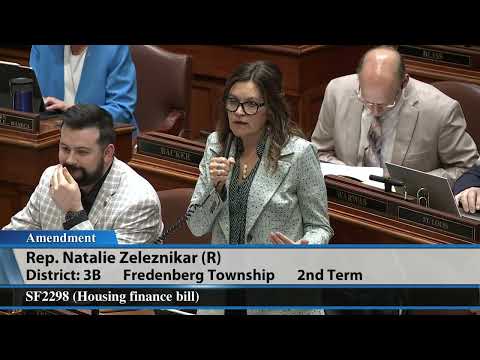
A separate amendment to add a senior representative to an aging task force was moved and described on the floor; Representative Zalesnikar urged adoption as "a voice for seniors," and the amendment was adopted. Representative Zalesnikar later moved an A5 amendment to pilot a home‑sharing program (described as a Minnesota Nice housing initiative pilot for Lake, St. Louis and Washington counties); that A5 amendment was withdrawn by the mover before a vote.
Floor debate and themes
Floor debate emphasized bipartisan cooperation and the scope of the housing problem. Representatives from different regions and parties framed the bill as a mix of funding and regulatory measures. Representative Nash (Carver) and others urged additional regulatory reform to increase starter‑home supply, while Representative Jones described how accessory dwelling units and small multifamily homes helped her buy housing earlier in life. Representative Momani Hilt Sleep spoke in strong support of the bill’s investment in the Family Homelessness Prevention Assistance Program (FHPAP), calling it "one of the most effective tools we have to prevent" family homelessness and citing cost estimates presented on the floor that prevention through FHPAP is far less expensive than responding after a family loses housing.
Final action
After debate the House took a roll call. The clerk closed the roll and announced: "There being 106 yays and 25 nays, the bill is passed as amended and its title agreed to." The transcript records no further procedural action in the House record included here.
What the record shows and what it does not
The House floor record and debate cite multiple funding totals and program targets as part of sponsors’ descriptions and floor amendments; where figures or program names were spoken on the floor, they are attributed in this article to the speakers who stated them. The transcript here does not include the enrolled bill text, bill fiscal notes, or a comprehensive list of line‑item appropriations; it also does not include the complete roll‑call list showing which members voted yes or no beyond the final tally. The bill is identified in the House transcript as Senate File 2298 (also referenced as house file 2298 in initial floor procedure remarks). The record provided does not show the bill’s next procedural step after passage on the House floor.