Get Full Government Meeting Transcripts, Videos, & Alerts Forever!
Get email alerts on the Jobs And Labor Omnibus topic
No spam. Unsubscribe anytime.
Senate adopts jobs and labor omnibus after hours of debate on nonprofits, unemployment and workplace rules
Summary
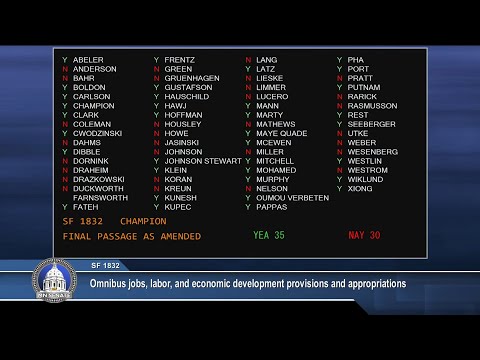
The Minnesota Senate passed Senate File 18-32, a jobs and labor omnibus, after extended debate and votes on amendments covering nonprofit funding, unemployment help for Iron Range miners, grant reporting and penalties for break-time violations. The bill passed on a 35-30 roll call.
Senators passed a combined jobs and labor omnibus, Senate File 18-32, after extensive floor debate on nonprofit funding, employer reporting and new worker protections.
The package includes the Jobs Committee budget and a separate labor article with operating funding for the Department of Labor and Industry and related agencies, plus new statutory language on rest and meal breaks and construction codes and licensing fee alignment. Lawmakers spent several hours debating amendments on direct appropriations to nonprofits, accountability and reporting language, and a targeted unemployment extension for Iron Range miners.
Supporters framed the bill as a mix of budgets and measured policy needed to support Minnesota workers and to modernize several agency programs. Senator Bobby Joe Champion, the bill author and jobs committee chair, described the bill as a budget document with discrete, noncontroversial policy changes added by committee deliberations. Labor chair Senator Lindsey McEwen outlined changes in the labor article, including new break-time guarantees and authority for the Department of Labor and Industry to seek temporary restraining orders for dangerous workplace conditions.
Opponents focused on accountability for taxpayer dollars given large direct appropriations to nonprofit organizations. Senator Drazkowski and others repeatedly pressed for stronger recoupment and reporting mechanisms after citing the 2023 Office of the Legislative Auditor review. In committee reporting read on the floor, the bill author stated about $56,600,000 in the 2026-27 biennium is included for nonprofit grants across the state; members repeatedly asked for and received more reporting language addressing some OLA concerns.
Key floor votes and actions included: - Adoption of committee reports recommending passage. (Motion moved by Senator Murphy; adopted.) - A64 (Iron Range unemployment extension): adopted by voice vote; supporters said it provides a near-term lifeline for laid-off miners and keeps experienced workers local. Opponents warned of drains on unemployment trust funds and urged permitting and energy-cost fixes as longer-term solutions. - A93 (delete nonprofit appropriations): withdrawn after debate; sponsor argued for removing $56.6 million in nonprofit spending citing auditor concerns; author and several supporters defended targeted appropriations and said committee added reporting guardrails. - A82 (require repayment and future grant ineligibility for grantees that fail to report): failed on roll call. Sponsor argued it created necessary enforcement; proponents warned it could require repaying funds even where reimbursements had been correctly earned. - Multiple employer-oriented and workforce amendments (A80, A83, A92, A97, A105, among others): debated; several failed on roll call, others withdrawn.
On worker protections, the labor article would guarantee minimum break timings (15 minutes for every 4 consecutive hours; 30-minute meal break for every 6 hours) and creates remedies for employees whose break rights are violated; the bill also permits the commissioner to assess a civil penalty (up to $1,000 per employee per day) in cases of repeated break violations. That penalty provoked sustained debate: supporters said it provides an enforcement backstop; critics said it risked overreach and could be used as a revenue source. Several amendments seeking to remove or alter that penalty were defeated.
After the final debate, the senate took a roll-call vote on final passage. Senate File 18-32 passed on a 35-30 roll call and its title was agreed to. Backers said the bill balances workforce and agency needs; critics warned the bill did not fully address grant accountability and raised concerns about new enforcement authorities and budget trade-offs.
Ending: Lawmakers who supported the bill said it funds and reforms agencies Minnesotans rely on and includes reporting and other guardrails; critics urged further work in conference to tighten accountability and to consider long-term impacts on employers and grant oversight.