Get Full Government Meeting Transcripts, Videos, & Alerts Forever!
Get email alerts on the Food Carts topic
No spam. Unsubscribe anytime.
Tualatin council opens review of food-cart rules, members push for pods, parking and equity considerations
Summary
City staff reviewed Tualatin's municipal rules on mobile food units and councilors asked staff to research expanding where carts can operate, how food cart pods would be sited in Basalt Creek and the city core (CORA), and whether city rules barring operations on gravel lots should change.
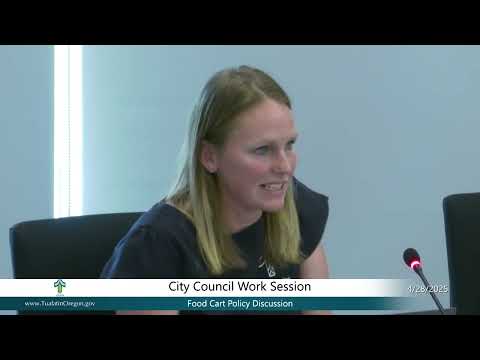
TUALATIN, Ore. — Tualatin staff laid out the city's existing mobile food unit rules during an April 28 work session, and councilors asked for follow-up research on permitting food-cart pods, loosening a pavement-only restriction and how the city could support start-up operators.
City staff said most local rules are codified in the municipal code as mobile food unit regulations and currently limit carts to paved surfaces, prohibit connections to public water, sewer or electrical service, and allow only one unit per private site except for a designated pod allowance in Basalt Creek.
"The majority of our food cart regulations are found in our municipal code. That would be in chapter 9 subsection 10. And they are referred to as mobile food unit regulations," said Aaron Engman, senior planner, during the presentation. Staff also told councilors that the Basalt Creek employment zone includes specific language allowing a food-cart pod of between two and 10 carts, requiring frontage on Grama Ferry Road, screening and architectural review.
Why it matters: Councilors framed the policy review around economic development goals and downtown activation. Several members said food-cart pods can lower barriers for entrepreneurs and create outdoor gathering spaces near the riverfront and the planned CORA area.
Councilor Sacco said she wants staff to evaluate adding a pod to the CORA core: "Yes, interested in learning more. And I am particularly interested in, in learning about how we can incorporate a food cart pod into our Quora area. Where we can bring, you know, a diverse food offering, but also a gathering place for folks that want to walk around our downtown area..."
Council feedback and concerns - Zones and pods: Councilors generally supported researching expansion beyond the current industrial, office commercial, recreation commercial and a limited general commercial area, but stressed that any pod or downtown location must address parking and traffic impacts. Council President Pratt warned that successful pods elsewhere can generate heavy weekend parking demand: "If you've ever been in West Linn around their food cart on a weekend, it's a zoo. You can't park in West Linn on their Main Street because there is no parking. So these are the things we need to look at, the unintended consequences of...doing this."
- Standards and screening: Staff noted Basalt Creek's pod allowance requires screening and architectural review. Councilor Gonzales emphasized design standards and site maintenance: "I would want to ensure that from the onset, it doesn't have that feel look...That way it's nice and clean, covers the wheels and those kinds of things."
- Pavement requirement and safety: Multiple councilors asked why gravel lots are excluded. Staff said the paved-surface requirement is a city development standard, not a state rule. "That's a in particular is a city regulation," Engman said. Councilors asked staff to research whether gravel with appropriate surfacing or permeable alternatives could meet safety and accessibility requirements.
- Utilities and health: Staff said existing code requires food carts on private property to be self-contained and not tap public utilities; state rules require a restroom with hand-washing facilities when seating is provided and strict standards for water source and waste disposal. Staff noted carts must provide adequate garbage and recycling and cannot obstruct vehicular or pedestrian areas.
What staff will do next: Staff asked council whether to research models used by nearby cities (including Tigard and Beaverton), explore options for public or private-managed pods, and identify code changes needed to allow carts in additional zones or to permit nonstandard surfaces. Multiple councilors asked for examples of operating models (city-owned site leased to an operator, private developer-led pods, or hybrid contracting arrangements) and for a deeper review of unintended consequences, safety liabilities and funding implications if the city were to invest in infrastructure.
Councilors also asked staff to return with best practices and lessons learned from nearby cities, and asked staff to evaluate how to integrate food carts into public areas such as the commons and parks while keeping sanitation and ADA access in mind.
Ending: Staff will return with follow-up research and examples; no ordinance or code amendment was proposed or voted on at the April 28 meeting.