Get Full Government Meeting Transcripts, Videos, & Alerts Forever!
Get email alerts on the State Tax And Regulation Roundup topic
No spam. Unsubscribe anytime.
Assembly Revenue and Taxation committee advances film credits, hemp rules and multiple tax measures; several bills sent to appropriations
Summary
The Assembly Committee on Revenue and Taxation advanced a package of bills affecting local taxes, wildfire recovery, cannabis regulation, housing and a major update to the film and television tax credit program, sending several measures to the Appropriations Committee and placing others on the suspense file.
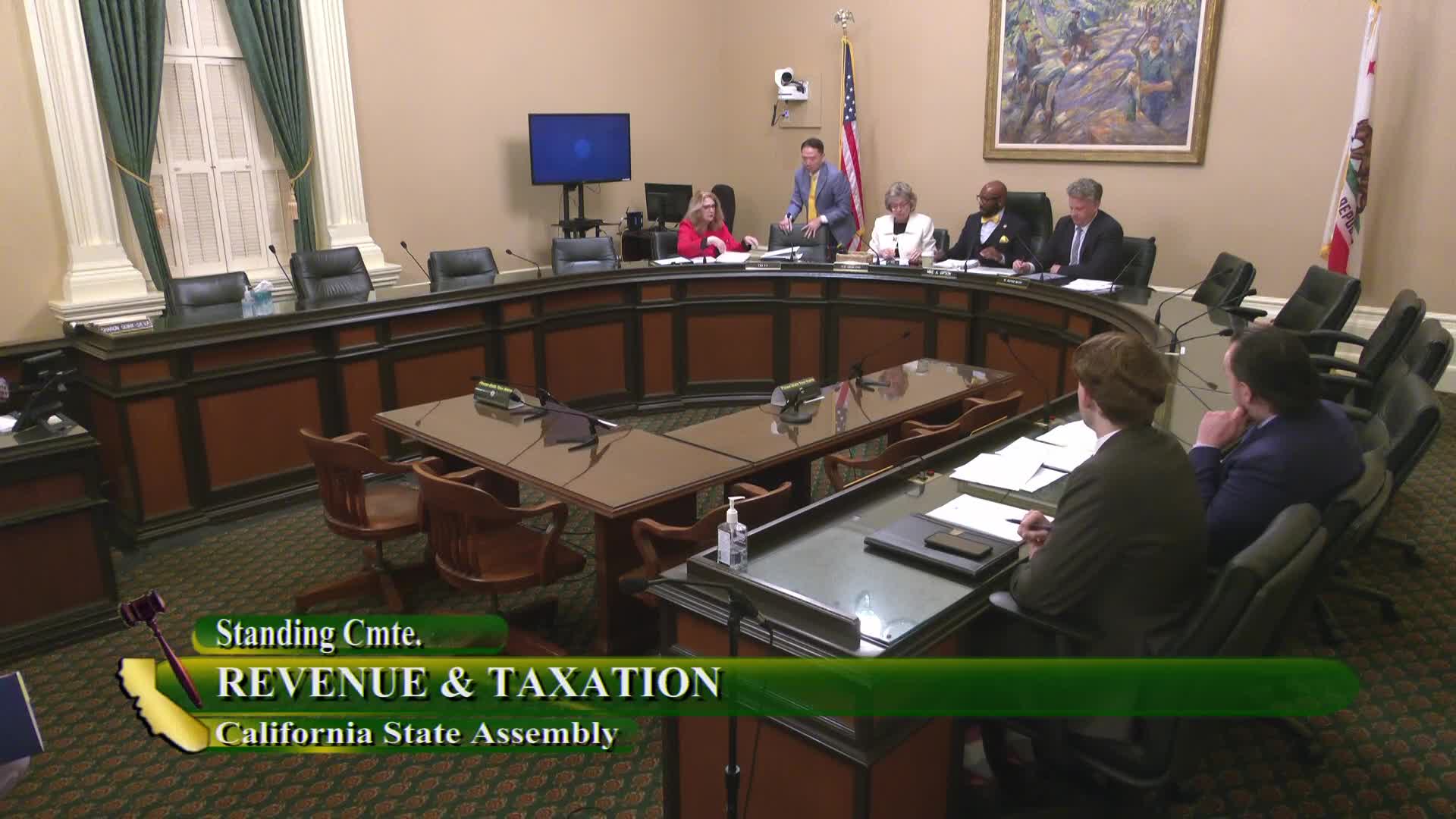
The California State Assembly Committee on Revenue and Taxation met to hear a slate of bills affecting local taxes, wildfire recovery, cannabis regulation, housing and the film industry. Committee members advanced several measures to the Appropriations Committee, placed others on the suspense file and left at least one bill held in committee.
Assemblymember Addis introduced AB 761, which would allow the Monterey–Salinas Transit district (MST) to place a countywide sales-tax ballot measure before Monterey County voters if two-thirds of the MST board approves the measure without requiring each member jurisdiction’s separate approval. MST representative Matt Robinson told the committee that Measure Q, a one‑eighth‑cent sales tax enacted in 2014, “has generated approximately $8,500,000 annually,” funding services for veterans, older adults and people with disabilities. Robinson said the bill would let MST “seek a two‑thirds approval of that board, before we move to the ballot.” The committee ultimately moved AB 761 forward; the vote record in the hearing indicated the item was carried and later announced as passed by the body.
On recovery and property taxes, Assemblymember Schultz presented AB 1253, aimed at reducing reassessment risk for homeowners rebuilding after wildfire and other declared disasters. Los Angeles County Assessor Jeff Prang said emergency permits that temporarily allow rebuilding up to 110 percent of the previous structure have created confusion about property‑tax reassessment. Prang said AB 1253 would provide a “clear, temporary, and limited fix allowing assessors to recognize rebuilding up to 10% of the home's original size without triggering reassessment” when reconstruction is done under government‑issued emergency permits. The committee moved the bill forward to Appropriations as amended.
AB 8, by Assemblymember Aguiar‑Curry, prompted extended debate. The bill seeks to close regulatory gaps between hemp and cannabis by treating intoxicating hemp‑derived products as part of the regulated cannabis supply chain, subject to the Department of Cannabis Control’s rules and cannabis excise tax. Amy Jenkins of the California Cannabis Operators Association summarized research finding that a large share of sampled hemp‑derived products “exceeded the legal THC limit,” were marketed to children and lacked potency testing. Labor witnesses from UFCW warned the committee these unregulated products undercut legal cannabis businesses and worker protections. Opponents, including representatives of small licensed cultivators and rural producers, warned that integrating nationally sourced hemp into the licensed market could flood supply and depress prices — and with it tax revenue. After testimony and negotiation, the committee passed AB 8 as amended to Appropriations.
The committee also spent significant time on AB 1138, a negotiated overhaul of the film and television tax credit program meant to preserve and restore production jobs in California. Joint authors and union representatives described the bill as a jobs measure intended to retain film‑production infrastructure and the many ancillary small businesses that depend on it. Supporters noted Governor Newsom’s budget proposal to increase the state’s annual film credit allocation to $750 million; AB 1138 would set competitive rules and job‑ratio incentives for awarding credits, increase the independent‑production allocation from $26 million to $75 million, and add a location uplift outside Los Angeles to steer work across the state. Testifying union leaders said the program produces thousands of job days and restores pension and health benefit eligibility for workers. The committee moved AB 1138 to Appropriations.
Public‑health and research measures also advanced. AB 829 would create a voluntary California Parkinson’s Disease Research Fund allowing donated tax contributions and grants to finance research and services; sponsors cited statewide registry work and estimated the disease’s statewide cost at about $5 billion annually. The committee approved AB 829 as amended to Appropriations.
On wildfire recovery, AB 376 would exempt certain disaster settlement proceeds from state income taxes for wildfire victims and was discussed as a way to avoid taxing proceeds intended to rebuild homes and communities. Testimony from the Rural County Representatives of California described multi‑year rebuilding delays and insurance shortfalls in high‑fire areas. AB 376 was noted and later held in committee rather than advanced from the hearing.
Housing measures included AB 474, which would exempt limited nonprofit home‑sharing rental income from state income tax for qualifying low‑income homeowners and ensure modest home‑share revenue does not disqualify people from social‑service benefits. University researchers and nonprofit program operators described small‑scale programs that match older homeowners and home seekers; one witness said the largest nonprofit program had 37 ongoing matches and estimated roughly 1,000 such matches statewide. The committee moved AB 474 as amended to Appropriations.
AB 480 would let developers convert state low‑income housing tax credits from the traditional allocated credits to higher‑value certificated credits after award, increasing private investment per dollar of state tax expenditure. Housing advocates told the committee certificated credits typically sell for about 10–14 cents more per dollar, stretching public subsidy further. The committee moved AB 480 to Appropriations.
Votes at a glance: AB 761 (MST ballot authority) — moved and ultimately carried by the committee; recorded as passed in the hearing record. AB 1253 (rebuild assessment clarification) — moved as amended to Appropriations. AB 8 (hemp/cannabis integration and enforcement) — moved as amended to Appropriations. AB 1138 (film/TV tax credit modernization) — moved as amended to Appropriations. AB 829 (Parkinson’s research fund) — moved as amended to Appropriations. AB 376 (tax treatment of wildfire settlements) — held in committee. AB 474 (nonprofit home‑sharing tax exemption) — moved as amended to Appropriations. AB 480 (convert to certificated housing credits) — moved as amended to Appropriations.
Committee members asked technical and fiscal questions across items, and several bills were placed on the suspense file for further fiscal review before final floor action. Multiple witnesses from labor unions, local governments, research institutions and industry groups provided testimony during the two‑plus hour hearing.
Assemblymember Addis and other bill authors thanked the committee and asked for “aye” votes on their measures; committee chairs closed hearings by referring several items to the Appropriations Committee and the suspense file for further review.