Get Full Government Meeting Transcripts, Videos, & Alerts Forever!
Get email alerts on the Curriculum Frameworks topic
No spam. Unsubscribe anytime.
Assembly panel hears governor's $1M proposal to study California curriculum adoption process
Summary
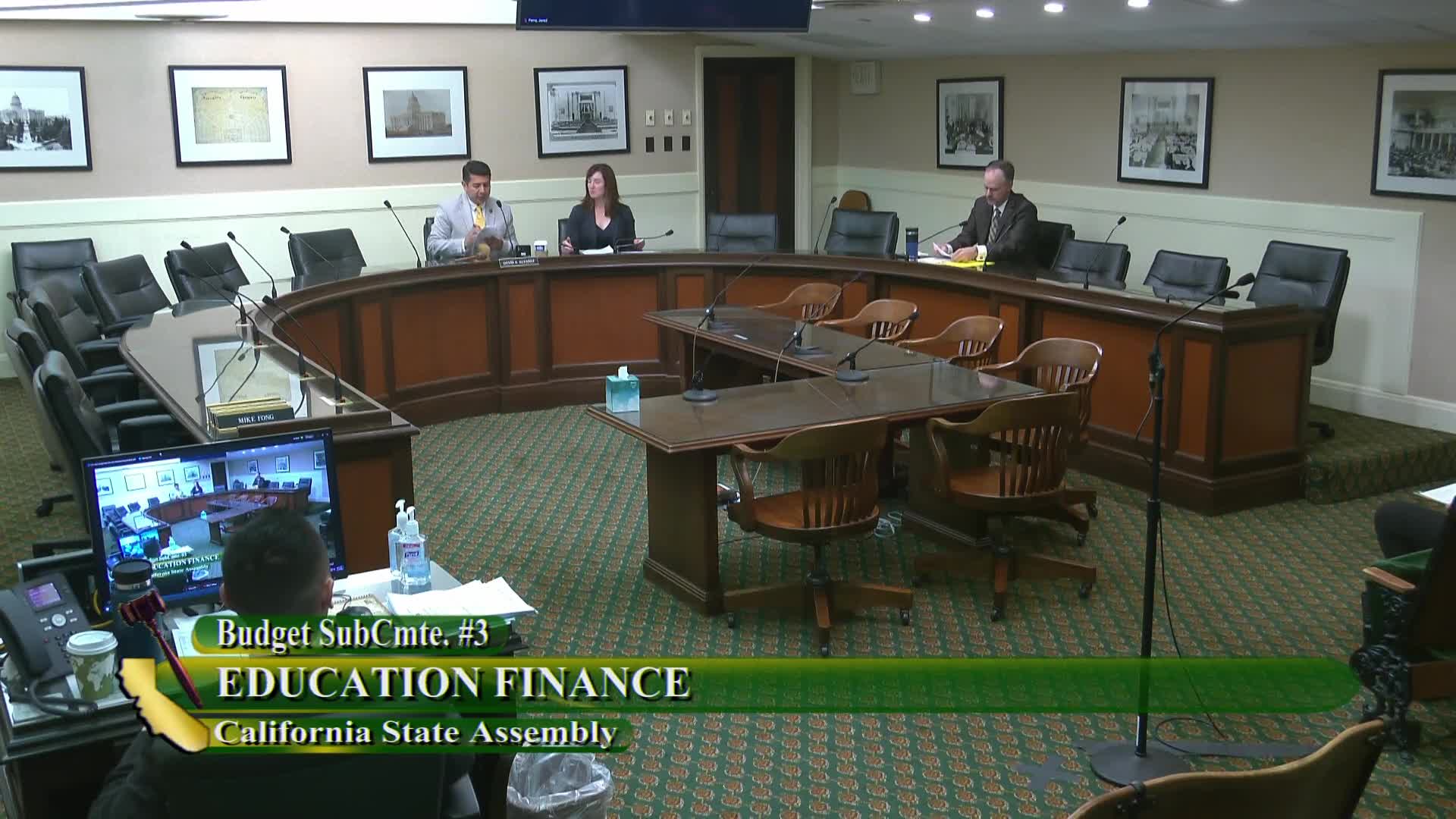
The California State Assembly Budget Subcommittee No. 3 on Education Finance heard the governor's proposal to fund a study of the state's curriculum adoption process during a hearing that opened with the item on curriculum frameworks, standards and instructional materials.
The California State Assembly Budget Subcommittee No. 3 on Education Finance heard the governor's proposal to fund a study of the state's curriculum adoption process during a hearing that opened with the item on curriculum frameworks, standards and instructional materials.
The governor's budget would provide $1,000,000 one-time Proposition 98 General Fund to the Superintendent of Public Instruction to allocate to a county office of education to contract with research organizations or nonprofits to study how other states develop curriculum frameworks, instructional guidance, professional development and instructional resources and how they evaluate alignment to state content standards. The selected contractor would deliver findings and recommendations to the Legislature and Department of Finance by Jan. 1, 2027. The administration also proposes $250,000 one-time (non-Proposition 98) to develop supplemental guidance tied to the ELA/ELD adoption.
Why it matters: State officials described California's current adoption cadence as uneven and sometimes out of date. Mike Torres, director of the Curriculum Frameworks and Instructional Resources Division at the California Department of Education, told the committee that the most recent history-social science standards were adopted in 1998 and that publishers typically need 18 to 24 months to produce program materials after a framework or standards update. "We most definitely see the worth of implementing a predictable and adaptable schedule of review and update for content standards, frameworks and the adoption of instructional materials," Torres said. The department favors an eight-year or shorter review cycle if a schedule can be adopted.
Panel discussion and concerns: Members pressed the administration on what the study would accomplish that a targeted legislative or administrative reform would not. Hugo Solis Galena of the Department of Finance said the study is intended to identify specific practices that other states use and to recommend how California could streamline its own processes. Legislative Analyst Office staff said they had no immediate objections but urged clarity about goals before spending the funds. Committee members asked how the study would address publisher lead times, educator participation in review panels and whether the study should require familiarity with existing California Education Code provisions. CDE said it would welcome study recommendations, and reiterated that changes to standards themselves require legislation.
Next steps/direction: Committee members asked the administration to reflect the hearing's questions in the May revision. The subcommittee held the item open for further follow-up.
Ending note: The study would be delivered by Jan. 1, 2027, and any statutory changes to mandate review cycles or to update standards would still require follow-on legislative action.