Get Full Government Meeting Transcripts, Videos, & Alerts Forever!
Get email alerts on the Budget topic
No spam. Unsubscribe anytime.
Ballston Spa trustees debate budget reserves, fire apparatus planning and sidewalk funding
Summary
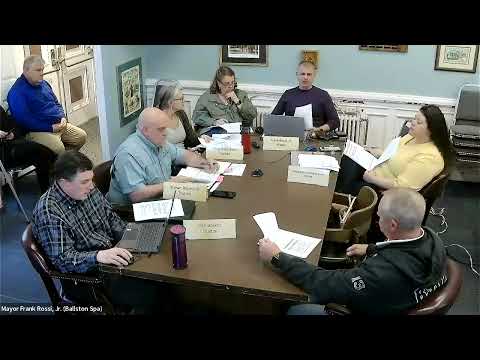
At an April 21 workshop on the 2026 tentative budget, Ballston Spa trustees and department leaders argued over how to fund fire apparatus and building improvements, whether to move money into reserves up front, and how to finance village sidewalks and related loan programs.
At a Village of Ballston Spa trustees workshop on April 21, 2025, board members and department leaders spent the evening’s budget discussion focused on reserve policy for fire apparatus and building improvements, equipment and personnel costs in police and DPW, and how to pay for an expanded sidewalk program.
The debate centered on two competing approaches: put anticipated but unspent building-improvement allocations into department-level lines now and move unused amounts to a truck-reserve after the fiscal year ends, or explicitly appropriate money into named reserve funds now. Mayor Frank framed the problem around long lead times and large purchases, saying trustees had been handed “a $2,440,000 ladder truck proposal” and that planning must start now to be able to pay for multi‑year apparatus purchases.
Why it matters: the board is preparing for multi‑year capital needs — ladder and pumper trucks, potential DPW building work and other large projects — while balancing operating budgets and avoiding what trustees described as double‑appropriating the same dollars.
Fire department and reserves
Fire Chief Kevin Croft, who said he has “only been through this my third time now,” described the department’s budgeting approach and requested money for firefighter cancer screening and equipment. Trustees debated whether to put larger amounts in building improvement lines this year and then move unspent funds into a reserve after the annual financial report (AFR), or to fund a clearly labeled apparatus reserve up front.
Trustees raised transparency and accounting concerns. One trustee said she was “not that comfortable with that approach” of padding operating lines with the expectation that unused funds will be swept into reserves later. The exchange highlighted disagreements about whether appropriations should be explicit in the budget or handled after-year accounting adjustments. Officials noted an anticipated pumper delivery in July and a ladder truck with a 45–48 month lead time; the board discussed planning for roughly $300,000 per year debt service for truck payments depending on financing choices.
Police and overtime
The police chief reported elevated overtime, citing a December on‑the‑job injury that left a full‑time officer out and additional senior officers using accrued leave. The chief said the department is using a state technology grant (about $237,000) to buy equipment — including body cameras — and is instituting related policy and training. On overtime, the chief said the department “has to front the pay, and then the state determines what the sheriff could give back to us on the disability end,” describing the strain on personal service lines and the uncertainty from an unapproved collective bargaining agreement (CBA).
DPW, trucks and sidewalks
Working Supervisor Scott Kern and Administrator Justin Lake described DPW staffing, equipment needs and ongoing vehicle lead‑time issues: two replacement trucks are already ordered but village officials said manufacturers have not provided firm delivery dates. The board discussed a proposed midsize dump truck and pickup with lift gate, and an apprenticeship/BOCES student pipeline for summer help.
Trustees also spent significant time on sidewalks and a proposed loan/reimbursement program. Officials described a program that would require homeowners to make repairs to be code‑compliant, with up to 50% reimbursement and an optional loan placed on property tax bills. The board confirmed it wants a formal law and a program schedule before aggressively enforcing sidewalk repairs; several trustees urged creation of a sidewalk reserve or capital plan so funding can be carried year‑to‑year rather than rebudgeted anew each year.
Capital planning and fund balance
Officials said portions of fund balance are identified in the capital plan for projects such as DPW building work, apparatus financing and park improvements; the mayor emphasized the need to match short‑term budgeting decisions with a multi‑year capital strategy. Trustees discussed permissive referendum and the tradeoffs between specific reserve funds (which may require permissive referendum on use) and type‑based capital reserves that give quicker flexibility for emergencies.
Discussion vs. action
The April 21 session was a workshop; trustees debated policies and line‑item approaches but did not adopt a new reserve policy at the meeting. Several trustees asked staff to return with clearer amortization schedules, written policy language for a proposed reserve approach, and specific capital cost estimates (particularly for the DPW building and truck amortization) ahead of a future formal vote.
Ending
The board scheduled continued work on the tentative 2026 budget and planned a public hearing/vote at a subsequent meeting. Trustees said written comments would be accepted through the public comment period before the next vote.