Get Full Government Meeting Transcripts, Videos, & Alerts Forever!
Get email alerts on the Minutes And Recordkeeping topic
No spam. Unsubscribe anytime.
Danvers Accessibility Commission approves minutes; discusses using AI and a standard template
Summary
At its April 24 meeting the Danvers Accessibility Commission approved previous meeting minutes and debated a consistent minutes template and whether to use AI drafts with human proofreading.
The Danvers Accessibility Commission approved its prior meeting minutes and discussed a proposal to standardize minute-taking and use AI-generated drafts that would be proofread by a human.
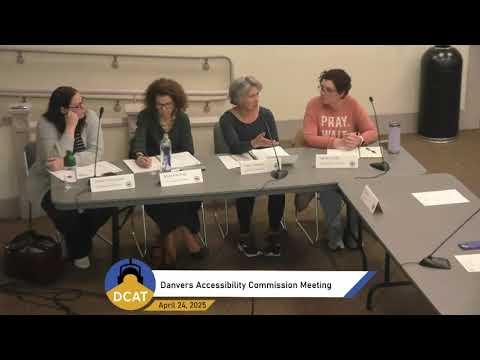
At the start of the April 24 meeting the chair moved to approve the minutes and the motion passed by voice vote. The chair and several members then discussed how detailed minutes should be and whether the commission should use AI tools to speed the process.
Commission members said minutes should follow the agenda, record major points, list votes, and capture motion makers and seconders. “I try to align to the agenda, have highlights of, like, major points that are getting covered, any votes, who made the motion, who seconded, and how the vote happened,” said a commission member. Several members said AI summaries could be helpful as a starting draft but needed human review. One member said an AI draft they tested “had a lot of errors,” and urged a human to proofread any output.
Members discussed two practical options: (1) rotate the responsibility among commissioners, or (2) assign a regular minute taker. The group sketched a template idea: header with meeting title/date/time/location, attendance (present/absent), agenda “chapters” with concise bullet summaries below each item, a consolidated action-items section at the end listing responsible parties and due dates, and a votes section noting motion text, mover/second, and result.
Commissioners volunteered to experiment with formats. One member offered to produce a digital template and circulate it for feedback before the next meeting. Members said it would be acceptable in some cases to feed handwritten or laptop notes into an AI tool and then validate the AI output against human notes. They emphasized that minutes should not attempt to be a verbatim transcript but should capture decisions, action items and any contested or substantive debate for posterity.
No formal motion to adopt a permanent template was recorded; the group agreed to circulate a draft template by e-mail for review.
Ending: The commission did not adopt a final policy during the meeting but directed members to try the proposed approach and review a draft template before the next meeting.