Get Full Government Meeting Transcripts, Videos, & Alerts Forever!
Get email alerts on the 1600 North Udot topic
No spam. Unsubscribe anytime.
Council approves sale of nine parcels to UDOT for 1600 North widening after public hearing; state-led noise walls to be installed where residents supported them
Summary
The council declared nine properties along 1600 North surplus and authorized sale to UDOT to enable a state road‑widening project. Consultants described planned nine‑foot noise walls on segments where residents voted in favor; demolition and construction timelines were presented.
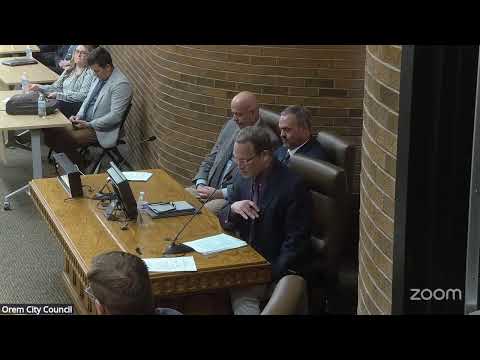
The Orem City Council declared nine parcels along the 1600 North corridor surplus and authorized their sale to the Utah Department of Transportation to enable the 1600 North widening project, after a required public hearing and a staff presentation.
Aaron Council (city staff) told the council the parcels were acquired in 2019 and 2020 using corridor-preservation funds supplied by the county. State law requires properties purchased with corridor preservation funds to be sold back to the state at the price the city originally paid; staff said eight of the parcels fall into that category and one parcel (a small portion of Bonneville Park frontage) was acquired with city funds and will be handled separately in the sale accounting.
Consultant Diego O'Carol and UDOT staff described project status: most affected parcels are already owned by UDOT and tenants have been relocated; several homes have been demolished and remaining acquisitions are near completion. Consultants showed maps of the corridor and described the ballot process UDOT uses to determine whether to install noise walls. Staff said they contacted affected property owners, and the ballots returned overwhelmingly in favor of noise walls in the segments being considered; one property owner requested continued park access and thus that specific park frontage will not receive a noise wall.
UDOT engineers described the typical sound wall as a concrete structure taller than a standard residential fence, and on this project noted 9-foot walls in many locations (the presentation said heights vary by segment based on the environmental analysis). Consultants said sound walls are permanent, heavy structures and that typical post‑construction measurements (before‑and‑after decibel readings) are used to validate effectiveness.
On schedule, UDOT staff said the project is readying bid documents and expects to advertise for construction bids in roughly one to two months. Construction could start in phases this fall where permitted, but Rocky Mountain Power’s transmission-line restrictions on the north side will limit some noise‑wall work until power shutdown windows are available; staff projected some north-side wall work would occur next fall. Overall construction was described as roughly 18 months (contractors would be asked to complete work by July 1, 2027, according to the presentation).
City staff framed the sale as part of a long-running corridor preservation effort; they said rent and other revenues accumulated while the city held some parcels will be used to offset expenses and any residual funds will be refunded to Utah County per the corridor‑preservation program rules.
The council held the required public hearing; no public comments were made at the hearing. A councilmember moved the item (motion language was read into the record) and the council seconded the motion. The motion was recorded as approved in the meeting minutes and the sale authorization will allow UDOT to proceed with property closings and the next design and construction steps.
Staff and UDOT emphasized that the noise-wall decision is property‑owner driven on affected segments (balloting requires a high response rate and a supermajority of respondents to approve), and that the environmental study completed earlier in the process contains the decibel metrics used to justify wall design and height. Councilmembers asked for the specific decibel values and other technical details; consultants said that data is included in the environmental document and offered to provide the study excerpts to the city for review.
No further land‑use or zoning action was taken beyond declaring the parcels surplus and authorizing their sale to UDOT; staff said additional construction permits and utility coordination will follow in the design and bidding process.