Get Full Government Meeting Transcripts, Videos, & Alerts Forever!
Get email alerts on the Budget Cip topic
No spam. Unsubscribe anytime.
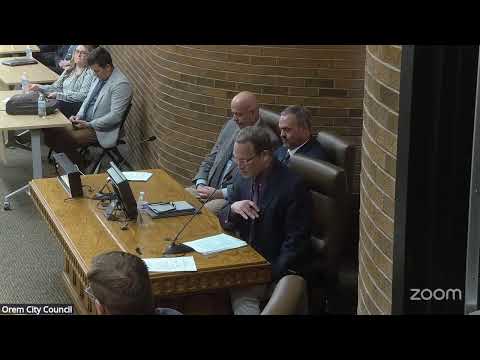
Orem outlines tight FY26 operating budget, $28 million in capital projects and new hires tied to growth
Summary
City staff presented staffing expansions funded by interlocal contracts and fee revenue, and a $28 million capital program that prioritizes water, roads and park improvements as part of the Fiscal 2026 budget process.
Orem city staff told the council they expect a tight fiscal year 2026 operating budget but presented a set of limited personnel additions — mostly tied to growth contracts and user fees — and a $28 million capital improvement program that prioritizes water, sewer and street projects.
City staff said they will transfer $3.2 million from general-fund reserves into the capital projects fund and plan to use about $1 million of that for recurring capital work and smaller park and facility projects. That transfer is part of the FY26 budget package the council discussed at a work session.
The budget presentation emphasized why the items matter: many additions are funded outside the general fund or by interlocal agreements, reducing the city’s direct operating impact while addressing capacity tied to new development.
The city described several proposed personnel changes. The fire department will add three firefighter–paramedics midyear to support operations tied to the Vineyard contract; staff said Vineyard’s payments will “totally fund” those hires. The department also plans a full‑time training coordinator for the new training facility and a deputy fire marshal position to serve as a liaison to partner cities. Division Chief Derek Spencer was identified in the meeting as the division chief over fire prevention and is being given the fire marshal title to provide clearer public oversight.
Public works will add a GIS technician to support enterprise funds and a technician to staff Heritage Park; staff said the heritage-park technician and related equipment will be paid from the Water Fund. Parks and recreation asked for a technician to support athletic rentals; staff said increased athletic-field rental income will fund that hire and an associated vehicle. Other new equipment requested by public works includes an electric John Deere Gator (to replace a noisy UTV), a wood chipper to reduce trips to the landfill, and five backpack leaf blowers to speed leaf collection.
Police department items include a multi‑year patrol rifle replacement program budgeted at $20,000 per year (a five‑year rotation was described) and funds to evaluate and potentially contract for AI-assisted report-drafting software. Staff said early testing suggests the AI could cut officer report-writing time by about 30%, though they described the timing of any personnel changes as “TBD” and said safeguards and human review would remain in place.
Library, facilities and Parks maintenance requests were also included. The library continues to hold $90,000 out of prior savings pending a bid; facilities maintenance will extend unified badge access and security upgrades across city buildings; parks projects mentioned a deep‑tine aerator and athletic-field maintenance equipment supported by rental revenue and prior sinking funds.
On the capital side, staff presented a recommended FY26 CIP package totaling about $28 million across funds: $2.6 million in city CIP funding, roughly $4.5 million in water, approximately $13 million for water-reclamation/treatment plant work, $2.7 million for stormwater, and $5 million for annual street projects. Projects highlighted included Lakeside Sports Park improvements, pickleball courts and restrooms at a new park (the presentation listed a $710,000 allocation to complete courts, lighting and a small building), park playground replacements at Cherry Hill and Foothill ($565,000), lower cemetery irrigation improvements ($160,000) to free more burial lots, security/fiber/camera work for parks, city center park pavilion completion and ballfield screening and soil screening to improve playing surfaces.
Staff said water master plan work will include upsizing small distribution mains and funding tank, booster and well priorities; sewer funding will address treatment-plant upgrades and local maintenance projects; stormwater funding is targeted at flooding and canal abandonment projects. Engineering staff described an annual street program that coordinates concrete, utility, and paving work so overlays and reconstruction are efficient.
City leaders repeatedly framed the CIP as long‑term, core maintenance rather than discretionary spending: “Street, water, roads” were cited as priorities that residents notice only when they break down. Staff said they are pursuing grants and alternative funding sources (Land and Water Conservation Fund, Community Development Block Grant and similar grants) in addition to the local CIP allocation.
No formal vote on the FY26 budget or the CIP occurred at the work session; staff said these are the recommended items to fold into the tentative budget and to discuss further in the formal budget hearings.
The council discussion included repeated requests for follow-up details (timelines for the training facility revenue, exact decibel or capacity figures for equipment replaced, and the vendor details for the AI software) and staff said they would return with refined cost breakdowns and contract terms. The budget presenters asked councilmembers to prioritize given the tight revenue assumptions for FY26 and to note that some expansion requests were accommodated in the current fiscal year because savings or reprioritization freed funds.
The session ended with staff and council members thanking department directors for paring requests and pursuing efficiencies to keep the FY26 requests minimal.