Get Full Government Meeting Transcripts, Videos, & Alerts Forever!
Get email alerts on the Public Safety School Protests topic
No spam. Unsubscribe anytime.
Lafayette council weighs limits on protests near elementary school after safety complaints
Summary
City attorneys and police described constitutional limits on restricting speech but acknowledged safety concerns. Council asked staff for more data and increased patrols after residents and a crossing guard said protests near Lafayette Elementary distract drivers and pedestrians.
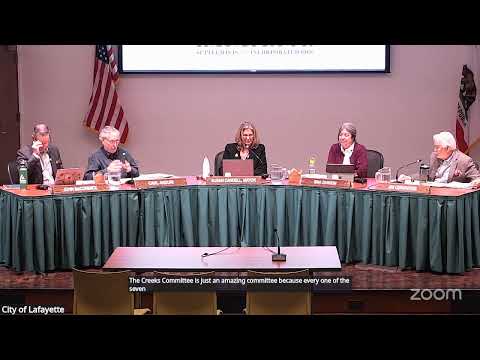
Lafayette City Council members debated whether and how to limit demonstrations near Lafayette Elementary School during a lengthy April 14 meeting, after residents and school staff said protesters standing at or near the school’s sidewalks were creating safety hazards during student drop-off and pick-up.
City Attorney Mala opened the discussion by warning that any local restriction would have to meet constitutional standards: time, place and manner rules must be content-neutral, narrowly tailored and leave open alternate channels for speech. She noted courts have permitted narrow “bubble-zone” rules in some contexts and cited recent litigation involving a San Diego ordinance that mirrors protections the U.S. Supreme Court approved in cases about reproductive-health facilities.
The matter drew sustained public comment from dozens of residents on both sides of the issue. Police Chief James Williams summarized the department’s enforcement record: “The police department received about 170 phone calls for service in the vicinity of Lafayette Elementary School … over the last year. Only 30 were related to protest-related calls for service. Only three of them generated police reports,” he said, and added that recent responses had not produced criminal findings. Williams said the department “remains aware of the ongoing demonstrations and is committed to maintaining public safety for all members of our community.”
Residents, school staff and a crossing guard said the protests are nevertheless increasing risk in a busy corridor. Rhonda Tobre, a crossing guard at Brook Street and Moraga Road, told the council: “This issue with the protesters being out there is a hazard because people are distracted … People are taking their cell phones out to take pictures, taking their hands off the steering wheel to flip people off, to slow down to talk to the individuals, which has happened many, many times.”
Speakers opposing the protests argued the demonstrations target children and parents at school and asked the city to create a protest-free zone. One petition presented to the council had 387 signatures requesting a two-block protest-free buffer around schools enforced one hour before and one hour after classes. Protesters and their supporters countered that the demonstrations are peaceful and protected by the First Amendment; several speakers, including attorneys in the audience, warned that overly broad restrictions would invite costly legal challenges.
Council members said they were seeking a balanced approach. Several asked staff to gather more objective data about traffic and safety in the drop-off and pick-up windows, to review ordinances other California cities have adopted, and to return with legal analysis and practical options. The council also directed the police department to increase patrols in the area during busy school times while staff prepares that follow-up information.
Why it matters: Lafayette’s Moraga Road corridor carries heavy traffic and serves several neighborhoods and schools. Council members said they must weigh the community’s interest in protecting children and traffic safety against constitutional limits on content-based restrictions on speech.
What council did next: The council gave staff direction to research comparable ordinances, collect traffic and incident data for the schools’ pick-up and drop-off periods, and have the police increase patrol presence at the affected intersections. No ordinance or new regulation was adopted at the April 14 meeting.
Community reaction: Parents, teachers and a crossing guard emphasized immediate safety concerns; civil liberties advocates and several residents stressed the need to preserve free-speech rights and cautioned against overly broad restrictions.