Get Full Government Meeting Transcripts, Videos, & Alerts Forever!
Get email alerts on the Homelessness topic
No spam. Unsubscribe anytime.
Homelessness in Toledo rose sharply; board calls for permanent supportive housing, prevention and coordination
Summary
Julie Embry of the Toledo Lucas County Homelessness Board told the public hearing that homelessness increased about 30% over four years with nearly 3,400 people homeless in 2024. The board recommended expanded permanent supportive housing, housing problem-solving funds, improved data systems and stronger cross-sector coordination.
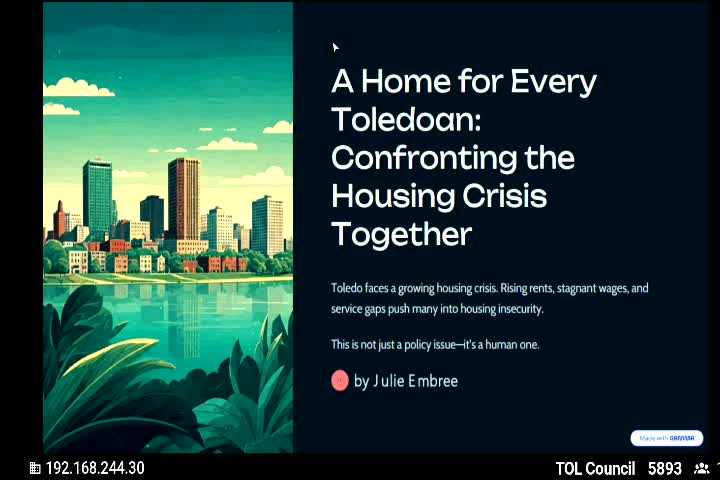
Julie Embry, representing the Toledo Lucas County Homelessness Board, outlined the board’s assessment of homelessness in the city and recommended a set of programmatic and policy responses to reduce homelessness and prevent future housing loss.
The current picture and why it matters
Embry said homelessness in Toledo is increasing: “We are a city rich in resilience but we face a growing crisis,” she said, and cited nearly 3,400 individuals experiencing homelessness in 2024, a roughly 30–33 percent increase over the prior four years. She said more than half of those counted in 2024 were experiencing homelessness for the first time and that shelters are operating near capacity.
Board recommendations presented
- Expand permanent supportive housing and housing-problem-solving funds: The board advocated more long-term housing options and funds for staffing that provides individualized housing problem solving for families, veterans and seniors.
- Strengthen prevention and diversion strategies: Embry emphasized stopping homelessness “before it even starts” through improved prevention, eviction diversion resources and better coordination with behavioral health and recovery services.
- Improve system coordination and data use: The board supports better use of data, stronger evaluation frameworks and closer alignment among city departments, nonprofit providers and funders to reduce duplicative efforts and speed rehousing.
- Increase voucher access and landlord accountability: The board urged policy changes to expand access to Housing Choice Vouchers and to address discriminatory landlord practices that impede voucher holder mobility.
Existing efforts and gaps
Embry noted current investments and initiatives, including a $4.0 million HUD program grant to identify and remove barriers to affordable housing, Lucas Metropolitan Housing’s portfolio of about 2,500 units and the Home for Everyone Continuum of Care’s 2024 strategic plan. However, she said gaps remain in long-term placements, targeted services for vulnerable populations, shelter capacity and cross-system staffing to support housing problem solving.
Call to action
Embry framed the issue as both a policy and a human concern and urged residents and leaders to advocate for increased local, state and federal funding and to support frontline organizations. She closed the presentation with the board’s tagline: “Housing is not a privilege, it’s a right.”
Next steps
The Homelessness Board’s recommendations are part of the public record and will be considered alongside other comments as the City finalizes the Consolidated Plan. Embry and the board urged continued interagency collaboration, leveraging federal resources and community engagement to implement long-term solutions.