Get Full Government Meeting Transcripts, Videos, & Alerts Forever!
Get email alerts on the Mental Health Facility Funding topic
No spam. Unsubscribe anytime.
Comal County seeks $9.5 million from state to fund operation of new mental‑health observation unit
Summary
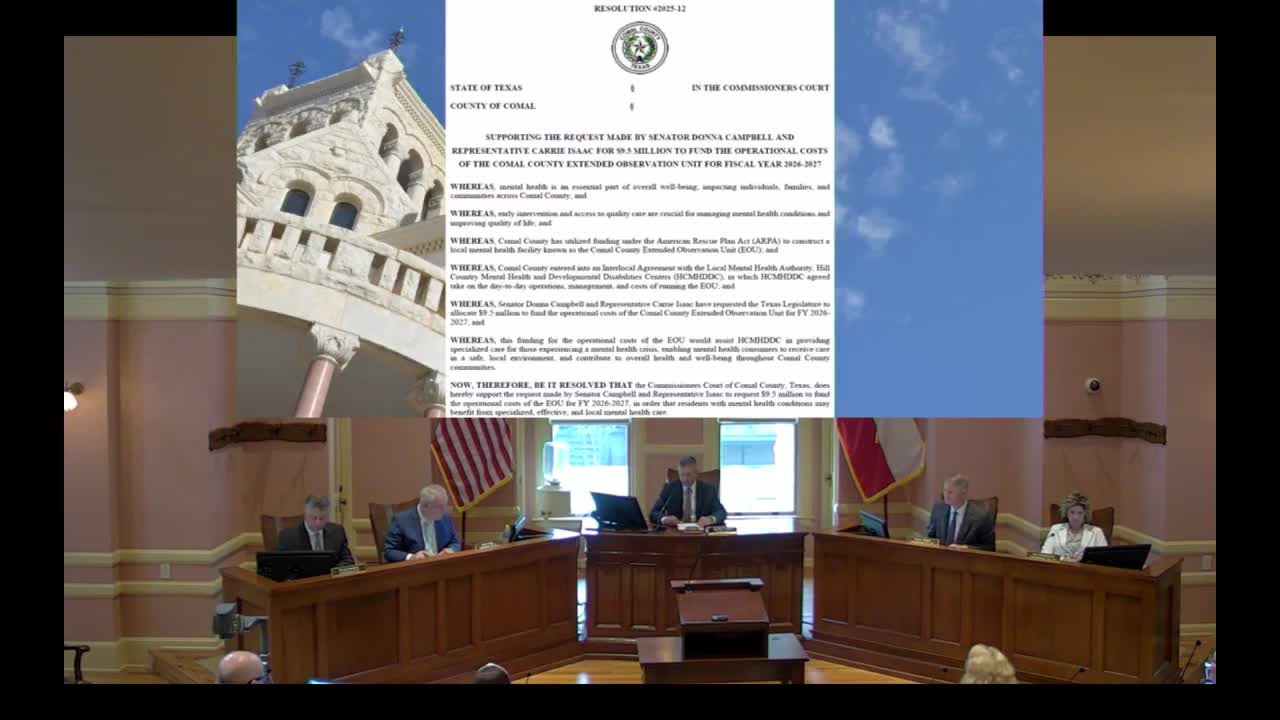
Comal County Commissioners Court adopted a resolution supporting Sen. Donna Campbell and Rep. Carrie Isaac’s request for $9.5 million in state funding to operate an extended observation mental‑health unit the county built with ARPA dollars, asking conference committee members to include the funding in the 2026–27 biennial budget.
Comal County Commissioners Court on Thursday approved a resolution backing a request for $9.5 million in state funds to cover operating costs for an extended observation mental‑health unit the county built with American Rescue Plan Act money.
The court voted to adopt Resolution 202512 in support of an item presented by the county judge. The resolution asks Senator Donna Campbell and Representative Carrie Isaac to press conference committee members to include the $9.5 million for fiscal years 2026 and 2027 so the Hill Country Mental Health and Developmental Disabilities Centers can operate the unit.
“Commissioners, you’re all aware that we’re using American Rescue Plan Act funding to build a mental health treatment facility,” the county judge said while presenting the resolution. The judge said county staff had coordinated with the Hill Country center on the assumption that the center would operate the facility once built and that state funding for operations is not currently in the enrolled budgets from either chamber.
The judge told the court that Representative Isaac had attached a rider to the House bill seeking the money and that Senator Campbell had filed a similar request on the Senate side, and that a conference committee would reconcile the two budget bills. Commissioners Webb and Crownover moved and seconded the resolution; the motion carried with the court’s unanimous voice vote.
The resolution does not create an appropriation at the county level; it is a statement of support to state lawmakers for inclusion of the requested funding in the upcoming biennial budget. The court’s presentation noted the county used ARPA funds for capital construction and is seeking state operational funding for the 2026–27 biennium.
County officials did not provide a breakdown of how the $9.5 million would be spent (for example, annual operating cost or staffing line items) during the meeting, and the resolution itself does not specify that level of detail.
The court’s action was procedural: adopting a resolution to communicate local support to state legislators as they negotiate the biennial budget.
A photograph and the formal text of the adopted resolution will be placed in the county record.