Get Full Government Meeting Transcripts, Videos, & Alerts Forever!
Get email alerts on the Parks And Recreation topic
No spam. Unsubscribe anytime.
Parks & Recreation recommends using excess fund balance to address deferred maintenance at rec center and pathways
Summary
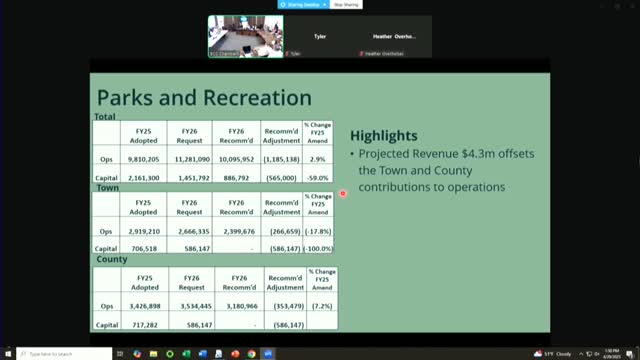
Parks and Rec staff told elected officials April 29 that an unexpectedly large fund balance — in part from conservative prior revenue projections — allows room to allocate funds toward deferred maintenance, including pool repairs at the recently opened rec center. Officials proposed commissioning a condition and capital prioritization study this
Parks and Recreation staff presented an operating and capital review April 29 and told the joint elected bodies that the department has a larger-than-expected fund balance due to conservative revenue estimates in the year after the rec center opened. Staff recommended using part of the fund balance to cover deferred maintenance and capital projects rather than shifting costs to the operating budgets in FY 2026.
Staff said they plan to issue an RFQ to hire a consultant to conduct a detailed condition assessment, priority ranking and cost estimating for long‑term capital and deferred maintenance needs. Max Moran, Parks and Pathways project manager, told officials the RFQ would go out within one to two weeks and the county expects to select a consultant by mid‑June and receive deliverables by the end of the summer. Staff said the program would identify end‑of‑life replacements, timing and estimated costs so elected officials can budget in future years.
Background and immediate needs: Parks staff noted near‑term needs at the rec center, including repairs to pool features and replacement of a sauna unit that could not be repaired. Staff recommended using fund balance for such one‑time capital repairs rather than shifting other projects or cutting operating programs. The department said many operating programs (summer camps, youth programming) are fee‑supported; staff noted that adding programs generally can be covered by fee revenue where capacity exists.
On pathways and capital maintenance, Pathways Coordinator Brian Schilling said routine maintenance (sweeping, plowing, vegetation control, sign replacement) is budgeted and conducted by Parks and Rec under an MOU; capital‑level repairs (asphalt replacement, engineered work) are in the Pathways program’s capital budget. Schilling said most routine maintenance has been funded in recent years, but some legacy projects remain unfunded.
Next steps: staff recommended setting aside an assigned fund or restricted portion of the fund balance for long‑term capital/deferred maintenance, completing the consultant condition assessment and returning with prioritized capital project recommendations so elected officials can consider whether to fund projects from fund balance or the operating budget.
Ending: Officials praised Parks leadership for the work and asked staff to identify a short list of candidate projects that could be restored from fund balance if elected officials choose to do so.