Get Full Government Meeting Transcripts, Videos, & Alerts Forever!
Get email alerts on the Transit topic
No spam. Unsubscribe anytime.
START board proposes service increases, vanpool pilot and vehicle strategy as federal grant uncertainty looms
Summary
START transit director and board presented a service plan and FY 2026 recommended budget, proposing targeted increases (town shuttle, Teton Village Express in summer, winter capacity) and a vanpool pilot. Staff warned that nearly half of START’s revenue is federal, leaving local service vulnerable if federal grants are reduced.
START, the joint municipal transit system serving Teton County and the Town of Jackson, presented its route/service plan and capital requests during the joint budget review on April 29.
The START board recommended a limited set of service increases aimed at addressing capacity at peak times. Transit Director Bruce Abel told elected officials the board seeks to add two year‑round round trips to the town shuttle (roughly $47,000 annual cost) to avoid leaving school‑age riders behind at the afternoon bell. The board also recommended adding summer express trips to Teton Village to relieve peak summer overloads and adding service during the winter season to increase capacity to the village. Abel said, “in 2024, we once again crossed the 1,000,000 passenger threshold, for START.”
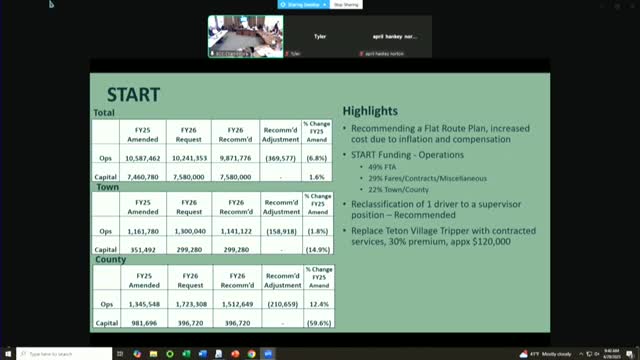
Board and staff emphasized the tradeoffs between service increases and available funding. Tyler (staff) and Jody (staff) noted that the START recommended changes are not included in the county/town recommended budget; restoring all START board items would cost roughly $354,000 total, or about $177,000 of joint town/county funding. Staff asked elected officials to indicate whether they wanted to add any of the START board’s recommended services back into the recommended budget.
Vanpool pilot and on-demand services: START and the transportation department proposed piloting a vanpool program — a low‑cost, employer‑supported model in which a van is leased and shared by 5–8 riders, with the driver often a rider — as a potentially cost‑effective alternative to some low‑ridership commuter routes. Transit staff said enterprise‑type vendors can provide leasing and administrative support and that a modest pilot (several vans) could be launched at an estimated modest annual operating cost; staff recommended evaluating employer and partner contributions (e.g., hospital, resort employers) to reduce the public subsidy needed.
Fleet procurement strategy: START flagged supply‑chain and cost escalation issues for the vehicle replacement program. Staff proposed shifting two vehicles originally budgeted as battery‑electric to hybrid electric (BUILD grant vehicles) and shifting some low‑NO grant vehicles to diesel to stay within last year’s capital budget and to ensure critical overdue coach replacements proceed. Abel said the agency faces rising prices — for example, coaches once priced at $715,000 in 2022 approach $870,000 now — and that some federal contracts for replacement coaches are under review. Elected officials and staff discussed prioritizing coach replacements while balancing community environmental goals.
Federal funding risk: Staff repeatedly warned of federal grant uncertainty. START receives a large share of its revenue from federal sources (the presentation estimated about 49% federal funding). Several speakers, including Bruce Abel and county staff, said that changes in federal funding formulas or decreases to transit grants would leave START exposed and could require significant increases in local contributions to maintain service. Abel said some contracts are executed and safe, but other capital contracts remain under review at the federal level.
Staffing and operations: The recommended FY 2026 budget includes reclassifying one driver to a supervisor position, replacing some contracted village service with internally operated buses where feasible and retaining an on‑demand contractor for paratransit‑style service. START staff proposed using fund balance to provide local match for bus procurement and noted an anticipated fund balance sufficient even after proposed purchases.
Next steps: Officials asked START to provide a clearer net cost accounting (federal/local/contract/fare revenues) for candidate service increases and to confirm capital savings noted during the presentation. Elected officials also signaled interest in the vanpool pilot and in reviewing options to right‑size some commuter or low‑use services.
Ending: The START presentation emphasized ridership growth, the operational imperative of not leaving riders behind at peak times, and the prudence of contingency planning given uncertain federal grant support.