Get Full Government Meeting Transcripts, Videos, & Alerts Forever!
Get email alerts on the Transportation Funding topic
No spam. Unsubscribe anytime.
Administration, municipal groups urge swift approval of $1.185 billion transportation bond bill
Summary
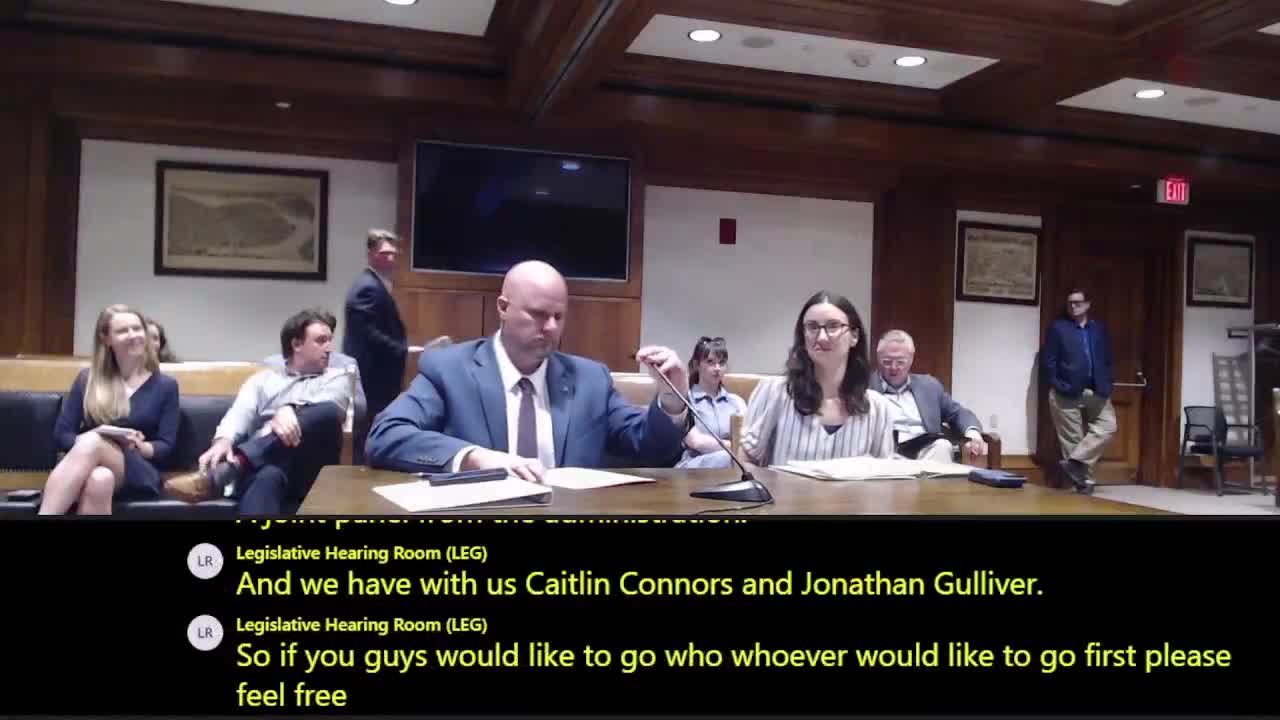
Administration officials and representatives of municipal and industry groups told the Joint Committee on Bonding, State Assets and Capital Expenditures on Monday, July 21, that House Bill 4257 would authorize $1,185,000,000 to support municipal and statewide transportation priorities and should move quickly through the Legislature.
Administration officials and representatives of municipal and industry groups told the Joint Committee on Bonding, State Assets and Capital Expenditures on Monday, July 21, that House Bill 4257 would authorize $1,185,000,000 to support municipal and statewide transportation priorities and should move quickly through the Legislature.
"This bill proposes a total authorization of $1,185,000,000 to support both municipal and statewide transportation priorities," State Highway Administrator Jonathan Belzer told the committee, laying out funding for local road programs, bridge and pavement lifecycle work, culvert and small-bridge modernization, and congestion and safety projects.
The measure would authorize $300 million for the Chapter 90 local-aid program, split into the traditional $200 million distributed under the longstanding Chapter 90 formula (a combination of road miles, employment and population) and an additional $100 million allocated solely on local road mileage to increase support for rural communities. The bill also would authorize $500 million for bridge and pavement lifecycle asset management, $200 million for culvert and small-bridge modernization, and $185 million for congestion- and safety-focused projects such as intersection work, ADA-compliant sidewalks and shared-use paths.
Why it matters: Committee members and administration officials said the package aims to give municipalities predictable funding for maintenance and targeted capital improvements while addressing climate resiliency and multimodal safety. "When municipalities can care for their roads, bridges, and sidewalks, kids can safely get to school, businesses can effectively deliver goods and services, our construction industry can access good jobs and families can travel together," Caitlin Connors, Assistant Secretary for Capital at the Executive Office for Administration and Finance, said in testimony.
How Chapter 90 would change: The administration described the two-part approach to Chapter 90 funding. The first $200 million would continue to be allocated under the customary formula; the supplemental $100 million would be distributed using local road mileage only, an adjustment officials said responds to post‑2020 shifts in commuting and employment patterns that skew employment-based measures. Belzer told the committee the additional mileage-based dollars are intended to help communities with high road miles but lower employment counts — typically rural towns.
Access and administration: MassDOT officials said municipalities should contact their district office state-aid coordinator or MassDOT’s municipal-aid staff to pursue grants. Belzer noted a centralized online tool: "we have a centralized website called Grant Central that we rolled out last year," to help cities and towns identify applicable programs and open opportunities. Officials said MassDOT provides technical support for smaller towns that lack in‑house planning or engineering staff.
Bonding and revenue source questions: Witnesses and committee members discussed how the bill’s financing would interact with the Commonwealth’s bond cap and with proposed securitization of "fair share" revenues. Connors and other administration witnesses said the current capital plan lists Chapter 90 authorizations under general obligation (GO) bonds but the bill contemplates making use of the Commonwealth Transportation Fund (CTF) and securitizing a portion of fair share revenues as special obligation bonds to expand capacity without unduly pressuring the GO bond cap. The administration said such special obligation bonds would be paid from the identified revenue stream and that, based on their modeling, they "anticipate that there will be no impact to our GEO credit rating" if structured as described.
Federal funding and contingencies: Committee members asked whether the proposed authorization would backfill rescinded or endangered federal grants. Administration witnesses said the bond funds are generally intended to support other state or municipally led projects and are not intended as a direct backfill for specific federal rescissions, though they noted some federal uncertainties have prompted the state to seek additional flexibility.
Industry and municipal support: The Massachusetts Municipal Association and the Massachusetts Aggregate and Asphalt Pavement Association testified in support. Dave Kaufman of the MMA said the increase in Chapter 90 and the additional authorizations would help cities and towns address deferred maintenance. Chuck Lapvis of MAPPA said the one-year $300 million authorization and the larger lifecycle and congestion authorizations would allow municipalities to begin long‑deferred work, and he noted higher material costs: "Liquid asphalt is probably the largest portion that has increased ... it was somewhat of 21%." Industry witnesses said some material prices rose roughly 20% in recent years and had not fallen back.
Next steps and procedural notes: Committee leadership said they expected to poll members and move the measure forward; no formal committee vote on House Bill 4257 was recorded at the hearing. The meeting concluded with a motion to adjourn that the committee approved by voice vote.
Ending: The hearing brought administration, municipal and industry stakeholders together to outline how the bill’s authorizations would be distributed and administered and to discuss financing options and municipal access. Committee members said they planned to proceed quickly; no final legislative action on the bill occurred at the July 21 hearing.