Get Full Government Meeting Transcripts, Videos, & Alerts Forever!
Get email alerts on the Education.special Education topic
No spam. Unsubscribe anytime.
Select Committee advances substitute special-education bill after weeks of hearings; due-process change debated and rejected
Summary
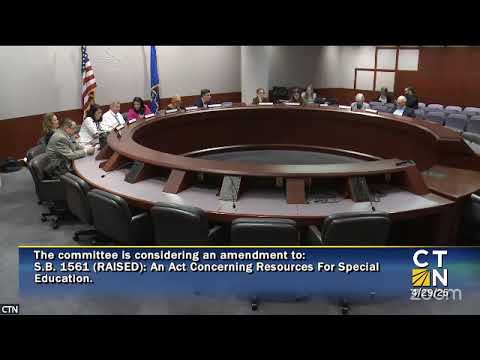
The Select Committee on Special Education voted to send a joint favorable substitute for House Bill 7277 (LCO 7568) and companion Senate Bill 1561 (LCO 7565) to the Joint Committee on the Judiciary and Public Safety (JFS) after committee debate and a failed amendment to strike proposed due‑process changes and replace them with a study.
The Connecticut General Assembly's Select Committee on Special Education voted to send a joint favorable substitute for House Bill 7277 (LCO 7568) — with an identical Senate companion (SB 1561, LCO 7565) — to the Joint Committee on the Judiciary and Public Safety after a full committee meeting and more than three months of public engagement.
The substitute language advanced out of the select committee after members debated draft changes that the chairs described as an initial response to a lengthy public hearing and listening tour. Committee leaders said the substitute removes an implementation timeline from earlier drafts, adds the Office of the Child Advocate to certain rate‑setting and oversight discussions, clarifies that rates should be individualized rather than a single universal fee, and makes other technical changes intended to increase oversight and flexibility.
Why it matters
The bills aim to reshape how Connecticut funds and oversees special education services, sequence rate‑setting, and provide new supports for families, teachers and school staff. Supporters argued the substitute language responds to district capacity and provider concerns and reflects testimony from hundreds of witnesses; critics warned the draft remains incomplete, asked for more agency buy‑in and fiscal detail, and pressed for clearer accountability metrics before final passage.
What the committee did and why
Committee leaders presented the substitute as a "work in progress" meant to show the committee heard testimony from parents, providers, educators and districts. Key changes the chairs highlighted in the substitute language include:
- Removal of a fixed implementation timeline that had alarmed providers and some parent advocates, to allow a more deliberative rate‑setting process. - Inclusion of the Office of the Child Advocate alongside the Office of Policy and Management (OPM) and the State Department of Education (SDE) in conversations about rate setting and oversight. Committee members described that change as an attempt to bring a child‑centered perspective into financial and operational discussions. - A shift in the bill's drafting away from a single, universal rate toward individualized rates tied to services documented in students' individualized education programs (IEPs), with attention to intensity and quality of services rather than cost alone. - Provisions to create or expand an educational ombudsman function placed within government accountability structures, and to extend that office's role to help Board of Education employees involved in PPTs (planning and placement team meetings). - New oversight tools, including random audits and site visits related to restraint, seclusion and provider compliance; and language lifting a moratorium on new providers that had been included in earlier drafts.
Concerns raised in committee
Members across parties praised stakeholders' engagement but repeatedly said the bill remains large and complex and that important questions remain unresolved: whether the agencies tasked with implementation support the proposals, how the state will pay for the changes, how many staff would be needed for a fully resourced ombudsman office, and how to avoid unintended consequences from altering due‑process procedures.
A substantial portion of the meeting focused on proposed due‑process language that would affect unilateral placements (situations in which a family places a child in a private program and later seeks reimbursement). Some members said shifting the burden of proof in those narrow unilateral cases could reduce municipal fiscal pressure; other members, parents and child‑advocacy voices argued the change would place new burdens on families and could reduce protections for students. The committee considered an amendment that would have stripped the bill's sections changing due process and replaced them with a directed study by the Commissioner of Education to analyze hearings and burden‑of‑proof issues.
Votes and formal actions
- House Bill 7277, LCO 7568: Motion for a joint favorable substitute to the floor moved by Senator Kissell and seconded by Representative Khan; the committee approved the substitute and voted to send the measure to the next committee stage (JFS). (Outcome: approved; committee recorded passage.) - Amendment (proposal to strike sections 41'43 and replace due‑process revisions with a study): Moved by Senator Kissell and seconded by Senator Austin; the amendment was defeated in committee (outcome: failed). - Senate Bill 1561, LCO 7565 (companion): The Senate substitute identical to the House substitute was also advanced to the floor (outcome: approved). The transcript records a later committee tally on the Senate bill roll call of 8 yes and 7 no for passage of the substitute language.
Committee discussion and next steps
Committee chairs and members repeatedly described the substitute as step one of a continuing process. They said work remains to: finalize a robust, verifiable rate‑setting approach; ensure agencies that will implement the law are prepared and have the necessary staff and resources; define the size and scope of an ombudsman office; and create usable accountability and outcome metrics for services funded by the state.
Several members urged that any final rate‑setting mechanism be based on a careful study of other states' experiences and not rushed into place. Committee members also highlighted that a recently enacted emergency appropriation (discussed in the hearing) provided $40,000,000 in earlier emergency funding to address immediate district pressures; they said additional fiscal analyses and OFA (Office of Fiscal Analysis) fiscal notes would follow as the bill moves through education and appropriations committees.
Where the bill goes from here
The substitute language will be transmitted out of the select committee to the next committee(s) in the regular legislative process. Committee leaders said they will continue stakeholder outreach, agency consultations and technical drafting changes before the bill reaches the full House and Senate. Because several members asked for more detailed implementation and fiscal information, the committee chairs indicated they expect further edits in education and appropriations committees.
Ending note
Members on both sides emphasized that the work is ongoing: the substitute is meant to reflect public testimony and begin the hard work of restructuring how the state supports students with disabilities, but the chairs and ranking members said more detail, agency buy‑in and bipartisan drafting remain necessary before the measures reach final passage.