Get Full Government Meeting Transcripts, Videos, & Alerts Forever!
Get email alerts on the Alcohol Licensing topic
No spam. Unsubscribe anytime.
Rep. Snyder, retailers say bill would remove $250,000 inventory rule that ties up cash for gas-station liquor licenses
Summary
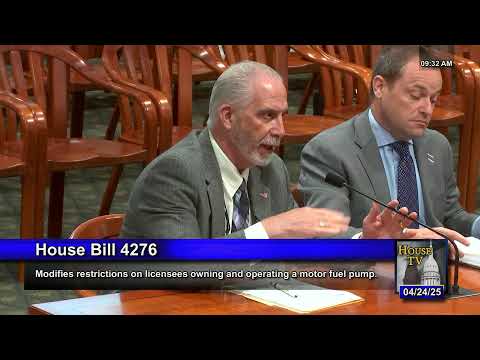
House Bill 4276, presented to the Regulatory Reform Committee, would eliminate a $250,000 inventory requirement that currently applies to certain license holders who sell motor fuel; sponsors and industry witnesses said the rule forces some gas‑station retailers to tie up large sums in items such as postage stamps to satisfy inventory checks.
Representative Snyder and industry witnesses told the Michigan House Regulatory Reform Committee that House Bill 4276 would eliminate an inventory requirement that single out motor fuel retailers seeking specially designated distributor (SDD) licenses to sell spirits, a rule witnesses described as an unfair barrier to small retailers.
Snyder said the requirement forces some retailers to hold a separate $250,000 stock of nonfuel, nonalcohol inventory to satisfy licensing checks. “This legislation would simply eliminate this inventory requirement. It is nothing more than an unnecessary bureaucratic red tape that doesn't serve a public good,” Snyder said.
Mark Griffin of the Michigan Petroleum Association and the Michigan Association of Convenience Stores testified in support. “This would end the current situation where only motor fuel retailers are treated unfairly like this,” Griffin told the committee, adding that only about 105 specially designated distributor licenses exist statewide and that many convenience stores will not seek to sell spirits.
JJ Westgate, who identified himself as a third‑generation owner of Wesco, described the practical impact on his company’s finances and operations. “All 56 of them have SDM and STD licenses. 45 of our locations have STD licenses. Of those 45, 26 of them are required to have the $250,000 inventory. That's about $4,600,000 in postage stamps that we have sitting around to satisfy the inventory requirements,” Westgate said, urging parity for gas‑station retailers.
Witnesses said the bill would not increase the number of SDD licenses available and would not change other licensing requirements; instead, they said, the change would free up capital that retailers could reinvest in stores and communities. Westgate said his family‑owned company typically keeps $60,000–$70,000 in approved inventory, but the SDD requirement forces a large, idle additional purchase that is not circulated because licensees fear inventory inspections.
Committee members asked whether the change would affect local enforcement or public safety. Witnesses said the bill includes language codifying a process for local government involvement in the liquor‑licensing review and that the Michigan Liquor Control Commission (MLCC) would retain enforcement authority. Representative Robozniak asked whether the statutory language that allows the MLCC to suspend licenses for violations referred specifically to liquor‑related codes; witnesses and staff said it would codify practices the MLCC already follows.
The committee heard letters and position cards read into the record denoting support from NFIB, Kwik Trip, Midwest Independent Retailers Association and others; the transcript shows Dave Martin of the Michigan Liquor Control Commission listed as neutral on the bill. The hearing concluded without a recorded committee vote in the transcript.
House Bill 4276 remains under consideration by the Regulatory Reform Committee.