Get Full Government Meeting Transcripts, Videos, & Alerts Forever!
Get email alerts on the Police Accountability topic
No spam. Unsubscribe anytime.
Caroline County ACC reviews draft police accountability ordinance; votes to send recommendations to commissioners
Summary
At its April 22 meeting, the Caroline County Administrative Charging Committee reviewed a draft ordinance to codify the county's police accountability process, debated language on subpoenaing officers and membership limits, and voted unanimously to send a letter of recommended changes to the County Commissioners.
The Caroline County Administrative Charging Committee (ACC) reviewed a draft ordinance to convert existing resolutions on the Police Accountability Board (PAB) and Administrative Charging Committee into local law and voted to send a letter with recommended changes to the County Commissioners.
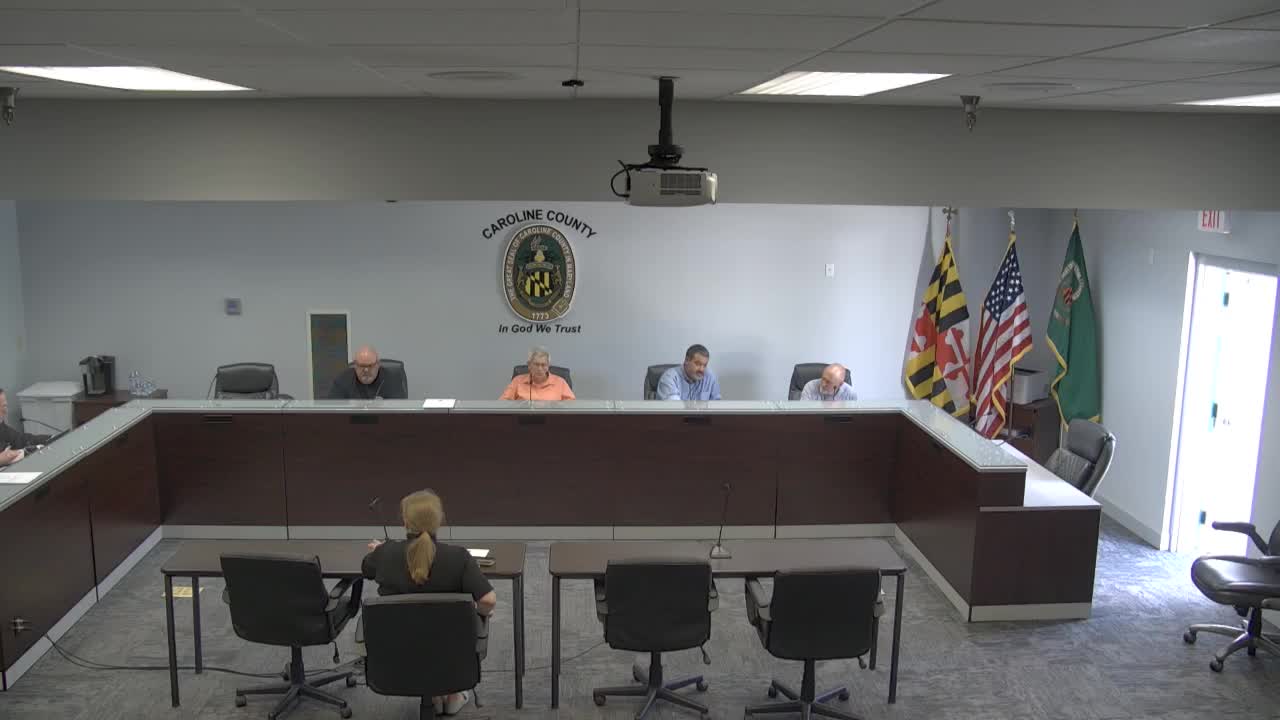
The ACC meeting convened on April 22, 2025, at the Caroline County Health and Public Safety Building in Denton. Committee members focused discussion on a proposed provision that would require the ACC to submit questions in writing to the law enforcement agency before summoning an officer, membership restrictions tied to affiliation with police unions or immediate family relationships, and whether those procedural rules belong in county ordinance or the ACC’s rules of procedure.
The committee’s recommendations — cleared in a motion that passed unanimously — instruct the chair to send a letter to the commissioners with three core items: move the new written-question/subpoena procedure from the ordinance into the ACC’s rules of procedure; remove language in the draft that goes beyond the state statute; and change membership language so immediate-family disqualifications apply only where the family member is an active officer in the county’s jurisdiction. The ACC also recommended removing a provision (listed in the draft as B.3) that would bar retired officers who remain members of police-affiliated organizations from service; the committee recorded that recommendation for the commissioners’ consideration.
“The outcome of this meeting hopefully will be a letter… giving your comments to the county commissioners, with any proposed changes,” said Nancy, the ACC chair, summarizing the desired next step.
Sheriff Baker spoke at length about the board’s authority to call officers and the effect on recruitment and morale. “I will be transparent to the fact that I absolutely disagree with this law,” Sheriff Baker said, arguing that hauling a young, nonunion officer before a civilian panel can be intimidating and have a chilling effect on hiring and retention.
Kim Reeder, PAB/ACC administrator, described the process the ACC follows once findings are drafted: she said she prepares the letter, the county attorney reviews it, the ACC reviews and edits, and then she uploads final findings into the department’s IA Pro tracking software and coordinates notice to the chief or sheriff and the officer. “When the findings are made within the next couple of days, I write the letter… Stewart goes over the letter, make sure that it looks good,” Reeder said.
Several ACC members said they want the ACC to retain the ability to request an officer’s input when written answers from the law enforcement agency do not resolve a factual discrepancy. One ACC member described a prior case in which a question could only be resolved by the officer’s own account; that member said the officer’s appearance clarified the issue and led to a different outcome than the ACC might have reached otherwise.
The draft ordinance cites state public-safety provisions and incorporates practices recommended by the Maryland Police Training Commission, but ACC members and outside participants debated whether the ordinance should formally require written pre-questions as a legal step or leave that as an internal rule of procedure. Several police chiefs and county legal advisors who spoke at the meeting urged written steps and clearer procedural safeguards; others urged retaining flexibility and cautioned against embedding every procedure into county law.
By the end of the meeting the ACC adopted a motion to draft a letter with the committee’s recommendations and authorized the chair to sign and forward it to the County Commissioners. The motion was seconded and carried with all present voting in favor.
The committee’s letter — as described during the session — will recommend: (1) transferring the written-question/subpoena sequence from the ordinance into ACC rules of procedure (with the caveat that the rules be subject to County Commissioner approval), (2) removing ordinance language that exceeds or alters state statutory text, (3) narrowing the immediate-family conflict restriction to apply only to active officers in the county jurisdiction, and (4) removing the clause that would bar retired officers who remain organizational members from serving on the ACC. The ACC chair was authorized to finalize and send that letter.
The meeting concluded after a public comment period in which a county commissioner invited ACC members to discuss their positions privately before the commissioners’ public hearing; the commissioners will consider the draft ordinance and any recommendations from the ACC.