Get Full Government Meeting Transcripts, Videos, & Alerts Forever!
Get email alerts on the Municipal Service Reviews topic
No spam. Unsubscribe anytime.
Kern LAFCO to study East Kern water districts; staff to return with MSR plan and budget options
Summary
The commission approved staff work to perform municipal service reviews (MSRs) focusing on Inyokern CSD, Indian Wells Valley Water District and City of Ridgecrest, and authorized staff to return with a staffing and funding plan after further analysis.
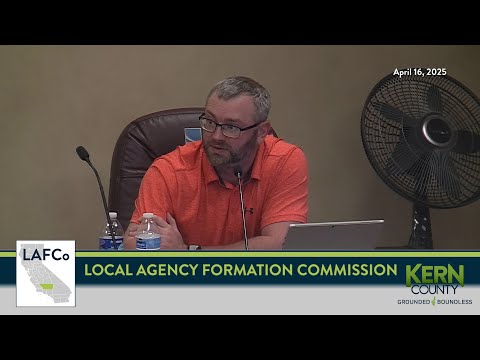
Kern LAFCO directed staff on April 16 to pursue municipal service reviews of East Kern water providers, including Inyokern Community Services District, Indian Wells Valley Water District, and the City of Ridgecrest, after staff described operational and groundwater concerns and a request from the State Water Board.
Executive Officer Bud Knox said the State Water Board has asked LAFCO to examine options in the Indian Wells Valley. Knox recommended adding funding and potentially a full‑time employee (or part‑time equivalent) in the draft budget to bring MSR work in‑house rather than charging individual agencies for reviews. He said staff lacks the current budget to do in‑depth MSRs for difficult cases and that including the work in the annual budget would be the simplest revenue approach.
Commissioners discussed likely review outcomes and next steps: options for a district could include status quo with improvements, rate increases, consolidation with another agency, or other structural changes. Knox emphasized he needs data to make recommendations and that consolidation, if proposed, can trigger a protest hearing and potentially an election; he noted LAFCO has statutory authority to approve consolidations but certain state bodies (e.g., the State Water Board) would also need to be involved for technical water issues.
Commissioners raised practical concerns: who would pay for consolidation or protest processes (staff said LAFCO bills for mailings and charges fees for hearings and had increased protest hearing fees to $750), the long timelines of state funding and board involvement, and public‑safety implications where inadequate water systems affect firefighting capability. Commissioners asked staff to return with prioritized candidates, options for sequencing the MSRs, and a plan for legal/closed‑session review where litigation risk exists. The commission agreed to let staff develop the plan and return next month with options and budget implications; the motion to proceed passed on a roll call vote.