Get Full Government Meeting Transcripts, Videos, & Alerts Forever!
Get email alerts on the Infrastructure Sewer topic
No spam. Unsubscribe anytime.
Santa Rosa commissioners decline to adopt mandatory sewer-hookup ordinance after hours of public comment
Summary
After a three-hour public hearing, the Santa Rosa County Board of County Commissioners voted down a motion to adopt a local ordinance restating state law on mandatory connections from on‑site sewage systems to central sewer, following extensive public testimony about costs, timing and enforcement.
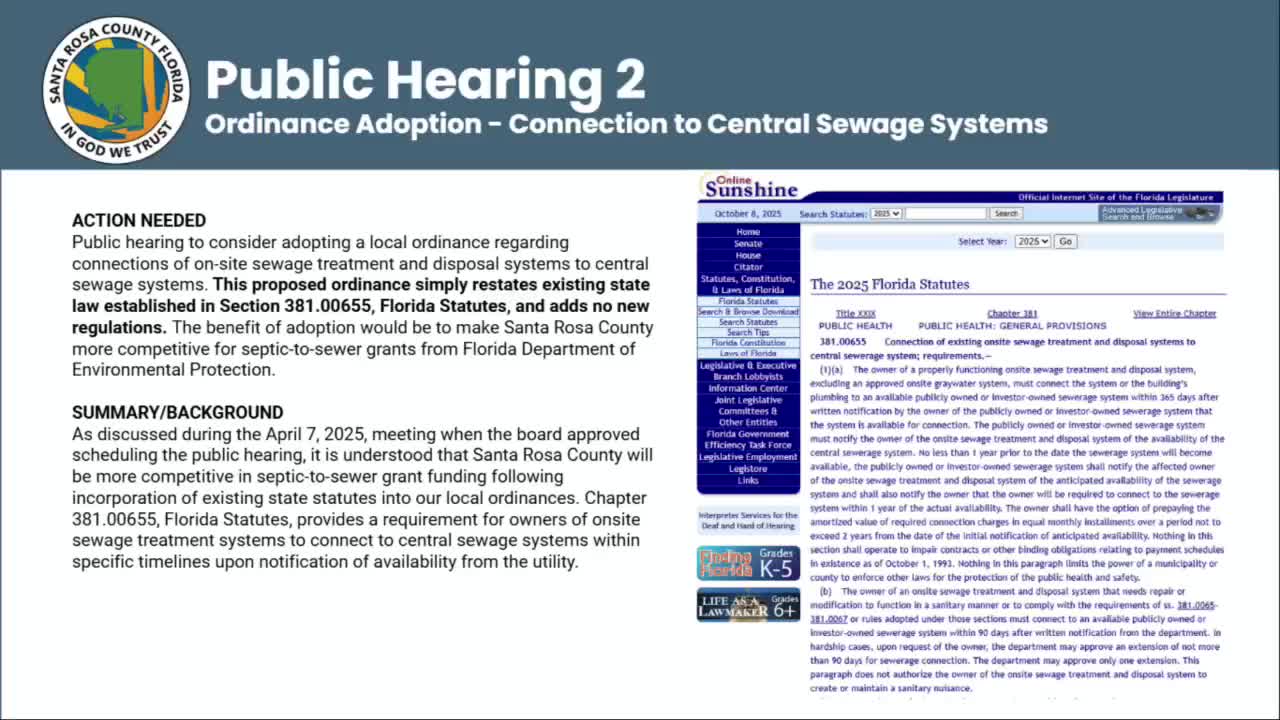
The Santa Rosa County Board of County Commissioners on Oct. 9 heard more than two hours of public testimony on a proposed local ordinance that would mirror Florida Statute 381.00655 and make the county eligible for some state and federal septic‑to‑sewer grants. The board ultimately voted down a motion to adopt the ordinance as drafted.
The proposal would have put the statutory requirement — that property owners hook up to central sewage when it becomes available — into county code to improve competitiveness for grant funding from the state and programs that help homeowners convert from septic to sewer. Commissioner Bobby Burkett, who introduced the topic, framed the measure as a way to help residents avoid large out‑of‑pocket costs if they are required to connect later: "What we're trying to do is protect your pocketbooks for when that does happen," he said during the hearing.
The meeting drew a packed audience. Dozens of residents testified, with many warning that mandatory connection could be financially crippling for homeowners who live far from sewer mains or who are on fixed incomes. Several speakers provided cost estimates from contractors and utilities: a resident said a recent conversion quote topped $20,000 when tap fees, grinder pumps and electrical upgrades were included; another said typical homeowner costs could range from $15,000 to $25,000 depending on distance and site conditions.
Speakers who opposed the ordinance argued it would effectively compel people to connect by imposing fines and liens if they did not, and they urged the county to pursue voluntary grant programs and better financing options instead. "People should have the right to decide for themselves if they want to hook up to sewer or not," said David Fowler of Pace. Others said functioning septic systems that are properly maintained do not pose an immediate threat to water quality in lower‑density areas.
County Attorney Dan Heiser told the board the proposed ordinance largely restated existing state law and would not change the state statute itself. He clarified that enforcement of the statutory connection requirement rests with the utility and state agencies, not the county: "If we do adopt this ordinance, it changes nothing with Florida statute," he said. Commissioners and staff also noted that adopting a county ordinance that mirrors state law can be a prerequisite for some state grant programs.
Board members acknowledged a tension between environmental concerns and the financial impact on residents. Commissioner Burkett said the ordinance was intended to improve the county's ability to obtain grants that could pay some or all hookup costs for homeowners, not to punish residents. Still, several commissioners said they needed more details on what grants would be available, who would be eligible and how the county would ensure hardship protections.
At the end of the hearing, a motion to adopt the ordinance with modified penalty language was made and seconded, but the motion failed on the board floor. No final ordinance was adopted during the Oct. 9 meeting.
The commission asked staff to provide more information about grant opportunities, typical contractor costs and specific hardship or waiver language from the state so the board can consider revisions at a future meeting. Commissioners emphasized they would continue to try to secure external funding to reduce homeowner costs should a conversion be required in the future.
Ending
The county did not adopt the ordinance; the board asked staff to return with more detailed cost, grant and enforcement information before reconsidering. Commissioners said they remain divided on the approach and urged residents who testified to continue the dialogue with staff and elected officials.