Get email alerts on the Utp Funding topic
No spam. Unsubscribe anytime.
TxDOT explains how Unified Transportation Program funding reaches Eagle Pass and which projects qualify
Summary
TxDOT Laredo District staff reviewed the 10-year Unified Transportation Program, funding categories affecting Eagle Pass MPO (notably category 2), project timelines and how local sponsors can advance projects into the UTP.
Roberto Rodriguez, director of transportation planning and programming for the TxDOT Laredo District, told the Eagle Pass Metropolitan Planning Organization on Oct. 8 that the Unified Transportation Program is the state’s 10-year funding plan and that communities should interpret “on the UTP” to mean a project has construction funds lined up.
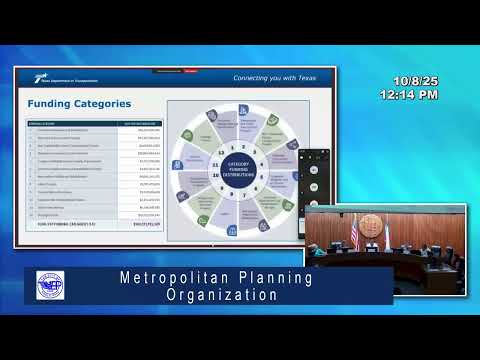
Rodriguez said the UTP groups projects into funding categories tied to different types of work and eligibility rules. ‘‘The UTP is our 10 year program, funding for the project,’’ he said. He explained that projects in years 1–4 are in the construction bracket while years 5–10 are in a development bracket that still requires design, environmental and right-of-way work before letting.
Why it matters: Eagle Pass-area officials are weighing where to push corridor-scale projects and smaller pedestrian or bike efforts. Category 2 — the MPO/state system category — is the most consistent source of district-level funding for the Eagle Pass MPO, but it only applies to projects on the TxDOT system and follows a statewide ranking and formula.
Rodriguez laid out category 2’s formula components — including population (25 percent), vehicle miles traveled (20 percent) and congestion and safety metrics — and said projects selected under that category are typically funded 80 percent with federal funds and 20 percent state funds. He cautioned that other categories (for example, transportation alternatives or carbon‑reduction) have different eligibility rules and local‑match expectations.
Local figures and examples: Rodriguez said the district is carrying over $4,950,000 in category 2 funds from fiscal 2025 for Eagle Pass, expects about $1,580,000 in fiscal 2026, and estimated roughly $27,640,000 in category 2 allocations for the MPO through fiscal 2035. He added a caution about category 10 (carbon reduction): funds are confirmed for 2025 and 2026 but allocations for 2027–28 depend on future legislative action.
On specific projects, Rodriguez said State Loop 480 was accelerated into the 2026 letting cycle (previously programmed for 2027) and that several bridge replacements on local routes are programmed to let in 2027. He noted two US‑57 rehabilitation projects on the district map with combined values approaching the mid‑tens of millions and said environmental and utility relocation can add 24–36 months to delivery schedules.
Questions from board members focused on which TxDOT funding categories apply to which roads, whether category 2 funds can be used off the state system (they cannot), and how rural categories (for example, a rural category sometimes used for US‑57) compete statewide for limited dollars. Rodriguez said rural four‑lane expansion projects must compete through their category and ranking process and that right‑of‑way acquisition or local participation can strengthen project readiness and competitive rank.
The presentation ended with board members asking TxDOT to provide a project table in future updates listing letting dates and funding categories for the convenience of local staff and elected officials.
Ending: TxDOT recommended early coordination and project readiness work — design, environmental clearance and right‑of‑way — to increase a project’s competitiveness for the UTP. Eagle Pass MPO staff said they will continue coordinating with the district as the MPO prepares its own long‑range plan and call for projects.
AI generated
The text on this page is AI generated. Summaries, highlights, analysis, and video transcripts are all produced from the original source material.
AI can make mistakes, so if you spot one, and we will fix it for everyone.
Note: the source content is unaltered by us. Any content source we link to, be it a video, an audio recording, or a document, is presented exactly as its publisher released it. That publisher is usually a government body, sometimes an individual official or another organisation.